
The Regional Roof Lifespan Atlas: How Climate Changes How Long a Roof Lasts
By RoofPredict Research TeamUpdated 55 min readMethodology
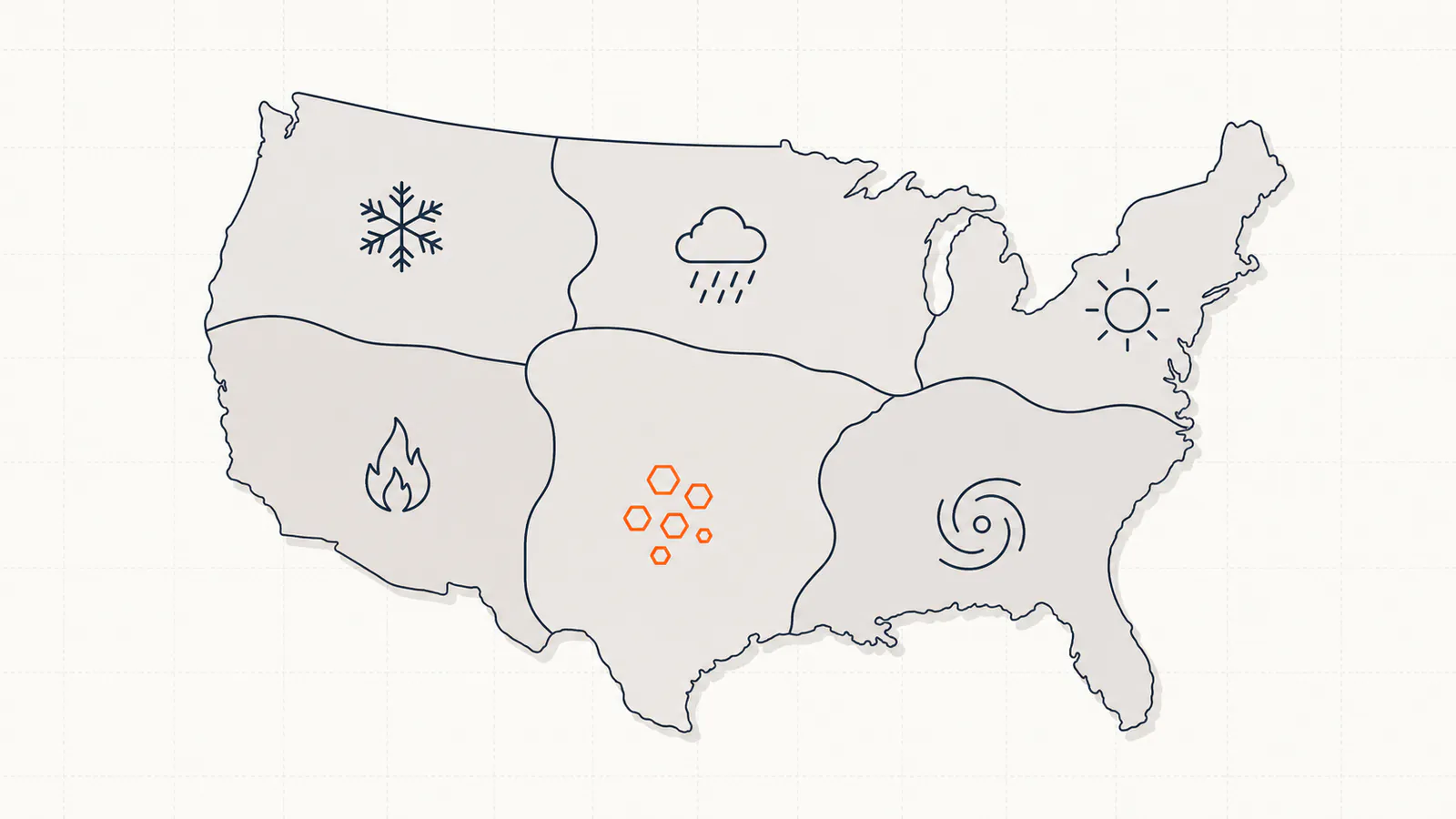
The same shingle roof can last 25 years in one state and 15 in another. Hail alley retires roofs by claim, the hurricane coast by wind, snow country by ice dams, the desert by heat, the Northwest by moss, and fire country by embers. This atlas explains what ages a roof in each region, what to inspect, when to look, and which signal to watch for.
Key takeaways
- After installation quality, climate is the largest swing factor in roof lifespan; the same shingle can gain or lose several years depending on where it is installed.
- Every region has one dominant stressor, one inspection season, and one early warning signal. Learn those three things and most roof advice sorts itself out.
- Where storms dominate, roofs retire by claim long before they wear out: in hail alley the useful question is impact resistance, and on the hurricane coast it is edge details, sealant bonds, and deck attachment.
- In snow country the roof's real enemy is the attic below it, and in the desert it is the underlayment beneath the tile. Neither is the part you can see from the street.
- In every region, the roofs that reach their rated life are the ones someone looked at on a schedule, not the ones with the most expensive shingles.
Want this answered for your property? Request a free Roof Report, then review the findings and open questions by phone with RoofPredict.
Why does where you live change how long your roof lasts?
A shingle is rated for a national market, but it ages on a local schedule. Industry guidance, including the National Association of Home Builders' 2007 Study of Life Expectancy of Home Components, puts standard asphalt shingles at about 20 years, with architectural grades lasting longer. Those are averages across every climate in the country. Your roof does not live in an average. It lives under your county's hail, your coast's wind, your winter's ice, or your desert's sun. Our guide to how long a roof lasts covers materials and warranties in depth. This atlas covers the other half of the answer: geography.
The differences are not subtle. Reading roof surfaces from imagery over time, our own work suggests turnover runs on visibly different cycles from one part of the country to the next, fast in the hail states and slower in mild maritime climates. Our 2026 National Roof Age Report maps those patterns city by city, and our methodology page explains what that kind of estimate can and cannot see. This atlas explains why the map looks the way it does. Each region chapter covers four things: the aging mechanism, the realistic effect on lifespan, exactly what to inspect, and the best time of year to do it.
One honest note before the tour. No public dataset measures roof lifespan region by region, and we have not measured it either. The lifespan effects in this atlas are directional, not decimal. Where a hard number exists (a code requirement, a temperature, a hail threshold), we cite it. Where one does not, we say "often," "commonly," or "contractors report," and we mean exactly that. Treat every regional tendency here as a reason to look at your own roof, never as a conclusion about it.
| Region | Dominant stressor | Realistic effect on an asphalt roof | Inspect when |
|---|---|---|---|
| Hail alley (TX, OK, KS, NE, CO) | Hail impact and wind | Often ends by storm claim rather than wear | Each spring, plus after any hail near an inch or larger |
| Hurricane coast (FL, Gulf, Carolinas) | Wind uplift, driven rain, humidity, UV | Commonly shorter than rated; insurers scrutinize roofs past about 15 years | Before June 1 and after any named storm |
| Snow and ice North (Upper Midwest, Great Lakes, New England) | Ice dams, freeze-thaw, snow load | Can reach rated life if the attic is right; ice dams cause hidden interior damage | Fall (attic and gutters) and late winter (eaves) |
| UV and heat Southwest (AZ, NV, inland SoCal, West TX) | Heat, UV, thermal cycling, monsoon storms | Asphalt often falls short of rated life; tile underlayment is the clock | Spring before monsoon season, and again after it |
| Pacific Northwest (western WA and OR, NorCal coast) | Moisture, moss, debris, winter windstorms | Near rated life with maintenance; neglected moss costs years | Late summer dry window; after winter windstorms |
| Wildfire zones (Western wildland-urban interface) | Wind-driven embers | Not an aging issue; assembly and upkeep decide survival | Late spring, before fire season |
The short version
Find your region in the table above. Note its dominant stressor and its inspection season. Then put one roof check on your calendar for that season, every year. In every region of the country, the roofs that reach their rated life are the ones someone looked at on schedule.
The Stressor–Season–Signal method
Regional roof advice usually arrives as a pile of disconnected tips. This atlas organizes it instead around a simple tool we call the Stressor–Season–Signal method, or S3. For any region, you need to know exactly three things. The Stressor: the one force that ends more roofs there than anything else. The Season: the one time of year when inspection and maintenance pay off most. The Signal: the earliest cheap-to-spot warning that the stressor is winning on your house. Each region chapter below opens with its S3 card, and the whole method fits in one table.
| Region | Stressor | Season | Signal |
|---|---|---|---|
| Hail alley | Hail impact | Spring, plus after any inch-plus hail | Dented gutters and vent caps; granule piles at downspouts |
| Hurricane coast | Wind uplift and driven rain | May, before the June 1 season start | Lifted or unsealed shingle tabs at edges and ridges |
| Snow and ice North | Escaping attic heat, refreezing water | Fall for the attic; late winter for the eaves | Heavy icicles, ice ridges above the gutter, winter ceiling stains |
| UV and heat Southwest | Heat, UV, and thermal cycling | Spring, before the monsoon | Cracked or curling shingles on south- and west-facing slopes |
| Pacific Northwest | Moisture that never dries | Late summer or early fall | Green moss fuzz at shingle edges on shaded slopes |
| Wildfire zones | Wind-driven embers | Late spring, before fire season | Debris-filled gutters and valleys; unscreened vents; wood shakes |
Know your stressor, inspect in your season, and act on your signal while the fix is still small.
Two companion rules travel with S3 through the chapters ahead. The first is the Four-Slope Walk. A roof does not age as one unit; it ages slope by slope. South- and west-facing slopes take the most sun. Shaded north slopes hold moisture and grow moss. The slope facing your region's prevailing storm track takes the most wind and hail. So once a year, walk the full perimeter of your house and grade each slope as if it were its own roof. Binoculars from the ground are enough; nothing here asks you to climb.
The second is the Two-Calendar Rule, for the many homes that sit in more than one zone. Inspect on your dominant zone's calendar, usually the zone your insurance policy prices hardest, and add the second zone's single most valuable check once a year. A later chapter shows how to identify your dominant zone in about ten minutes, using clues your insurer and your local building code have already left you.
Why organize a lifespan guide around inspection at all? Because in every region, the gap between a roof that reaches its rated life and one that dies a decade early is rarely the shingle. It is whether small, cheap-to-fix damage got caught before water followed it in. The stressor varies by geography. The habit that defeats it does not.
How does hail alley shorten a roof's life?
Hail does not wear a roof out; it breaks it, one strike at a time. An asphalt shingle is a fiberglass mat coated in asphalt and armored with mineral granules. Those granules exist mainly to block ultraviolet light. A hailstone hits hard enough to knock granules loose and to bruise, or even fracture, the mat underneath. The bruise may be nearly invisible from the ground. But the newly bared asphalt then ages fast under the sun, and a fractured mat eventually cracks through and leaks. This is why hail damage is often called latent: the storm takes years off the roof immediately, and the leak shows up later.
The numbers behind the threat are well documented. The National Weather Service defines severe hail as one inch in diameter (quarter-sized), a threshold it raised from three-quarters of an inch in 2010. NOAA's National Severe Storms Laboratory estimates that one-inch stones fall at roughly 25 to 40 mph, and that stones over four inches can exceed 100 mph. NSSL also names the geography: "hail alley," where Colorado, Nebraska, and Wyoming meet, averages the most hail days in the country, seven to nine per year. The broader hail belt runs south through Kansas, Oklahoma, and Texas, which produce enormous numbers of damaging-hail reports each year, peaking from April through June.
| Hail size | Common comparison | Typical effect on asphalt shingles |
|---|---|---|
| Under 1 inch | Pea to nickel | Usually cosmetic at most on a healthy roof; can scuff granules on an old, brittle one |
| 1 inch | Quarter | The NWS severe threshold; granule loss and bruising become possible, especially on aging shingles |
| 1.25–1.75 inches | Half dollar to golf ball | Bruising and mat fractures likely on most asphalt roofs; soft metals dent clearly |
| 2 inches and up | Hen egg to tennis ball and beyond | Widespread mat fractures and punctures; cracked skylights, broken tile, split wood shakes |
Here is the regional lifespan reality: across Texas, Oklahoma, Kansas, Nebraska, and Colorado, roofs frequently retire by insurance claim rather than by wear. A shingle rated for 30 years may be replaced at year 8 because a storm crossed the neighborhood, and its replacement may go at year 12 for the same reason. Insurance-industry tallies routinely put Texas at or near the top of the country in hail claims. So the useful planning question in hail alley has less to do with rated life than with two others: how well will this shingle take a hit, and what happens with my insurer when it does?
Impact resistance has a standard, UL 2218, which grades shingles from Class 1 to Class 4 by how the mat survives a steel-ball impact test; our storm damage claims guide covers the test and the claim process it feeds. What matters here is the money. Class 4 shingles cost more per square, but many insurers in hail states offer meaningful premium credits for them, and the credit compounds every year the roof survives without a claim. Some carriers in hail states have also moved the other direction, paying depreciated value on older roofs or attaching cosmetic-damage exclusions. Both trends turn the material choice at your next replacement into a genuine financial decision.
Metal roofs and the cosmetic exclusion
Metal takes hail well structurally but dents cosmetically, and many policies in hail states carry a cosmetic-damage exclusion specifically for metal roofing. Dents that do not cause leaks become your expense. Read that clause before choosing metal for its hail resistance; our roof age and insurance guide explains this and other policy terms that quietly change the math.
What should you inspect in hail alley, and when?
S3 card: hail alley
Stressor: hail impact. Season: each spring before storm season, plus within weeks of any hail near an inch or larger. Signal: dented gutters, downspouts, and vent caps, and granule piles at downspout outlets.
Timing matters more in hail alley than anywhere else, for one blunt reason: insurance deadlines. Most homeowner policies set a window for reporting storm damage — commonly a year, sometimes less. Latent hail damage that goes unnoticed past the deadline becomes your cost rather than the insurer's. That is why the post-storm check below is worth doing even when the roof "looks fine" from the driveway. Hail damage usually does look fine from the driveway.
- After any hail you would estimate at an inch or larger, start with soft metals from the ground: gutters, downspouts, vent caps, flashing, and air-conditioner fins. Metal records impacts honestly. Dents there mean the shingles took hits too.
- Check window screens and painted deck rails, along with anything else soft that faces the sky. Adjusters read these same clues.
- Look across each slope, the Four-Slope Walk again, for dark bruised spots or bare patches scattered at random. Random scatter suggests hail; straight-line or uniform wear suggests age.
- Check downspout outlets and splash blocks for piles of granules. Some granule shed is normal; a sudden pile after a storm is not.
- Photograph everything with your phone, including a dated shot of the hailstones next to a coin or tape measure if you can do it safely.
- Have a roofer or inspector you chose examine the roof within a few weeks. Be wary of anyone who knocked on your door first. Hail regions attract storm-chasing crews, and signing the wrong document can hand them your claim.
The annual rhythm is simpler. Each spring, before the April-through-June peak, do a ground-level walk and clear debris, so you know the roof's baseline condition before the season starts. A known baseline is also claim leverage: dated photos from March make it easy to show that October's damage is new. Each fall, glance again and clean gutters. And at replacement time, price a Class 4 shingle against your insurer's specific credit before deciding; in hail states the premium math frequently favors it. A professional visit is worth scheduling if you have never had a baseline inspection, and our roof inspection guide shows exactly what a good one covers.
| When | What to do | Why it matters |
|---|---|---|
| Each spring (March–April) | Ground-level Four-Slope Walk; photograph each slope; clear gutters and debris | Establishes a dated baseline before storm season |
| Within weeks of any inch-plus hail | Soft-metals check, granule check, photos; schedule your own inspector | Policies set reporting deadlines; latent damage is easy to miss |
| Each fall | Quick ground check; clean gutters after leaf drop | Catches summer storm damage before winter seals it in |
| At replacement | Price UL 2218 Class 4 shingles against your insurer's credit; ask about cosmetic exclusions | In hail states, impact rating is a financial decision, not a preference |
How does the hurricane coast age a roof?
Coastal roofs in Florida, along the Gulf, and up through the Carolinas face four stressors at once, and they take turns. Wind uplift works at the edges, rakes, ridges, and at any shingle whose factory sealant strip never bonded. Rain driven horizontally gets under laps and into vents that shed vertical rain perfectly well. Salt air corrodes fasteners and flashing near the water. And between storms, the everyday climate does quiet damage: year-round humidity feeds algae, and Florida's sun is nearly as hard on asphalt as the desert's. NOAA's National Hurricane Center landfall records show Florida has taken far more hurricane strikes than any other state since record-keeping began in 1851, with Texas, Louisiana, and the Carolinas following.
The wind mechanism deserves a closer look, because it explains what to inspect. Wind moving over a roof creates suction, and the suction is strongest at the perimeter (the eaves, rakes, ridges, and corners) rather than in the middle. A shingle roof resists that suction almost entirely through its sealant bonds, the heat-activated adhesive strips that glue each course to the one below. A tab that never sealed, or whose bond aged and released, becomes a flap. One flap lifting in a gust breaks its neighbor's bond, and failures propagate from there. This is why hurricane-coast roofs so often fail from the edge inward, and why a five-minute look at the edges tells you more than an hour staring at the field.
| Failure point | What happens in a storm | What prevents it |
|---|---|---|
| Eaves, rakes, and corners | Suction peaks at the perimeter and peels shingles from the edge inward | Correct edge metal, starter strips, and enhanced perimeter nailing |
| Ridge and hip caps | Caps take the highest wind exposure on the roof and leave first | Quality cap shingles, correct nailing, timely resealing checks |
| Unsealed field shingles | Tabs whose sealant never bonded lift, then unzip their neighbors | Mid-life sealant spot-checks; hand-sealing where bonds failed |
| Flashing and penetrations | Driven rain enters at walls, chimneys, and vents even when shingles hold | Proper flashing details; checking after every named storm |
| The roof deck itself | If the covering goes, unsealed deck seams pour water into the house | A sealed roof deck (taped or membraned seams), as in the FORTIFIED standard |
Codes changed this region's math. After Hurricane Andrew in 1992, Florida rebuilt its rules, adopting a statewide building code in 2002 with stricter product approvals, strictest of all in the designated high-velocity hurricane zone around Miami-Dade and Broward. Post-storm engineering studies, including work by the Insurance Institute for Business & Home Safety, keep reaching the same conclusion. Homes built to modern codes lose their roofs far less often than their older neighbors in the same storm. The practical translation for a homeowner: the age of your roof and the code era it was built under both matter. A 2005 roof in Florida is not just newer than a 1995 roof; it was very likely nailed and edged to a different standard.
Now the lifespan effect. Between UV, humidity, and wind working at the sealant bonds, asphalt roofs on this coast commonly fall short of their rated life, and insurers price accordingly. Florida's 2022 legislation drew the brightest line in the country. While an asphalt roof is under 15, its age by itself is off the table as a reason to decline coverage, and once past 15, an owner can answer an age objection with an inspection documenting years of service still ahead. Florida revises these rules often, so confirm the current version before relying on it; our roof age and insurance guide walks through the underwriting mechanics in detail. The underlying message has been stable. On this coast, carriers treat an asphalt roof as old at about 15 years, and documentation of actual condition is your main defense.
The hurricane-coast calendar: May, and after every named storm
S3 card: hurricane coast
Stressor: wind uplift and wind-driven rain. Season: May, before the June 1 season start, plus after every named storm. Signal: lifted or unsealed shingle tabs at edges and ridges, and any new attic stain after wind-driven rain.
The pre-season check is the one that pays. Hurricane season runs June 1 through November 30. Nearly everything on the checklist below is cheaper and easier in May than in the week a storm is named, when contractors and materials both run short at once.
- Walk the perimeter and study the edges: look for lifted, curled, or flapping shingle tabs at eaves, rakes, and ridges, and for drip edge or edge metal that has pulled loose.
- Scan ridge and hip caps with binoculars. They are the most wind-exposed shingles on the roof, and they usually fail first.
- Clear gutters and downspouts, and trim any limb that could strike the roof in a 100-mph gust. In a hurricane, trees are the roof's most common assailant.
- Check the attic on a rainy day for stains, damp sheathing, or daylight at penetrations. Driven rain finds openings that vertical rain never does.
- Photograph every slope, dated, and store the photos off-site or in the cloud. Pre-storm condition photos are the backbone of any later claim.
- Around mid-life (8 to 12 years for asphalt here), have a roofer spot-check sealant bonding. Tabs that never sealed are the ones that leave in the first strong wind, and hand-sealing them is cheap.
Two documents amplify everything else you do. The first is a wind mitigation inspection: a short, standardized report, routine in Florida and spreading along the Gulf, that documents roof shape, deck nailing, roof-to-wall attachment, secondary water resistance, and opening protection. Insurers award premium credits from it, and the credits often repay the inspection fee many times over. The second is the IBHS FORTIFIED Roof designation at replacement time, which means a sealed roof deck, ring-shank nails, and enhanced edges. IBHS testing has found that sealing the deck blocks the great majority of the water a storm would otherwise drive into the house once the covering fails. Several Gulf states run grant programs that help pay for FORTIFIED upgrades; Alabama's program has funded thousands of them.
After any named storm, the sequence matters. Photograph every slope from the ground before anyone touches the roof. Check the attic and ceilings for new stains. Call your insurer before signing anything a door-knocking contractor puts in front of you, because post-hurricane neighborhoods draw the same storm-chasing dynamics as hail alley, plus assignment-of-benefits paperwork that can take control of your claim. Tarping to prevent further damage is appropriate immediately; permanent repairs generally wait for the adjuster.
| When | What to do | Why it matters |
|---|---|---|
| Each May | Edge and ridge check, gutter and limb clearing, attic look, dated photos of every slope | Everything is cheaper before June 1; photos anchor future claims |
| After every named storm | Ground photos, attic check, call your insurer first, tarp if needed | Fast documentation and the right order protect the claim |
| Mid-life (years 8–12) | Professional sealant bond spot-check; hand-seal failures | Unsealed tabs are the roof's weakest link in wind |
| Once, anytime | Wind mitigation inspection | Premium credits usually repay the fee many times over |
| At replacement | Price a FORTIFIED Roof and check state grant programs | A sealed deck keeps a covering failure from becoming a flooded house |
How do ice dams and snow age roofs in the North?
Across the Upper Midwest, the Great Lakes, and New England, cold itself is surprisingly kind to asphalt. There is less UV than in the South, hail is less frequent than on the Plains, and shingles that stay cool stay pliable. The trouble is not the cold — it is what heat from your house does to the snow sitting on the roof. That single mechanism, the ice dam, causes more northern roof grief than every other winter stressor combined, and it is worth understanding step by step.
An ice dam forms in four moves. First, warm air leaks from the living space into the attic through recessed lights, bath fans, the attic hatch, chimney chases, and thin insulation. Second, that heat warms the roof deck and melts the snow from below, even on a below-freezing day. Third, meltwater runs down the roof until it crosses the eaves (the overhang beyond the heated walls, which stays at outdoor temperature) and refreezes there into a growing ridge of ice. Fourth, the ridge dams the water behind it. Shingles shed water; they do not resist a standing pool that is slowly working uphill. The pool backs under the shingle laps, and the first symptom most homeowners see is a stain on a ceiling or a wet window frame — in the house, not on the roof.
| What you see | What it means | What to do |
|---|---|---|
| A few small icicles at the gutter | Normal freeze-thaw; usually harmless on its own | Note it; no action needed |
| Thick, heavy icicles and an ice ridge above the gutter line | Meaningful heat is escaping the attic and refreezing at the eave | Rake snow off the lower roof; plan attic air-sealing work |
| Bare, snow-free streaks on an otherwise snowy roof | Concentrated heat leaks below those streaks | Find and seal the leak paths; the snow has drawn you a map |
| Frost or damp sheathing on the attic's underside | Moist house air is reaching cold wood; rot and mold risk | Air-seal the ceiling plane; verify bath fans vent outdoors |
| A winter ceiling stain or wet window trim | Water is already backing up under the shingles | Act now: remove snow, consider steam removal, fix the attic in spring |
Codes acknowledge the mechanism directly. In areas with a history of ice forming along the eaves, the International Residential Code requires an ice barrier. That is a self-adhering waterproof membrane running from the roof's lowest edge to at least 24 inches inside the exterior wall line. That membrane is the safety net under the shingles: it will not stop a dam from forming, but it keeps the pooled water out of the house. Homes roofed before their local code adopted the requirement, or reroofed carelessly, may not have it. It is a standard line item on northern reroof quotes and worth confirming on yours.
The other winter stressors are real but secondary. Freeze-thaw cycling works at every crack and flashing seam, converting small defects into larger ones each season. Snow load is mostly a structural design question; northern roofs are engineered for their climate. But the lake-effect belts from Buffalo through northern Michigan to Grand Rapids can stack extraordinary depths. Wet spring snow also weighs several times what dry powder does. Doors that suddenly stick or new drywall cracks after a record snowfall justify getting weight off the roof and asking a professional to look.
The lifespan effect follows from all of it. Handled well, a northern asphalt roof can reach the long end of its rated range, part of why national averages understate roofs in cold, hail-quiet areas. Handled poorly, ice dams cause damage that has nothing to do with shingle age: soaked insulation, rotted eave decking, stained ceilings, and mold. The roof's fate in this region is written mostly in the attic, which is good news, because attic fixes are among the cheapest life-extension work in all of roofing. The Department of Energy's guidance on attic air sealing and insulation, generally R-49 or more in cold climates, is the closest thing this region has to a fountain of roof youth.
Averages only get you so far. A Roof Report puts your property on the timeline with an estimated age range, the evidence behind it, and the questions that could narrow it.
What should you inspect in snow country, and when?
S3 card: snow and ice North
Stressor: escaping attic heat and refreezing meltwater. Season: fall for the attic and gutters; late winter for the eaves. Signal: heavy icicles, an ice ridge above the gutter, bare melt streaks in the snow, or any winter ceiling stain.
Snow country is the one region where the most important inspection happens indoors. The fall attic check below takes an hour with a flashlight and a tape measure, and it predicts your winter better than any forecast.
- Measure insulation depth in several spots. If you can see the ceiling joists, you almost certainly need more; DOE guidance for cold climates generally calls for R-49 or higher.
- Hunt air leaks at the usual suspects: recessed lights, the attic hatch, bath fan housings, plumbing stacks, and chimney chases. Feel for warm drafts on a cold day, or look for dirty insulation, since dust-stained fiberglass marks moving air.
- Confirm every bath and kitchen fan duct runs outdoors rather than into the attic. A fan dumping shower air into cold attic space frosts the sheathing all winter.
- Check that soffit vents are not buried under insulation and that the ridge or gable vents are clear. Ventilation keeps the deck cold; building codes generally size it at about one square foot of net vent area per 150 square feet of attic, or half that with a balanced soffit-and-ridge layout.
- After leaf drop, clean the gutters. A gutter full of ice-bonded leaves gives an ice dam its foundation.
In late winter, the inspection moves outside, and it is mostly a matter of looking up. Walk the perimeter after a cold snap that followed snow. Heavy icicles and a thick ice ridge above the gutter mean heat is escaping; note which slopes and which sections, because that pattern points to the leak paths. Use a roof rake (a wide blade on a telescoping pole, worked from the ground) to pull snow off the lower three to four feet of roof after big storms. Removing the snow starves the dam. Do not chip, chisel, or hammer ice off shingles, and do not salt the roof with rock salt; both do more harm than the dam. If water is actively entering, professional steam removal is the safe emergency option. Electric heat cables are a bandage worth understanding as exactly that: they manage symptoms at the eaves while the attic problem persists.
One more northern habit: treat any winter ceiling stain as a roof conversation, even if it dries and fades by April. Water that reached your ceiling once traveled through insulation and along framing to get there, and it will use the same path next winter. Spring, when the attic is accessible and roofers are between seasons, is the time to trace it and fix the cause rather than repaint over the symptom.
| When | What to do | Why it matters |
|---|---|---|
| Each fall (before freeze-up) | Attic check: insulation depth, air leaks, fan ducts, clear vents; clean gutters after leaf drop | The attic decides whether ice dams form at all |
| Midwinter, after storms | Rake the lower few feet of roof from the ground; watch icicle and ridge patterns | Removing snow starves the dam; melt patterns map your heat leaks |
| Late winter | Perimeter walk: eaves and ice ridges, plus a look at the attic underside for frost | Catches backup damage while it is still small |
| Spring | Trace any winter stain to its cause; schedule attic or flashing fixes | Repainting a stain without fixing the path guarantees a rerun |
| At replacement | Confirm the ice barrier membrane extends at least 24 inches inside the wall line, per code | The membrane is the safety net when a dam forms anyway |
How fast do desert heat and UV age a roof?
Desert roofs in Arizona, Nevada, inland Southern California, and West Texas age by drying out. The U.S. Department of Energy notes that a conventional dark roof can reach 150°F or more in the summer sun, while a reflective cool roof under the same conditions can stay more than 50°F cooler. At those surface temperatures, the asphalt binder in a shingle loses its lighter oils season by season and slowly turns brittle. Ultraviolet light attacks the same binder chemically. The granules exist to block that UV, so when heat-cycled shingles begin shedding granules, the newly exposed asphalt ages faster still. It is a spiral: heat causes shedding, shedding exposes asphalt, exposure accelerates aging.
The second mechanism is movement. Desert nights cool off dramatically (swings of 30°F or more between afternoon and dawn are routine), and every component of the roof expands and contracts on that daily cycle. Over thousands of cycles, sealant bonds fatigue, pipe-boot flashings crack, fasteners work loose, and brittle shingles split at their stress points. Then, every summer, the North American monsoon arrives, mid-June through September in Arizona, bringing microbursts, dust, and rain driven at angles the roof never sees the rest of the year. The monsoon is the desert's annual exam: it finds every seal that the previous ten months of heat quietly broke.
For asphalt shingles, the lifespan effect is the least ambiguous in this atlas, even though no public dataset measures it. Southwest contractors and inspectors widely report that asphalt falls short of its rated life here. The gap is widest on the sun-blasted south and west exposures. That is why the region's signature material is concrete and clay tile. But tile changes the question rather than ending it. The tile itself can last many decades. The waterproofing underneath it, a felt or synthetic underlayment, is the actual water barrier, and it bakes in the oven the tile creates. Industry guidance and Southwest roofers commonly put underlayment life at 20 to 30 years. After that, the fix is a "lift and relay": the tile comes off, new underlayment goes down, and the same tile goes back. A tile roof that looks timeless from the street can genuinely need that work.
| Component | Its job | Realistic desert clock | What renews it |
|---|---|---|---|
| Asphalt shingles | Whole weather surface | Often shorter than rated life; south and west slopes go first | Replacement; cool-color and better-grade shingles slow the clock |
| Concrete or clay tile | Armor and sun shade for the membrane below | Many decades; individual tiles crack or slip | Spot replacement of broken tiles |
| Underlayment beneath tile | The actual waterproof layer | Commonly 20–30 years, per industry guidance | Lift-and-relay: new membrane under the existing tile |
| Foam or coated flat roof | Seamless surface on low-slope sections | Coating needs renewal on a set cycle, often every 5–10 years per the maker | Recoating on schedule: cheap insurance against a full redo |
| Sealants and pipe boots | Seals at every penetration | Frequently the first failure, sometimes within a decade | Inexpensive replacement during any service visit |
Flat and low-slope roofs, common across Phoenix, Tucson, Las Vegas, and El Paso, run on their own version of the underlayment clock. Foam and coated roofs work as a seamless membrane whose protective coating sacrifices itself to the sun; recoating on the manufacturer's schedule is what keeps the system alive. Ponding water after monsoon storms, alligator-skin cracking in the coating, and bubbles or blisters are the three signals that the schedule slipped. The levers that genuinely slow desert aging are the same ones DOE documents for energy. Reflective "cool" surfaces and lighter colors cut peak roof temperature. Generous attic ventilation keeps the deck from cooking the shingles from below. Nowhere in the country does ventilation buy more roof life than here.
The Southwest calendar: before the monsoon, and after it
S3 card: UV and heat Southwest
Stressor: heat, UV, and daily thermal cycling. Season: spring, before the monsoon, with a follow-up after it. Signal: cracked, curling, or balding shingles on south- and west-facing slopes; slipped or broken tiles; alligator cracking on flat-roof coatings.
The desert calendar pivots on the monsoon. A spring inspection finds what the winter's thermal cycling broke while there is still time to fix it in dry weather. A fall inspection finds what the monsoon exploited anyway. Between the two, the roof mostly needs shade it cannot have and attention it rarely gets.
- In spring, run the Four-Slope Walk sun-side first: study south- and west-facing slopes for curling, cracking, or bare spots. Those slopes age years ahead of the north side, and they preview what the rest of the roof will do later.
- On tile roofs, scan for slipped, cracked, or missing tiles, and for any glimpse of exposed underlayment. On a tile roof past its mid-teens, ask a roofer to assess the underlayment directly, since that hidden layer decides when major work is due.
- On flat sections, look for ponding rings, alligator cracking, and blisters in the coating; clear scuppers and drains so monsoon downpours can leave the roof.
- Check every penetration you can see: pipe-boot flashings and mastic seals crack early in this climate and cost almost nothing to renew.
- After the monsoon, repeat the walk: look for lifted shingle tabs, freshly displaced tiles, debris dams, and any new stain on interior ceilings, especially below roof valleys and penetrations.
Two desert-specific habits round out the calendar. First, if you have a foam or coated flat roof, put recurring coating-renewal dates on the actual calendar. The recoat cycle is the roof, and it is the item homeowners most often let lapse. Second, when replacement comes, treat color and reflectivity as functional choices, not just curb appeal. DOE's cool-roof guidance translates directly into lower attic temperatures and a slower material clock. Some utilities even offer rebates for qualifying products. And if a struggling desert roof has you weighing full replacement against targeted work, weigh the underlayment or the coating's condition first; in this region the renewable layer usually settles the question, and our repair-or-replace guide frames the rest of that decision.
| When | What to do | Why it matters |
|---|---|---|
| Spring (April–May) | Sun-side Four-Slope Walk; tile and penetration check; clear drains and scuppers | Finds winter's thermal-cycling damage before the monsoon exam |
| After the monsoon (October) | Repeat the walk; check for lifted tabs, moved tiles, and new interior stains | The monsoon exposes every seal the heat broke |
| On the maker's cycle | Recoat foam or coated flat roofs on schedule | The coating is the roof; letting it lapse forfeits the system |
| Tile roof mid-teens onward | Professional underlayment assessment every few years | The underlayment clock, not the tile, sets the replacement date |
| At replacement | Choose cool-rated colors and verify generous attic ventilation | The two levers that genuinely slow desert aging, per DOE |
The Pacific Northwest, told one roof at a time
West of the Cascades, in western Washington, western Oregon, and along the Northern California coast, the problem is duration rather than intensity. The wet season runs roughly October through May. The sun stays low even when it appears, and a canopy of firs and cedars drops needles into every roof valley. Nothing here hits hard. Everything here works constantly. That makes the region easier to describe through a single house than through a checklist, so the rest of this chapter follows one, composed from the ordinary pattern rather than drawn from any particular customer.
Picture a 1994 split-level in a suburb east of Seattle. Its architectural asphalt roof went on in 2009, so it is entering year 17 of a rated 30. A Douglas fir shades the north half of the house from midmorning on. From the street the roof looks entirely unremarkable: no missing shingles, no sag, nothing an appraiser would flag. The owner has never been on it, which is fine, and has never really looked at it, which is the actual problem. Because the south slope, where the sun reaches, is in good shape for its age, and it is the only slope anyone ever sees.
Walk around to the north side and the roof changes character. There is green fuzz along the lower courses, thickening into small cushions where the shingles meet the valley. Farther up, flat gray-green rosettes are stuck to the surface like scabs. Dark streaks run down the west slope. Three different organisms with three different verdicts, and homeowners routinely treat them as one problem.
| Growth | What it looks like | How much harm | Right response |
|---|---|---|---|
| Algae | Dark gray or black streaks running down the slope | Mostly cosmetic on a sound roof; it feeds on the limestone filler in shingles | Gentle chemical wash if you mind the look; algae-resistant shingles at replacement |
| Moss | Green cushions and fuzz, worst at shingle edges and on shaded slopes | Real damage: lifts tabs, holds water against the surface, roots into the granule layer | Roof-rated moss treatment in the dry season; brush off dead moss gently; fix the shade and debris |
| Lichen | Crusty gray-green rosettes glued flat to the shingle | Worse than it looks: its holdfasts pit granules and scar the surface when torn off | Chemical treatment and patience; do not scrape it off dry |
The moss is the one costing this roof years, and it works mechanically. Its cushions wick and hold water against the shingle for weeks after the rain stops. Its rhizoids work under the edges of tabs and lift them, breaking sealant bonds and opening paths for wind and water. And it grows fastest exactly where inspection is rarest: the shaded north slope, under the fir, on the part of the roof nobody sees from the street. Seventeen years in, the two slopes of this house are no longer the same age in any way that matters.
In the Northwest, the sunny slope and the shaded slope are two different roofs, on two different clocks.
Suppose the owner starts paying attention in September, which is the right month. The region reliably gives a dry window from roughly July through September, and everything works better inside it. Moss treatments need dry days to act before rain rinses them off. Debris cleared in September keeps valleys open through eight months of rain. And a roof inspected in the dry window can actually be repaired before the water comes back. So the September work is: needles and leaf litter out of the valleys and off the field, gutters and downspouts cleared, a roof-rated moss product (typically zinc- or potassium-salt based) applied on a dry day, and the fir limbed back from the roof plane. The dead moss then browns over the following weeks and can be brushed off gently, or simply left for the rains to carry away. Zinc or copper strips near the ridge are worth adding while someone is already up there. Rain washing over the metal slows regrowth downslope. It suppresses the problem rather than curing it.
What the owner should not do is hire the cheapest pressure washing on the neighborhood app. Pressure washing an asphalt roof strips granules, the shingle's UV armor, and can drive water up under the laps, trading a cosmetic problem for a structural one. The region's roof-cleaning industry offers plenty of gentle alternatives; "soft wash" and treat-and-rinse approaches do the job without sanding years off the roof. The same principle applies doubled on the cedar shakes still common west of the Cascades: keep them clear so they can dry, and replace split or spongy shakes promptly, since in constant damp their enemies are rot and splitting rather than sun. Anyone planning to replace a shake roof in kind should check local fire rules first, because several Western jurisdictions now restrict wood roofing.
Then comes winter, and the region's other signature stressor: the autumn and winter windstorms that roll in off the Pacific and drop limbs onto roofs. After each of those, our imagined owner does a ground check that takes ten minutes. Any limb strikes? Any shingles lifted or creased along the edges? Any fresh needle dam building in a valley? Anything moving at the skylight or chimney flashing? Under constant rain, small storm damage compounds quietly, and a creased shingle in November is a stained ceiling in February.
Here is why this chapter is the most optimistic one in the atlas. With that maintenance, Northwest asphalt roofs genuinely reach their rated life. The low UV is gentle on the binder, and the mild temperatures spare shingles the thermal cycling that grinds down desert roofs. Without it, a shaded slope quietly loses years to moss and trapped moisture while the rest of the roof looks fine from the driveway. In other regions the weather decides and the homeowner adapts. Here, unusually, the homeowner decides. The 2009 roof on that split-level can reach 2039 or fail around 2031 — the difference is a few hours of attention each September.
What decides whether a roof survives a wildfire?
Wildfire is the one chapter in this atlas that does not age a roof; it tests it, all at once, on a day nobody schedules. The mechanism is worth stating plainly because it is widely misunderstood. Most homes lost in wildfires do not burn because the flame front reached them. They ignite from embers: burning fragments lofted by wind, sometimes a mile or more ahead of the fire. Research cited by NFPA's Firewise program attributes the large majority of home ignitions, by some estimates up to 90 percent, to embers and small flames rather than direct flame contact. And the roof is where embers land.
Where exactly they land, and what they find there, decides the outcome. An ember that lands on a clean Class A surface goes out. The same ember landing in a gutter packed with fir needles starts a fire at the roof edge. One that drifts under the open end of a barrel-tile course finds the underlayment. One that is sucked through an unscreened attic vent finds the driest fuel in the house. This is why fire scientists talk about the roof assembly and its housekeeping, not just the covering: the shingle rating matters, and so does everything the wind can reach.
| Entry point | What happens | The fix |
|---|---|---|
| Gutters and valleys full of debris | Embers land in dry needles and ignite at the roof's edge | Clean before fire season; consider metal gutter guards where needles are constant |
| Attic, eave, and gable vents | Wind drives embers straight into the attic | Screen with 1/8-inch metal mesh or install ember-resistant vents |
| Open ends of tile courses | Embers and birds' nests collect under the tile at the eaves | Bird stops: closures that seal the tile ends |
| Wood shake roofing | The covering itself is fuel; embers ignite it directly | Plan replacement with a Class A assembly; several jurisdictions now require it |
| The first five feet around the house | Mulch, woodpiles, and shrubs ignite and lap flame up the wall to the eaves | Keep the five-foot zone free of anything that burns |
Codes and standards have converged on the same list. Since 2008, California's building code (Chapter 7A) has required Class A fire-rated roof assemblies, ember-resistant vents, and related exterior hardening for new construction in designated fire-hazard zones. Other Western states have been adding similar rules and wood-shake restrictions. The Class A rating itself comes from a standardized burn test of the roof covering or assembly. Most asphalt shingle, metal, and tile roofs sold today achieve it as part of a standard assembly. Untreated wood shakes do not. The IBHS Wildfire Prepared Home standard and NFPA's Firewise USA program both document the roof-and-five-foot-zone details above, and they agree to a striking degree.
What does connect wildfire to roof age is condition and insurance. The hot, dry climates where fire risk concentrates, from inland California to the Colorado Front Range and central Arizona, are the same climates that age asphalt fast. An old, curling roof with debris-choked valleys is both nearer the end of its life and easier for an ember to ignite. Insurers now enforce the fire chapter of this atlas more actively than any code office. California requires carriers to offer discounts for documented mitigation under its Safer from Wildfires framework: a Class A roof, ember-resistant vents, and a clear five-foot zone. Across the wildland-urban interface, whether you can get or keep coverage increasingly depends on those same details.
The ember audit, in one table
Fire country gets the shortest chapter in the atlas, because its annual check is a housekeeping audit rather than a damage hunt. Once a year in late spring, before fire season peaks, spend an hour on four things.
| Step | What it means in practice | Why it matters |
|---|---|---|
| Remove the fuel | Clean gutters, valleys, and the roof surface of needles and leaves; clear mulch, woodpiles, and touching plants from the five-foot zone | Embers need something to land in; a clean Class A surface puts them out |
| Close the openings | Screen every attic, eave, gable, and foundation vent with 1/8-inch metal mesh or ember-resistant vents; fit bird stops at open tile ends | Vents are the shortest path from a flying ember to the driest fuel in the house |
| Verify the rating | Confirm the covering is Class A through a roofer, the permit record, or product documentation; if you have wood shakes, start planning the replacement | Rating decides whether an ember landing on the field is an event at all |
| Photograph the file | Dated photos of cleaned gutters, screened vents, the clear five-foot zone, and the Class A paperwork | In California this earns Safer from Wildfires discounts; anywhere in the interface it strengthens renewal |
Because wildfire zones overlap heavily with heat and snow zones, most fire-country homeowners run this audit alongside another chapter's calendar, which is the Two-Calendar Rule in action. A Front Range home runs the hail calendar plus the ember audit. A Sierra foothills home runs the desert calendar plus the ember audit. The audit itself does not change: fuel, openings, rating, photos, once a year, before the smoke.
How does the humid Southeast mix every stressor at once?
Tennessee, the Carolinas' interior, Georgia, Alabama, and upstate South Carolina do not fit neatly into any single chapter above, and that is exactly what makes the humid subtropical belt worth its own. This region gets a sampler of everything. Spring brings real hail from the same severe-storm systems that feed the Plains. Late summer brings hurricane remnants inland, with tropical rain and gusty wind. Add one of the country's most active tornado corridors, strong summer UV, and the humidity that keeps algae streaks on half the roofs in any subdivision. No single stressor dominates the way hail dominates Oklahoma, so the region's risk hides in the mix.
| Stressor | Where it comes from | Season | Highest-value response |
|---|---|---|---|
| Hail and severe wind | Spring severe-storm systems, including a very active tornado belt | March–June | Run the hail alley post-storm check after any inch-plus hail or damaging wind |
| Hurricane remnants | Gulf and Atlantic storms arriving inland as wind and heavy rain | August–October | Pre-season edge and gutter check; post-storm attic look |
| Humidity and algae | Long, damp, warm summers | Year-round | Gentle washes if desired; algae-resistant shingles at replacement |
| Heat and UV | Strong summer sun and hot attics | May–September | Attic ventilation check; watch south and west slopes first |
| Falling trees and debris | Heavily wooded lots meeting saturated soil and wind | Any storm season | Trim limbs; check the roof after every major blow |
The lifespan effect is genuinely mixed, and honesty requires saying so. Southeastern asphalt roofs face more UV and attic heat than northern ones, and more storm exposure than western ones. Contractors in the region commonly describe real-world asphalt life in the high teens to low twenties. That is a hedge rather than a measurement; no public dataset settles it. The black algae streaks that define the region's roofscapes are, on a sound roof, mostly a cosmetic issue. The moss that sometimes joins them on shaded, tree-covered lots is not, and it behaves exactly as it does in the Northwest chapter.
For inspection, the Southeast runs the Two-Calendar Rule as a way of life: a spring calendar borrowed from hail alley and a fall calendar borrowed from the hurricane coast. In practice that means a March ground check with photos before severe-storm season, plus the soft-metals check after any hail. Then an August look at edges and gutters before remnant season, and an attic check after any tropical system passes over. Homeowners near the Gulf and Atlantic coasts of this region should also know the FORTIFIED standard from the hurricane chapter; Alabama's grant program has made the Southeast the national center of FORTIFIED reroofing.
What if your home sits in more than one zone?
Most American homes sit in at least two of this atlas's zones, and some sit in three. The Colorado Front Range is hail alley, snow country, and wildfire interface at once. Dallas–Fort Worth pairs Plains hail with near-desert summer heat. The Florida Panhandle stacks hurricanes on top of intense UV and humidity. Boise and Spokane mix snow with fire-season smoke and embers. Even Minneapolis, the archetype of snow country, takes real hail. Multi-zone living is ordinary, which is why the tour closes with the rule built for it.
The Two-Calendar Rule: run the full inspection calendar of your dominant zone, and add the second zone's single most valuable check once a year. The dominant zone is the one that actually ends roofs where you live, and you rarely have to guess, because your insurance policy and your local building code have already told you. Insurers price the stressor they lose money on, and codes legislate the one that damages houses.
- A separate wind/hail deductible on your policy, often 1 to 2 percent of dwelling coverage, is the clearest possible signal that you live in hail or wind country.
- A hurricane deductible, wind mitigation credits, or a roof-age rule points to the hurricane coast chapter.
- A local code requirement for eave ice barrier membrane means your jurisdiction has ice dam history: snow country.
- A wildfire mitigation discount, a brush-zone designation, or Chapter 7A-style requirements on new construction mean the fire chapter applies to you.
- Ask longtime neighbors why the last three roofs on the street were replaced. Storm, ice, wear, or insurance pressure after a fire — the answers name your dominant zone faster than any map.
Worked examples
Denver: hail calendar (spring walk, post-storm soft-metals check), plus a fall attic check and a late-spring ember audit. Dallas: hail calendar, plus the desert chapter's sun-side slope watch each spring. Pensacola: hurricane calendar, plus algae and heat habits from the Southeast chapter. Minneapolis: snow calendar, plus the post-hail check whenever spring delivers one.
Materials, region by region
The same material earns a different grade in every chapter of this atlas, which is why national "best roofing material" rankings are close to meaningless. Impact rating is worth real money in Oklahoma and nearly irrelevant in Portland. Tile is the desert's default and an earthquake-and-moss question on the coast. The table below is the atlas in purchasing form: what tends to fit, what deserves caution, and the regional wrinkle that changes the math. Prices and product lines change; the logic does not.
| Region | Strong fits | Use caution | The regional wrinkle |
|---|---|---|---|
| Hail alley | UL 2218 Class 4 asphalt; stone-coated or thick-gauge metal | Standard 3-tab asphalt; thin-gauge metal | Insurer Class 4 credits and metal cosmetic-damage exclusions change the real cost of every option |
| Hurricane coast | High-wind-rated architectural asphalt; standing-seam metal; concrete tile where structure allows | Anything installed without sealed deck and enhanced edges | Installation details and code era matter more than the covering brand |
| Snow and ice North | Architectural asphalt over a full ice barrier; standing-seam metal for shedding | Low-slope sections without membrane detailing | The attic below decides performance more than the material above |
| UV and heat Southwest | Concrete or clay tile; cool-rated asphalt; foam or coated flat systems maintained on schedule | Dark standard asphalt on full-sun exposures | Underlayment and coating clocks, the renewable layers, set the real replacement dates |
| Pacific Northwest | Algae-resistant architectural asphalt; metal; composite shakes | Untreated wood shakes; anything under heavy unpruned canopy | Maintenance access and shade management matter more than material choice |
| Wildfire zones | Class A asphalt, metal, or tile with bird stops and ember-resistant vents | Wood shakes in any form | The assembly and the housekeeping are rated, not just the shingle |
Two cross-regional notes complete the picture. First, algae-resistant shingles, which blend copper-bearing granules into the surface, are a cheap regional upgrade across the entire humid half of the country, from the Gulf to the Northwest. Second, when comparing materials, think in cost per year of expected service in your region rather than sticker price. A premium product that sidesteps your region's dominant stressor (Class 4 in hail alley, a sealed deck on the hurricane coast) often wins the per-year math while losing the per-square comparison. The warning signs that a roof is nearing the end look much the same in every region and on every material, and our guide to the signs you need a new roof walks through them.
Insurance is the enforcement arm of this atlas
Carriers experience regional roof risk as claims, and they translate it into the terms you live with: deductibles, exclusions, age rules, and discounts. Reading your policy against your region tells you what your insurer believes ends roofs where you live, and what it will pay you to prevent.
| Region | What insurers scrutinize | What earns credit or keeps coverage |
|---|---|---|
| Hail alley | Roof age and material; prior hail claims; growing use of separate wind/hail deductibles and depreciated payouts on older roofs | UL 2218 Class 4 shingles; documented recent inspections |
| Hurricane coast | Roof age (Florida's 15-year line), code era, roof shape, and attachment details | Wind mitigation inspection credits; FORTIFIED Roof designation |
| Snow and ice North | Prior water-damage claims; visible maintenance | Fewer formal programs; documented attic and ice-barrier work strengthens claims |
| UV and heat Southwest | Roof age, especially underlayment age on tile; condition at underwriting photos | A documented lift-and-relay resets the clock in underwriting terms |
| Pacific Northwest | Moss, debris, and deferred maintenance visible in imagery or drive-by photos | A clean, maintained roof at renewal time |
| Wildfire zones | Brush zone, roof rating, vents, and defensible space, increasingly judged from imagery | Safer from Wildfires-style mitigation discounts; Class A documentation |
Notice the thread running down the last column: documentation. In every region, the homeowner who can produce dated photos, inspection reports, and receipts holds the stronger position at renewal and at claim time. Carriers increasingly review imagery of roofs themselves, in every region, and the homeowner's answer is a file, built one inspection season at a time, that shows the roof's actual condition and care. It is the same habit every chapter here has recommended, wearing its financial hat.
The common thread: six mechanisms, one habit
Six regions, six mechanisms, one pattern. Hail bruises, wind peels, ice pushes, heat dries, moisture grows, embers ignite. In every one of those cases, the damage that ends roofs early is the damage nobody saw for years. The regional details in this atlas matter, but they all serve one habit: learn the force that ends roofs where you live, look in the season when looking pays, and move on the first signal you see.
- Hail alley: assume the storm, not the calendar, will end your roof. Check soft metals after every inch-plus hail, and buy impact resistance when you replace.
- Hurricane coast: the edges and the sealant bonds decide everything. Inspect each May, document the roof's condition, and consider FORTIFIED at replacement.
- Snow country: fix the attic and the roof mostly takes care of itself. Air-seal and insulate in fall, rake the eaves in winter, and treat icicles as data.
- Desert Southwest: sun is the stressor and shade does not exist. Watch the south and west slopes, respect the underlayment clock on tile, and inspect around the monsoon.
- Pacific Northwest: the roof that stays clean stays healthy. Clear debris and treat moss in the dry window, every year, and never pressure wash.
- Wildfire country: survival is about assembly and housekeeping, not age. Verify Class A, screen the vents, and keep the roof and its five-foot zone free of fuel.
And everywhere, the Four-Slope Walk applies: grade each slope of your roof separately, because your region's stressor never hits them equally. Age plus region tells you where to look and when; the roof itself supplies the answer. A 20-year-old roof in Minneapolis over a tight, well-vented attic can be in better shape than a 9-year-old roof in Amarillo that took two hailstorms. So treat the calendar as a prompt to go look, and let what you find decide what happens next.
The whole atlas in three sentences
Every region hands you the same two questions: what ends roofs here, and when should I look? The roofs that reach their rated life are the ones whose owners answered both and kept the appointment. If you do not know where your roof stands today, finding out, from the ground, from your records, or from a professional, is the single highest-value step in any region.
Frequently asked questions
- Which region has the shortest roof lifespan?
- It depends on how you measure. By replacement frequency, hail alley and the hurricane coast, where storms end roofs before wear does. By pure material wear, the desert Southwest, where heat and UV dry asphalt out fastest. No public dataset measures regional lifespan precisely, so the direction is well established and the decimal places are not.
- Do roofs last longer in cold climates?
- For the shingles themselves, often yes. There is less ultraviolet exposure than in the South, hail is less frequent than on the Plains, and asphalt that stays cool stays pliable instead of turning brittle. The catch is that shingle life is not what usually costs northern homeowners money. Ice dams are, and they ruin insulation and rot eave decking with little regard for how old the roof is. So the answer splits on the attic. A northern roof over a well-insulated, air-sealed, properly vented attic can reach the long end of its rated life, and the same roof over a leaky attic can generate four-figure interior repairs while the shingles are still in fine condition. Fix the attic and the cold climate becomes the advantage it should be.
- How often should I inspect my roof in hail alley?
- Once a year from the ground each spring, plus a closer look after any hail you would estimate at an inch or larger. Check soft metals first: gutters, downspouts, vent caps, AC fins. If they are dented, the shingles likely took hits too. Have someone you chose inspect within a few weeks of a significant storm, because policies set claim-reporting deadlines.
- Does Florida require a new roof at 15 years?
- No. That number comes from insurance law rather than any replacement mandate: it marks when a carrier may start raising roof age as an objection, which an inspection documenting remaining service life can answer.
- Are metal roofs a good choice in hail country?
- Structurally, yes. Metal takes hail well and rarely leaks from it. The complication is cosmetic denting, because many policies in hail states attach a cosmetic-damage exclusion to metal roofs, which makes dents your expense rather than the insurer's. If you choose metal for hail resistance, read that clause first, and ask about thicker-gauge panels and textured finishes that hide small dents.
- Does moss really shorten a roof's life?
- Yes. It lifts shingle tabs, holds water against the surface, and roots into the granule layer, so a shaded slope that stays mossy can lose years while the sunny slope stays fine.
- Are black streaks on my roof damaging it?
- Mostly no. Those streaks are algae feeding on the limestone filler in shingles, and on a sound roof the harm is largely cosmetic. Moss and lichen are the ones that physically lift and pit shingles. If the look bothers you, use a gentle chemical wash rather than pressure, and consider algae-resistant shingles at replacement.
- How many years does climate actually add or subtract from a roof's life?
- No public dataset measures this, so any precise number would be invented, and you should be skeptical of sources that offer one. What industry guidance and insurer behavior support is a range of several years in either direction for asphalt. Roofs run shorter in the desert, where heat and UV work continuously; shorter on the hurricane coast, where wind fatigues sealant bonds; and shorter still wherever hail resets the clock by claim, since there the rated life may never be the binding constraint at all. They run longer in cold or mild climates over a well-managed attic. But the spread within any one region is wider than the gap between regions, which is the more useful fact: two identical roofs a mile apart can differ by a decade based on ventilation, installation quality, and whether anyone ever looked. Your own roof's documented condition outweighs any regional average.
- When is the best time of year to replace a roof?
- Work backward from your region's stressor season. In hail and hurricane country, aim to have the new roof on before storm season starts. In snow country, roofers prefer late spring through fall, when shingle sealant strips bond well in the warmth. In the desert, spring and fall avoid both the brutal installation heat and the monsoon. Everywhere, off-peak scheduling usually prices better than emergency work does.
- Does salt air matter if I live a few miles inland?
- Much less. Salt-driven corrosion of fasteners and flashing is mostly a concern within about a mile of open salt water. Farther inland, wind, driven rain, humidity, and sun are what matter.
- What is a wind mitigation inspection, and do I need one?
- It is a short, standardized inspection, common in Florida and spreading along the Gulf, that documents wind-resistant features: roof shape, deck nailing, roof-to-wall attachment, secondary water barrier, and opening protection. Insurers use it to apply premium credits, which often repay the fee many times over. If you live in hurricane country and have never had one, it is usually worth scheduling.
- My city gets hail, snow, and wildfire smoke. Which calendar do I follow?
- Follow the Two-Calendar Rule. Pick the dominant zone, usually the stressor your insurer prices hardest, which shows up as a separate wind/hail deductible, a mitigation discount, or a roof-age rule. Run that zone's full inspection calendar, then add the second zone's single most valuable check once a year. On Colorado's Front Range, for example, that means the hail calendar first, plus a fall attic check and a spring ember audit. Trying to run three complete calendars is how people end up running none.
Sources
- NOAA National Severe Storms Laboratory, Severe Weather 101: Hail
- Severe thunderstorm criteria from the National Weather Service, including the one-inch severe hail threshold adopted in 2010 (locate by title on weather.gov)
- Hurricane climatology and the state-by-state continental landfall record since 1851, NOAA National Hurricane Center (locate by title on nhc.noaa.gov)
- "Study of Life Expectancy of Home Components," National Association of Home Builders, 2007 (locate by title on nahb.org)
- Insurance Institute for Business & Home Safety research on roof performance in wind and hail
- FORTIFIED Home standard, certification, and insurer incentives by state (IBHS)
- Firewise USA program materials on ember ignition and wildfire-resistant roof details, National Fire Protection Association
- Safer from Wildfires: the mitigation features California requires insurers to discount (California Department of Insurance; locate by program name on insurance.ca.gov)
- Energy Saver guidance on cool roofs, attic insulation, and air sealing, U.S. Department of Energy
- International Residential Code provisions for roof assemblies, eave ice barriers, and attic ventilation (International Code Council; code text is viewable through iccsafe.org)
Figures reflect general industry guidance and public data, not a prediction about any specific roof. See our methodology and editorial standards.
Want a clearer plan for your roof?
Request a free, property-specific Roof Report. We call to confirm the home, explain what the findings mean, and help you sort what matters now, what can wait, and what still needs an on-site look.
Keep reading
The 2026 National Roof Age Report: How Old Are America's Roofs?
The median U.S. owner-occupied home is in its early forties. What an aging housing stock means for roof age, insurance terms, and replacement timing.
How Long Does a Roof Last?
Architectural asphalt shingles last 20–30 years, 3-tab 15–20, metal 40–70. What really sets roof lifespan and how to find your roof's age.
How Your Roof's Age Affects Your Home Insurance
Why insurers care about roof age, the 10/15/20 thresholds, ACV vs. RCV payouts with the math shown, roof imagery reviews, and what to do at non-renewal.