
Signs You Need a New Roof: The Complete Visual Checklist
By RoofPredict Research TeamUpdated 64 min readMethodology
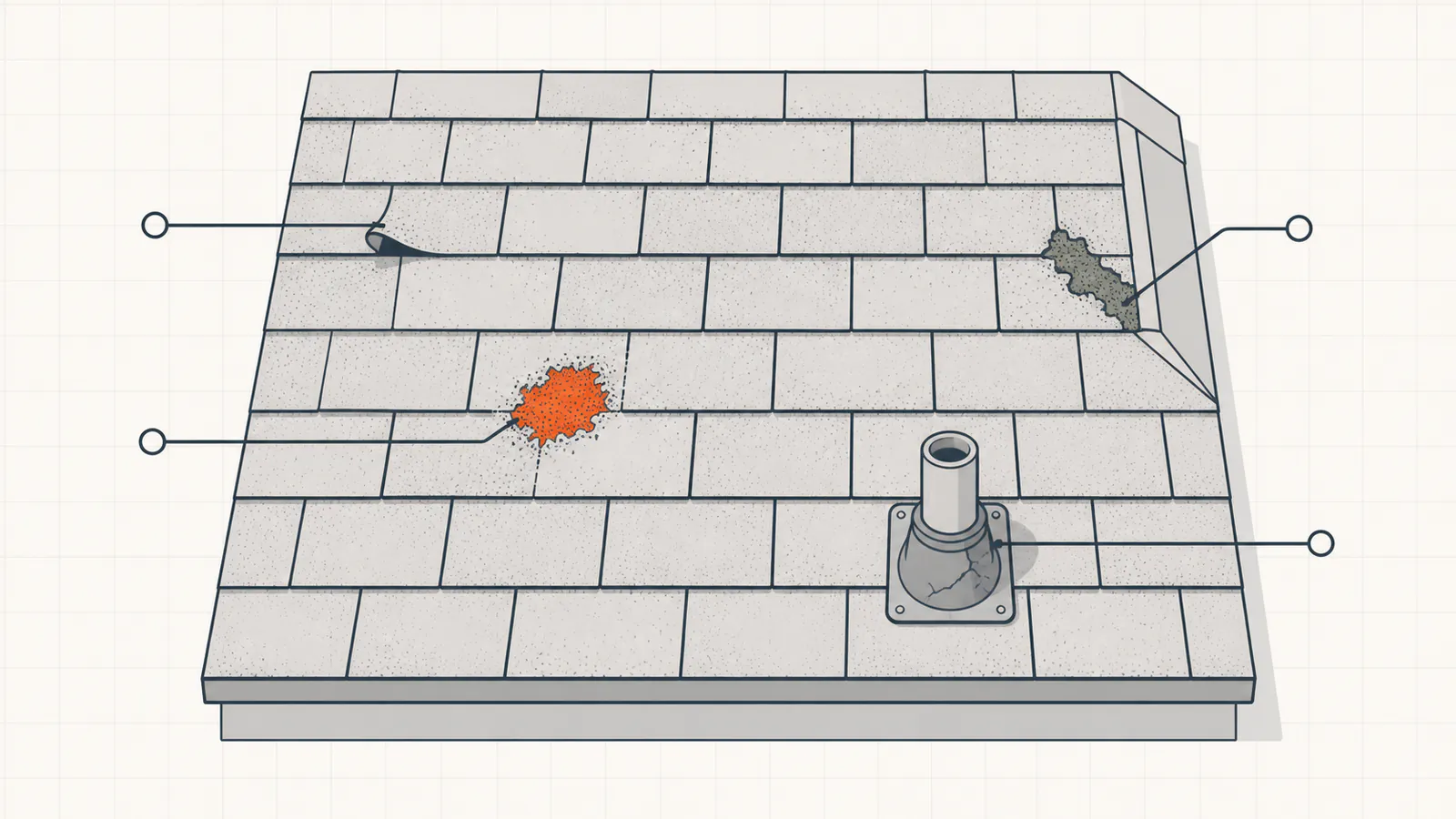
The strongest signs you need a new roof are widespread curling or bald shingles, heavy granule loss in the gutters, a sagging ridge, daylight or water stains in the attic, and leaks in more than one place, especially on a roof past 20 years old. Isolated damage on a younger roof is usually a repair, not a replacement.
Key takeaways
- The clearest replacement signs are the widespread ones: curling or bald shingles across a whole slope, steady granule loss, a sagging ridge, and leaks in more than one place.
- Run every sign through the Three-Question Triage (Is water getting in? Is it spreading? How old is the roof?) and the right level of urgency usually becomes obvious.
- You can check almost everything from four safe vantage points: the ground, a ladder at the eaves, the attic, and the rooms below, never by walking the roof itself.
- Granules in the gutters, curling edges, bald patches, and crazed tabs are age wear rather than storm damage; they mean the shingle has used up its protective coating.
- A sagging ridge, a wavy roof plane, or spongy decking is structural rather than cosmetic, and it belongs at the top of the severity ladder.
- Photograph what you find with dates. A simple Roof File turns a vague worry into evidence an inspector, a roofer, or an insurance adjuster can act on.
Want this answered for your property? Request a free Roof Report, then review the findings and open questions by phone with RoofPredict.
How do you know if you need a new roof?
Here is the direct answer. The signs that most reliably mean a roof is at or near the end of its life are: shingles curling, cracking, or losing their granules across large areas rather than in one spot; a steady stream of granules washing into the gutters; bald or dark patches where the shingle mat is exposed; a ridge line or roof plane that is no longer straight; daylight, water stains, or damp insulation in the attic; and leaks showing up in more than one place, or coming back after repairs. Any one of these on a roof past 20 years old is a strong signal. Several of them together, at almost any age, means the roof deserves a professional look this season, not someday.
Just as important is what does not automatically mean you need a new roof: one missing shingle after a windstorm, black algae streaks, a cracked rubber boot around a plumbing vent, a single water stain under a chimney, or moss on a shaded corner. Those are maintenance and repair items on a roof that may have years of life left. Roofs rarely fail all at once. They wear out in stages, and each stage leaves evidence you can see without ever setting foot on the shingles. The skill this guide teaches is telling the difference between a local problem with a local fix and a surface that is finished everywhere at once.
The guide is organized the way you will actually look: first from the ground, then from a ladder at the eaves (only if you can do that safely), then from inside the attic, and finally from the rooms below. Along the way, every sign gets run through the same simple framework, the Three-Question Triage, so that by the end you will not just have a list of what you saw, but a clear verdict on how urgent each item is. Two ground rules before we start. First, age changes the meaning of every sign: a cracked shingle on a 6-year-old roof is a defect or a storm hit, while the same crack on a 24-year-old roof is the roof telling you it is tired. Second, none of it requires walking on the roof. Not one thing. Walking an aging roof grinds off granules and cracks brittle shingles, and it puts you a slip away from the emergency room.
| Vantage point | What you need | Time | What it reveals |
|---|---|---|---|
| From the ground | Binoculars or a phone camera with zoom; a walk around the full perimeter | 15–20 minutes | Shingle surface condition, missing tabs, sagging lines, flashing and chimney trouble, moss and algae, fascia and soffit stains |
| From a ladder at the eaves | A stable ladder, a helper, calm dry weather, and the judgment to skip it if you are not comfortable | 10–15 minutes | Granule depth in gutters, drip edge condition, the first courses of shingles, nail pops, gutter slope and standing water |
| From the attic | A bright flashlight or headlamp, a dust mask, shoes with grip | 15 minutes | Daylight through the deck, active and old leak stains, damp insulation, mold, frost, rusted nails, ventilation failures |
| Inside the home | Your eyes, a pencil to mark stain edges, and attention after heavy rain | 5–10 minutes | Ceiling stains, peeling or bubbling paint near the roofline, sagging drywall, musty odors upstairs |
The short version
One problem, in one place, on a roof under 15 years old is almost always a repair. The same problem repeated across the roof, or any problem on a roof past 20, is a replacement conversation. The middle is where a professional inspection earns its fee.
The Three-Question Triage
A checklist of signs is only half the tool. The other half is knowing what to do about each one, and for that this guide uses one framework from start to finish: the Three-Question Triage. For any sign you find, ask three questions in order. First: is water getting in? Evidence of active water (a damp stain, wet insulation, a drip, a musty smell that intensifies after rain) outranks every cosmetic finding on the roof, because water inside the structure does compounding damage to decking, framing, insulation, and drywall every week it continues. Second: is it spreading? A single curled shingle is a data point; curling across a slope is a trend. One stain is an event; a stain that grows between rains is a process. Widespread or spreading signs point at the whole surface, and whole-surface problems do not have spot fixes. Third: how old is the roof? Age is the multiplier that turns a minor sign into a major one. The same granule wash means very different things at year 8 and year 20.
Active water outranks every cosmetic finding on the roof.
The answers place each sign on a three-rung severity ladder. Monitor means photograph it and look again next season (no call required). Schedule means book a professional inspection within the next several weeks; the sign is meaningful but the roof is not actively failing. Act soon means get a roofer or inspector out within days, because water is entering, the sign is worsening visibly, or the structure is involved. Every sign below gets a triage verdict, and the master table near the end collects them all in one place.
| Is water getting in? | Is it spreading or widespread? | Roof age | Verdict |
|---|---|---|---|
| No | No (one spot) | Under 15 | Monitor. Photograph it and recheck next season. |
| No | No (one spot) | 15–20 | Monitor to Schedule. Isolated wear on an aging roof deserves a professional look within a few months. |
| No | Yes (a slope or more) | Any age | Schedule. Widespread signs are about the whole surface, and the whole surface is a professional question. |
| No | Yes (a slope or more) | Over 20 | Schedule now. This is the classic profile of a roof entering its final years. |
| Yes | No (one stain, one spot) | Any age | Act soon. Isolated water entry is usually a repairable flashing or detail failure, but it does not heal itself. |
| Yes | Yes (multiple places or returning leaks) | Any age | Act soon, and start the replacement conversation. Multiple entry points on one roof rarely stay patched. |
Triage is not diagnosis
The Three-Question Triage tells you how fast to move, not what the fix is. Whether the answer is a $400 flashing repair or a full replacement is a separate decision, one this guide deliberately leaves to a professional inspection and to our repair-versus-replace guide.
One more habit that makes the triage work: answer the age question before you start looking. If you do not know when your roof was installed, you are missing the single most useful piece of context for everything you are about to see. Closing documents, a permit search, a talk with a long-tenured neighbor, or historical roof imagery can usually pin it down in under an hour; the age section later on points to the full methods. Even a rough band ("under 15," "15 to 20," "over 20") sharpens every verdict below.
The ground survey: method, light, and limits
The ground survey is the foundation of everything else, and doing it well is mostly a matter of method, not equipment. You need binoculars (almost any pair helps; 8x magnification or better is ideal) or a phone camera you can zoom and later examine on a bigger screen. Then walk the entire perimeter of the house, not just the front, and study each roof slope as its own separate object, because slopes age at different speeds and the differences are informative.
- Pick the right light. Low-angle sun (the first two hours after sunrise or before sunset) rakes across the roof and throws every curl and wave into relief. The flat light of midday hides texture; the same slope can look fine at noon and clearly worn at 7 a.m.
- Stand back before you stand close. From across the street or the far end of the yard, sight along the ridge line and along each eave. Both should read as straight lines. Then look at each plane of the roof as a whole: does it lie flat, or does it roll and dip between rafters?
- Scan each slope in a grid. Sweep the binoculars along each course of shingles, top to bottom, looking for anything that breaks the pattern: a tab darker than its neighbors, an edge lifting, a shiny spot, a horizontal crease, a patch of missing granules.
- Give extra time to south- and west-facing slopes. They take the most sun and usually age first. If the south slope looks tired and the north slope looks fine, you are seeing normal differential aging, and a preview of where the whole roof is headed.
- Study the details, not just the field. Chimney flashing, valleys, plumbing vent boots, skylight perimeters, and the ridge cap fail earlier and more often than the open field of shingles. Rust streaks, tar smears, lifted metal edges, and sloppy patch jobs all show up in binoculars.
- Check what the roof sheds. Look at downspout outlets and splash blocks for granule piles, at the lawn and shrubs for shingle fragments after wind, and at the fascia and soffit boards for stains or peeling paint where water has been escaping the gutter path.
A ground survey has honest limits, and knowing them keeps you from false confidence. You cannot see hail bruises from the ground; hail damage is mostly a texture you find by touch and close inspection, which is a professional's job. You cannot see the condition of the underlayment, the decking, or most of the flashing detail. And a steep roof hides its upper courses from street level entirely. What the ground survey does well is catch the signs that show early, so small problems get fixed small; certifying the roof as healthy is beyond its reach. The attic check, covered later, is the other half of the picture: many roofs that pass the street test fail the flashlight test.
After a rain, one more ground-level observation is worth a minute: watch how the roof dries. A healthy shingle surface sheds water and dries fairly evenly. Sections that stay dark and damp hours after the rest of the roof has dried are holding moisture: because the surface has degraded, because moss or debris is trapping water, or because that area gets no sun. Persistent damp patches are where organic growth starts and where shingles age fastest, so note them in your photos even if nothing else looks wrong.
What do curling, clawing, and cupping shingles mean?
Curled shingles are the single most recognizable sign of an aging roof, and they come in two shapes worth telling apart. Cupping is when the edges and corners of a shingle turn upward, so the shingle forms a shallow bowl. From the ground, cupped shingles catch low-angle light along their raised edges and give the slope a rough, ruffled texture. Clawing is the reverse: the edges stay down while the middle of the shingle lifts, so each tab looks like a claw curling under itself. Both shapes come from the same underlying process. An asphalt shingle is a fiberglass mat soaked in asphalt and surfaced with mineral granules; as the asphalt ages, its oils oxidize and evaporate, and the shingle shrinks and stiffens. Because the top and bottom of the shingle dry at different rates, the shingle distorts instead of shrinking flat.
Age is the usual cause, but not the only one. Chronic attic heat, the product of poor ventilation, bakes shingles from beneath and can curl a roof years ahead of schedule, which is one reason the attic check later on matters even when the problem seems to be outside. Shingles installed over an old layer (a "roof-over") curl earlier because they bridge the uneven surface below and run hotter. And occasionally a manufacturing defect curls one production run while its neighbors stay flat. If your roof is young (under 10 years) and curling anyway, the question is not whether to replace but why it is failing early. The answer usually involves ventilation or installation, and sometimes a warranty claim.
What curling means practically: a curled shingle has lost the two things that make a shingle work. It no longer lies flat, and it is no longer flexible. Its raised edges give wind a handhold, so curled slopes shed tabs in storms that a flat roof would shrug off. Wind-driven rain can be pushed under lifted edges. And because the shingle is brittle, it cannot be repaired flat: pressing a curled shingle down cracks it, which is why hand-sealing curled tabs with roofing cement is a stopgap measure, not a fix. Curling is also effectively irreversible and progressive: a slope that shows curling this year will show more next year.
Run the triage. Water getting in? Usually not yet — curling precedes leaking, which is exactly what makes it valuable as a warning. Spreading? This is the decisive question. A handful of curled shingles in one spot (often over a poorly ventilated bathroom or a hot spot in the attic) is a Monitor-to-Schedule item. Curling scattered across an entire slope, or visible on multiple slopes, means the asphalt itself is at the end of its life everywhere, and no repair changes that: Schedule an inspection now and begin planning. Age? Widespread curling under year 12 is a Schedule item with a "find out why" agenda; past year 18 it is simply the roof announcing its retirement.
Curling plus wind forecast
A slope with widespread curling is unusually vulnerable to the next wind event. If you are in hurricane or severe-thunderstorm season with visible curling across a slope, move the inspection up; losing tabs in a storm converts a planned replacement into an emergency one, often with interior damage added.
Missing shingles: why the cause matters more than the count
The honest answer: the count matters less than the cause. A roof can lose three shingles in one storm and be fine for another decade, or lose one shingle a month in ordinary weather and be finished. The question a roofer asks is less "how many are gone?" than "why did they leave, and are the neighbors about to follow?"
Shingles are held down by nails and by a factory-applied sealant strip, a line of thermoplastic adhesive that bonds each shingle to the one below it after a few warm days on the roof. When shingles go missing after a specific, memorable wind event and the rest of the slope looks uniform and flat, the likely story is a localized wind hit: gusts exceeded what the bond could hold at the roof's most exposed spots (edges, rakes and corners take the worst suction). That is a repair, and possibly an insurance matter, since wind is a covered peril under most homeowners policies; the storm section below covers what to document and when. But when shingles go missing in ordinary weather, or a few leave with every breezy day, the story is different: the sealant strips across the roof have aged past holding, and every shingle is now loose in a way you cannot see from the street. Replacing the missing ones does nothing for the thousands whose bond has failed. A roofer can check this directly by gently lifting tabs by hand. Bonded shingles resist; age-failed ones lift freely.
Whatever the cause, a missing shingle is a hole in the armor that needs prompt attention. The underlayment exposed beneath it is a water barrier, but not one designed for open weather: sun degrades it and wind works at its laps, so an exposed patch that would be harmless for a week becomes a leak over a season. Get missing shingles replaced quickly even if you suspect the roof's days are numbered; a $300 repair that protects the decking is cheaper than the decking repair. Expect the patch not to match: replacement shingles start darker or lighter than their weathered neighbors, and a visible color patch is cosmetic, not a defect. Two adjacent signs to check while you are looking: tabs that are present but creased (a horizontal line across the tab where wind folded it back; a creased shingle is broken even though it is still attached) and exposed or "popped" nails at spots where shingles have shifted, which show up in binoculars as small shiny dots.
Triage: missing shingles always start at Schedule at minimum, because exposed underlayment does not wait. Storm-caused loss on a roof under 15 → repair promptly, photograph everything first, and consider whether a claim makes sense. Recurring loss in ordinary weather, or loss accompanied by widespread curling → this is a whole-surface bond failure; Schedule an inspection and start the replacement conversation. Missing shingles with water already showing in the attic below → Act soon.
Granules in the gutters: reading the evidence
Granules are the crushed, ceramic-coated stone bonded to a shingle's surface, and they do three jobs: they block ultraviolet light from reaching the asphalt (UV is what ages asphalt fastest), they provide the shingle's fire rating, and they armor it against hail and foot traffic. A shingle without granules is a shingle on a fast countdown: bare asphalt in full sun can degrade to a cracked, exposed mat within a couple of seasons. That is why granule loss is one of the most reliable early-warning signs a roof gives, and why your gutters and downspouts are worth reading like an instrument.
| What you find | Most likely meaning | Triage verdict |
|---|---|---|
| Loose granules in the first year after a new roof | Normal. Manufacturing leaves excess granules on every shingle, and the surplus washes off over the first several rains. | Monitor. Expected behavior, no significance. |
| A light gritty film after heavy rain, mid-life roof | Ordinary weathering. All shingles shed slowly throughout their lives. | Monitor. Note it in your photos for comparison. |
| Steady, accumulating granules on an older roof (roofers commonly treat this as a late-life sign once a roof is past roughly its first dozen years) | The surface is wearing through its protection. Usually accompanied by visible color unevenness or bald spots on the sunniest slopes. | Schedule. This is the classic 'final years' signal, especially alongside curling. |
| A sudden heavy shed right after a hailstorm | Impact scouring. Hail knocks granules loose in a single event; the roof may also have bruises you cannot see from the ground. | Schedule promptly, and photograph the gutters and downspouts with the date before rain washes the evidence away. |
| Granules heavy below one slope only | That slope is aging ahead of the others (usually the south- or west-facing one) or is taking concentrated wear from a valley or downspout above. | Schedule if the slope also shows bald patches; Monitor otherwise. |
Where to look: the bottoms of gutters (during a cleaning, or from your ladder vantage), the outlets of downspouts, and the splash blocks or pavement where downspouts discharge. Granule accumulations look like coarse, colored sand, often matching your shingle color, which is the giveaway that they came from the roof rather than blown in from elsewhere. After any hard rain, a glance at the downspout outlet costs nothing and builds the baseline that makes change obvious.
Bald patches, the end stage of granule loss, show from the ground as dark or shiny spots that break the slope's even color, because exposed asphalt is darker than the granule surface, and an exposed fiberglass mat can read as a pale sheen. Check the south and west slopes first and hardest. One caution against overreaction: a difference in color between slopes, or streaking that follows vertical lines, is more often algae (covered below) than granule loss. Granule loss changes the texture; algae changes only the color. Binoculars in low-angle light can usually tell them apart, and a pro's fingertips on the shingle settle it.
Triage: granule evidence is almost never an Act-soon item by itself, because it precedes leaks. That is its whole value. But it is the sign most worth tracking over time; the trend is the diagnosis. A photo of your downspout outlet every season turns "I think it is worse" into "here is last spring versus this spring," which is exactly the kind of evidence that makes an inspection productive.
Cracks, splits, and blisters, and what each one is telling you
Cracking is the brittleness stage of shingle aging, and like curling it comes in patterns that mean different things. Surface crazing (networks of fine cracks in the top layer, sometimes called alligatoring for its resemblance to alligator hide) is aged asphalt shrinking and checking under UV exposure. It usually shows up alongside granule loss on the sunniest slopes. Through-cracks or splits, meaning single clean cracks that cross a shingle entirely, often more or less straight, come from thermal cycling: the daily expansion and contraction of the roof surface, sometimes concentrated by movement in the decking below. A shingle with a through-crack is two shingles overlapping badly; it no longer sheds water reliably.
Blisters are the third pattern and the one most often misread. A blister is a small raised bubble in the shingle surface, caused by moisture or gas trapped in the asphalt during manufacture, and often aggravated by an over-hot roof deck (poor attic ventilation again). Unpopped blisters are mostly cosmetic and can stay stable for years. Popped blisters matter more: each one is a small crater with the granules gone and the asphalt or mat exposed, which puts that spot on the fast-aging track. From the ground, a blistered slope looks pebbled or pockmarked in raking light; popped blisters read as a spray of dark pinpoints. Blistering is also commonly confused with hail damage. The difference (blisters rise from within; hail bruises crush from without, and hail leaves other evidence like dented soft metals) matters enormously for insurance, and it is an argument for professional eyes before anyone files or denies a claim.
The pattern across slopes tells you as much as the cracks themselves. Sun is the great ager of asphalt, so wear concentrates first on south- and west-facing slopes in most of the country. If your south slope shows crazing, bald patches, and curling while the north slope looks years younger, that is no reason to relax about the north slope: same roof, installed the same week, simply running a few years behind on the same road. Roofers replace roofs, not slopes, for exactly this reason: by the time the last slope fails, the first has usually been leaking for years, and a slope-by-slope replacement buys the worst of both costs.
Triage: a few cracked or blistered shingles in one area on a roof under 15 is a Monitor. Photograph it and mention it at your next inspection. Crazing or through-cracks visible across a slope: Schedule; brittleness at that scale will not stop, and every windstorm now has more to work with. Cracking plus curling plus granule loss together is the standard portrait of a roof in its final act. Schedule now and begin budgeting, because you are choosing the timing of the replacement, not whether.
Is moss or algae on the roof a problem?
Usually less of one than it looks, but the answer depends on which organism you are looking at, and the three common ones behave very differently. Algae is the dark vertical streaking that runs down roof slopes, most often on the north side and in humid regions; the common culprit is a blue-green algae (roofers know it by the species name Gloeocapsa magma) that feeds on the limestone filler in shingles and builds a dark protective coating. Algae is overwhelmingly a cosmetic problem. It does not hold meaningful moisture, it does not lift shingles, and a streaked roof can have many sound years left. What algae mainly costs you is curb appeal, and sometimes negotiating position when you sell, because buyers read streaks as neglect.
Moss is a different matter. Moss grows a spongy mat that holds water against the shingle surface for days after every rain, and its root-like structures work into the gaps between and under shingles. Over years, that means shingle edges lifted enough to admit wind-driven rain, granule loss under the mat, accelerated rot in any exposed wood, and in freezing climates a freeze-thaw wedge prying at the surface all winter. A light dusting of moss on a shaded corner is a maintenance note. Thick established moss across a slope, especially if it has clearly been there for years, is a legitimate roof-health problem, and on an older roof it often hides the surface so completely that only removal or an inspection reveals what is left underneath. Lichen, the third organism, forms crusty rosettes that bond so tightly to the granule surface that removing it usually takes granules with it; established lichen is best left to a professional's judgment about whether treatment costs the roof more than the lichen does.
What to do, and what never to do. Never pressure-wash an asphalt shingle roof; the industry's manufacturers, through the Asphalt Roofing Manufacturers Association, are unambiguous that pressure washing strips granules and voids the surface, trading a cosmetic problem for a structural one. The accepted gentle method is a solution of household bleach and water applied with a sprayer, left to work, then rinsed at garden-hose pressure. Note carefully that this is still roof work, with fall risk and plant-killing runoff, and it belongs to a professional cleaning service for most homeowners. Moss is treated, allowed to die, then brushed off gently downslope (never upslope, which lifts shingle edges). Prevention is the better spend. Trim back overhanging branches to cut shade and debris, and keep gutters clear so the roof edge dries. Zinc or copper strips near the ridge, a traditional practice, inhibit regrowth on the wash-zone below, with the honest caveat that their effectiveness is partial and gradual rather than total.
Triage: algae streaks are a Monitor; clean for appearance whenever you choose, because it is not urgent and never will be. Light or new moss is Monitor to Schedule: treat it this season and fix the conditions (shade, debris, damp) that invited it. Thick, long-established moss, moss on a roof past 15, or moss accompanied by lifted edges and interior signs calls for a scheduled inspection, because the question is no longer the moss but what the moss has been doing to the surface beneath it. And a useful reframe for the anxious: organic growth is usually a symptom of a damp, shaded roof section before it is a cause of failure. Whatever you find growing, ask what moisture invited it.
Averages only get you so far. A Roof Report puts your property on the timeline with an estimated age range, the evidence behind it, and the questions that could narrow it.
What does a sagging ridge or wavy roofline mean?
Nearly every other sign on this checklist is about the roof's skin. Sagging is about its skeleton, and that is why it sits at the top of the severity ladder. Sight along the ridge (the horizontal peak line) from across the street or from a corner of the yard: it should read as a dead-straight line against the sky. Then sight along each eave, and then look at each roof plane as a surface. Three distinct problems show up this way, and they mean different things.
A dipping or swaybacked ridge means the structure under the peak is yielding: rafters spreading at their feet, an undersized ridge board, broken or modified framing (a surprising number of sagging roofs trace back to a previous owner cutting truss webs to make attic storage), or walls bowing outward under the roof's thrust. A wavy or rolling plane (the surface undulating between rafters in even ribs) usually means the decking is the problem: plywood or board sheathing that has been repeatedly damp has delaminated or softened and is sagging between its supports. Roofers feel this as sponginess underfoot, but you can often see it from the ground in raking light. A localized depression in one area of a plane usually marks a long-term leak that has rotted the decking in one zone, commonly below a valley, a chimney, or a spot where debris piles up.
Causes worth knowing because they change the response: long-term water intrusion (the most common), a second layer of shingles adding weight the framing was never sized for, snow loads in northern climates, and chronic attic humidity softening the deck from below. One honest de-escalation: on older homes with board (plank) decking, a slight, stable, uniform waviness can be decades old and structurally boring; the boards cupped long ago and stopped. What distinguishes the boring version from the worrying one is change and company: a sag that is deepening, spreading, or accompanied by interior evidence (fresh drywall cracks upstairs, doors that recently stopped latching, a stain below the dip) is active.
If you see a sag
Photograph it today from a fixed spot you can find again (same corner of the yard, same zoom) with the date. Repeat monthly. Have a roofer or structural-savvy inspector look within a few weeks. If it is visibly worsening, if water is coming in below it, or if it follows a heavy snow, make the call this week rather than this month. Do not go onto the roof, and keep anyone else off it too; a soft deck is exactly where a foot goes through.
Triage: all sagging starts at Schedule and escalates to Act soon with any sign of progression or water. And it carries a planning consequence: sagging areas almost always mean decking replacement when the roof is redone, so a borderline repair-versus-replace decision tips toward replacement. Once the shingles are off, fixing the deck is straightforward; patching a soft deck under a worn surface means paying for the same real estate twice.
Flashing trouble, seen from the ground
Many of them, yes, and it is worth learning to, because flashing failures cause a large share of residential roof leaks while having nothing to do with the shingles' remaining life. Flashing is the metal (or, at plumbing vents, metal-and-rubber) system that waterproofs every place the roof plane is interrupted: chimneys, valleys where two slopes meet, sidewalls where a roof dies into a vertical wall, plumbing vents, skylights, and the roof's edges. Shingles shed water across open field; flashing handles every transition. When a "roof" leaks on a roof with life left, the flashing is the first suspect.
| Detail | What trouble looks like from the ground | What it usually means |
|---|---|---|
| Chimney | Gaps or shadows where the counterflashing meets the brick; metal lifting away from the mortar line; heavy tar smears; white or green staining on the brick below the roofline | Counterflashing pulling out of its mortar joint, the most common chimney leak path. Tar smears mean someone has been chasing this leak with roofing cement instead of fixing it. |
| Valleys | Rust streaks or orange staining running down or below the valley metal; shingles in the valley worn ahead of the field; debris dams | Valley metal corroding through, or concentrated water flow wearing the valley shingles out early. Valleys carry the most water on the roof and fail ahead of the field. |
| Plumbing vent boots | The rubber collar around the pipe visibly cracked, split, or curled away from the pipe (binoculars can catch this) | The boot's rubber has weathered out. Contractors commonly treat boots as a 10-to-15-year part; they routinely die a full cycle before the shingles around them. A cheap, classic source of 'mystery' bathroom-ceiling stains. |
| Sidewalls and dormers | Stains on the siding just above the roofline; kick-out area at the bottom of the wall with water marks on the wall or fascia below | Step flashing failing behind the siding, or a missing kick-out flashing letting the wall's runoff pour behind the gutter (a notorious slow rot-maker). |
| Skylights | Staining on the roof below the skylight; debris packed above it; interior stains at the skylight's corners | Failed skylight flashing or seals. Skylight perimeters are leak-prone enough that many roofers recommend replacing the unit whenever the roof is replaced. |
| Drip edge and eaves | Peeling paint, dark stains, or soft-looking rot on the fascia boards; water marks on the wall below the gutter line | Water getting behind the gutter: a missing or failed drip edge, or ice-dam history. The fascia is where that story is written. |
One ground-visible red flag deserves its own mention: roofing cement. Shiny or weathered black tar smeared around a chimney, along a valley, or over a flashing joint is the signature of a cheap chase-the-leak repair: it works for a season or two, then cracks and channels water in new directions. A roof decorated with tar patches is telling you two things: it has leaked before, and nobody has yet fixed it properly. Budget for real flashing work, and factor the history into any purchase or replacement decision.
Triage: flashing signs are the great impostors. They produce dramatic interior evidence (a stained ceiling, a drip in a closet) on roofs that are otherwise healthy, and they push worried homeowners toward replacement quotes they do not need. Most flashing failures are Schedule items: repairable, at modest cost, by any competent roofer. They become Act soon when water is actively entering. The age question still applies, since flashing failures on a roof past 20 usually share the stage with surface wear and the inspection should assess both; on a young roof, though, a flashing leak is a repair, full stop. A contractor who answers a single vent-boot leak on a 9-year-old roof with a full replacement quote should be asked to explain, in writing, what is wrong with the rest of the roof.
The ladder vantage: what it adds, and when to skip it
The eave line, where the roof meets the gutter, is the one vantage point that adds real information beyond the ground survey, and it is also where this guide draws a hard safety line. Being on a ladder at the gutter is a judgment call that depends on your health, your balance, your equipment, your ground conditions, and your honest tolerance for height. Being on the roof is not a judgment call: do not walk the roof. Falls from height are one of the most common causes of serious home-injury in the United States. Safety agencies including the Consumer Product Safety Commission have long counted ladder falls among the leading sources of emergency-room visits for home projects, with estimates running to the hundreds of thousands of injuries a year. A roof inspection is never worth a fall, and everything a ladder reveals, a professional with the right equipment can also photograph for you.
- Skip the ladder entirely if any of these is true: the ground is soft, uneven, or sloped; the weather is wet, windy, or icy; you are alone; the ladder is borrowed, bent, or the wrong height; or you simply do not feel steady. Binoculars plus a professional inspection cover everything below at zero risk.
- If you do go up: use a sturdy extension ladder on firm, level ground, angled at roughly one foot out for every four feet up, extending about three feet above the gutter line, with someone steadying the base.
- Keep three points of contact, keep your hips between the rails (never lean sideways; move the ladder instead), and never step onto the roof surface or the gutter.
- Work in the morning before shingles heat up, and never touch power lines or the service drop to the house: keep the ladder well clear of all wiring.
- A modern alternative worth naming: a phone on a selfie stick or an inexpensive camera pole can capture eave-level and even mid-slope photos from a lower, safer rung. Drone photography, where legal, gets a roofer full coverage without anyone leaving the ground.
What the eave vantage shows that nothing else does. First, the gutters themselves: how much granule sediment has actually accumulated (a thin gritty film is life as usual; a layer deep enough to bury a fingertip is a late-life roof shedding hard), whether the gutter holds standing water (bad slope, which keeps the roof edge damp), and whether shingle fragments or nails have washed down. Second, the first courses of shingles (the rows nearest the eave), which take ice-dam abuse in cold climates and are often the first place edge damage, lifted tabs, and nail pops show clearly. Third, the drip edge: the metal strip that should guide water off the deck edge into the gutter. On many older roofs it is missing entirely, and its absence explains rotted fascia and water marks behind the gutter. Fourth, close texture: at arm's length you can see granule wear, crazing, and bruising that binoculars smooth over. Take photos of everything; the point of the trip is to bring the evidence down, not to linger.
Triage: the ladder vantage mostly sharpens verdicts you have already formed: it turns "granules, probably" into "a quarter-inch of granules in every gutter run." Deep granule beds and brittle or damaged first courses are Schedule items on their own; so is a missing drip edge with fascia rot. Anything that surprises you at close range on a roof past 15 is worth a professional look regardless of what the ground survey suggested.
What are the attic signs of a failing roof?
The attic is where most roofs confess. Problems that are invisible from the street — pinhole leaks, condensation, slow flashing seeps, cooking heat — all leave their marks on the underside of the roof deck, and a 15-minute flashlight inspection twice a year tells you more about your roof's real condition than an hour of squinting from the curb. Go in with a bright flashlight or headlamp, a dust mask (attic insulation and dust are not lung-friendly), shoes with grip, and one rule burned in: step only on the framing (the joists or truss chords), never on the drywall between them, which will not hold you. If your attic has no safe footing or no access, skip it and put it on the list for the professional inspection instead.
Timing multiplies what you can see. The single most productive attic visit is during or just after a hard rain, when active leaks announce themselves as damp streaks and drips you could never find dry. A bright sunny day is for the daylight test. And in cold climates, a subfreezing winter morning reveals condensation problems as visible frost. If you only make one trip, make it the rainy one.
| What you find | What it usually means | Triage verdict |
|---|---|---|
| Daylight through the deck (check with lights off): pinpoints at nail holes, glows around the chimney or pipes, gaps at the ridge | Anywhere light passes, water can. One honest caveat: an even glow at the ridge or at the eaves may be your ridge and soffit vents working as designed: daylight at vents is normal; daylight through the field of the deck is not. | Act soon for field-of-deck daylight; it is an open path for water. |
| Dark, damp stains or glistening streaks on the deck or rafters during rain | An active leak, live and locatable. Trace the streak uphill to its highest point. Water runs along framing before it drops, so the entry is usually upslope of the drip. | Act soon. Photograph it wet; note the location relative to chimneys and valleys. |
| Old stains: lighter, chalky-edged rings, dry to the touch | A past leak: repaired, seasonal (ice dams, wind-driven rain from one direction), or simply dormant. Dormant is not dead. | Monitor. Circle the stain edge with a pencil and date it; if it grows past the line after a rain, it is active: escalate. |
| Damp, compressed, or discolored insulation, especially below valleys, chimneys, skylights, or vents | Water is arriving faster than it evaporates. Wet insulation also stops insulating and can hold moisture against the framing. | Act soon if wet now; Schedule if dry but matted and stained. |
| Rust on nail tips ('shiners') or dark rings around nails | Condensation: humid indoor air condensing on cold metal. A ventilation and air-sealing sign more than a leak sign, but it drips real water in cold snaps. | Schedule. Widespread rusty nails mean the attic runs damp. |
| Mold: black, green, or gray blooms on the sheathing, often worst on the north-facing side | Sustained moisture: chronic condensation, a long-running leak, or bath fans dumping into the attic. Mold on the deck also degrades the sheathing itself over time. | Schedule promptly. Small patches are a moisture-source hunt; the EPA's general guidance is that areas beyond roughly ten square feet call for professional remediation. |
| Frost on the underside of the deck in winter | Warm moist house air is reaching cold sheathing and freezing. Every thaw is a small rainstorm inside the attic. | Schedule: a ventilation and air-sealing project, best done before it becomes a mold project. |
| Plywood delaminating: plies separating, edges wavy, surface flaky or soft to a screwdriver poke | Repeated wetting has broken down the deck itself. This is the stage before sponginess and sags show outside. | Act soon. Deck damage compounds and adds cost the longer it runs. |
| A musty smell that intensifies after rain | Moisture is getting in somewhere you have not found yet. Trust the nose; it detects damp before the flashlight does. | Schedule. Persistent must with no visible source is a professional hunt. |
One distinction saves homeowners a great deal of misdirected worry: leak versus condensation. A leak is local and event-driven — it maps to specific rains, sits below or upslope-adjacent to a specific feature, and stains in defined streaks and rings. Condensation is diffuse and seasonal: it shows up across broad areas (rusty nails everywhere, frost everywhere, a generally damp deck), correlates with cold weather rather than rain, and worsens with indoor humidity. The distinction matters because the fixes are different: leaks are roofing work, condensation is ventilation and air-sealing work, and replacing a roof does nothing for a condensation problem, which will happily continue under the new deck.
What do attic ventilation problems look like, and why do they age your roof?
Ventilation failure is the quiet roof-killer, and it deserves its own stop on the attic tour because it shortens roof life without producing a single drip. A typical system breathes passively: cool air enters at soffit vents under the eaves, warms, rises, and exits at ridge or gable vents, carrying heat and moisture out with it. When that loop is blocked, two things happen. In summer, the attic superheats, and the shingles — already taking full sun from above — get baked from below as well, drying out the asphalt years ahead of schedule; premature curling and blistering are the outside evidence. In winter, moist household air lingers and condenses (the rusty nails, frost, and mold from the table above), and in snow climates a warm attic melts the snowpack from beneath, feeding the meltwater down to refreeze at the cold eaves as ice dams, which pry at the roof edge and force water backward under the shingles. The Department of Energy's Energy Saver guidance treats attic ventilation and insulation as a single system for exactly these reasons.
- Look along the eaves from inside the attic: you should see light or feel airflow at the soffit vents. Insulation stuffed into the eave bays, the most common blockage, means the intake is smothered; baffles (channels that hold insulation back from the vents) should be visible if the system was done right.
- From outside, check that soffit vents exist and are not painted over or clogged with dust and lint. Run a hand under them; they should look like open grilles, not solid panels.
- Confirm bathroom and kitchen fans duct all the way outside, not into the attic. A bath fan exhausting into the attic is a humidifier aimed at your roof deck, and it is a fix measured in tens of dollars, not thousands.
- Note the symptoms you have already logged: frost, rusty nails, mold on the north deck, ice dams at the eaves in winter, and an attic that feels like an oven on a merely warm day are all ventilation evidence.
- As a scale reference: a common rule of thumb in residential guidance sizes vent area at about one square foot per 150 to 300 square feet of attic floor, split between intake and exhaust. Precision here is a contractor's job, but 'my attic has almost no visible venting' is a finding you can make yourself.
Triage: ventilation signs are Schedule items, but they carry an unusual payoff — this is one of the few roof problems where the fix is cheap relative to what it protects. Adding baffles, clearing soffits, and rerouting a bath fan cost a small fraction of a reroof and can add years to the surface above. If you are already planning a replacement, insist that ventilation be corrected as part of the job; putting new shingles over a broken ventilation system starts the new roof's clock at a sprint. And if your roof is aging faster than its neighbors of the same vintage (curling at year 12 while the street's roofs lie flat), ventilation is the first place to look for the reason.
What interior signs point to a roof problem?
By the time evidence reaches the rooms you live in, the water has usually been traveling for a while: through the roof, along framing, across the top of the drywall. So interior signs deserve prompt attention even when they look minor. The classic sign is the ceiling stain: a tan, brown, or yellowish patch, often with darker rings at its edge, on an upstairs ceiling. Ring patterns record episodes. Each ring is a wetting that spread and dried, so a multi-ring stain has leaked more than once. Location is your first clue to the source: stains below valleys, chimneys, skylights, valley lines, and plumbing-vent paths point at those features; a stain in the middle of an open ceiling plane points at the field of the roof or at something traveling along framing from farther upslope.
The other interior signs cluster near the roofline. Peeling, bubbling, or flaking paint at the top of walls and along ceiling edges — especially on the upper floor — is moisture pushing through from behind, either roof water or chronic attic humidity. Wallpaper lifting at the ceiling line tells the same story. A sagging or bulging patch of ceiling drywall is water pooled above it, and it is the one interior sign that can involve immediate mess: a water-heavy bulge can release suddenly. If a bulge is visibly holding water, put a bucket and plastic below it and consider relieving it deliberately with a screwdriver puncture at its low point: a controlled drip beats a collapsed panel. Then get help fast. Water at a ceiling light fixture is an electrical hazard first and a roof problem second: keep the fixture off at the breaker until an electrician or the drying process clears it. And upstairs mustiness that arrives with rain is the same nose-evidence described in the attic section, one floor down.
Before you convict the roof, rule out the other suspects, because interior water has several sources and the fixes differ completely. Plumbing leaks track to supply and drain lines, with stains below bathrooms, kitchens, or laundry lines that grow steadily regardless of weather point at pipes, not shingles. Condensation problems (an uninsulated duct sweating in a hot attic, a poorly sealed whole-house fan) produce stains that follow seasons rather than storms. The single most useful diagnostic you can run costs nothing: correlation with weather. Mark the stain's edge with a pencil and date it, then watch what the next few rains do. Grows only after rain: roof system. Grows after wind-driven rain from one direction: flashing or siding on that side. Grows steadily rain or shine: plumbing. Grows in cold snaps: condensation. Bring that log to whoever you call; it can cut the diagnostic hunt from hours to minutes.
Triage: any actively growing stain, bulging drywall, or dripping: Act soon; active interior water never waits well. A dry, stable, dated stain with no growth across several rains is Monitor, but mention it at your next inspection, and treat it as Schedule if you cannot establish when it last grew. Multiple stains in unrelated locations on a roof past 20. That is the multi-entry-point profile from the triage table, and it belongs in the replacement conversation. One reassurance for perspective: a single stain under a single feature is, far more often than not, a flashing repair — dramatic evidence, modest fix.
Is age alone a reason to replace a roof?
Age is the one sign on this list that requires no ladder, no binoculars, and no rain, and it is more predictive than any single visual finding, because it sets the base rate for everything else. An architectural asphalt shingle roof typically serves 20 to 30 years and a three-tab roof 15 to 20, per general industry guidance including the National Association of Home Builders' life-expectancy study; the full material-by-material picture, and the four ways to establish your own roof's install date, are in our roof lifespan guide. What age does to the checklist is recalibrate it: at year 8, most findings are anomalies to explain; at year 22, most findings are confirmations of what the calendar already suggested.
Age is the multiplier that turns a minor sign into a major one.
So is age alone a verdict? No, and it would be dishonest to pretend otherwise. Plenty of 25-year-old roofs are sound, and replacing a healthy roof early buys little. What age changes is how much weight everything else you find deserves. Still, age alone is a legitimate reason to act in three specific ways. First, it justifies a professional inspection even when nothing looks wrong: a roof past 20 with zero visible signs has, at minimum, earned a documented condition report, because the failure modes of old roofs (brittle shingles, spent sealant strips, tired flashing) are exactly the ones the street view misses. Second, it should trigger financial planning: a funded replacement plan started at year 18 turns the eventual reroof from a crisis into a scheduled project. And scheduling is leverage, since homeowners who choose their timing get to vet contractors properly instead of hiring whoever answers the phone after a failure. Third, it changes your insurance posture: many carriers tighten terms as roofs age: inspections at renewal, wind-and-hail deductibles, or a shift from replacement-cost to depreciated actual-cash-value payouts, and a carrier's letter about your roof is a sign in its own right, even for a roof that looks fine from the street; our roof age and insurance guide covers how to read and respond to those letters.
If you take one context fact from this section: old roofs are not rare, and having one does not mean you have neglected anything. The rooftop imagery we analyze across U.S. metro areas suggests that a substantial share of American homes are carrying roofs in the final third of their expected service life. The housing stock's roofs are, collectively, old. (How we estimate roof age from imagery, and the limits of those estimates, are described in our methodology; the national picture is in the 2026 National Roof Age Report.) The homeowners who come out ahead are not the ones with young roofs; they are the ones who know their roof's age and act on their own schedule.
How age changes the weight of every other sign
A 20-year-old roof with sound shingles, intact flashing, and a dry attic can have real years left. What it should not have is an owner who is guessing. Know the age, get the condition documented, fund the plan, then let the roof serve out its actual life.
What should you check after a storm?
Storm signs are a different category from age signs, and confusing the two costs homeowners in both directions — age wear filed as storm claims gets denied, and real storm damage dismissed as "just an old roof" goes uncompensated. Storm damage is event-based: it happened on a date, from a direction, with a mechanism (wind suction, hail impact, debris strike). Age wear is gradual and directionless. After any hailstorm or serious wind event, run this ground-level sweep within a few days, while the evidence is fresh and the date is provable.
- Check the soft metals first. They are your hail-truth-tellers. Look for fresh dings and dimples on gutters, downspouts, the mailbox, the AC condenser's cooling fins, window screens and wraps, and any aluminum fascia. Hail hard enough to damage shingles almost always marks the soft metals too, and those dents are objective, dateable evidence.
- Walk the yard and beds for shingle pieces, tabs, hail-shredded leaves, and heavy fresh granule wash at the downspouts. Bag a sample fragment; photograph piles where they lie.
- Scan the roof with binoculars for what wind does: missing tabs, tabs folded back or creased horizontally at the bond line (a creased tab is broken even though it is still attached), lifted ridge caps, and damage concentrated at edges, rakes, corners, and the ridge, because wind suction is strongest at the perimeter.
- Look for what hail does, knowing that from the ground you mostly cannot. Hail bruises are soft, dark spots where granules were crushed into the mat, often subtle enough to require touch to confirm; from the street you may see nothing at all on a genuinely damaged roof. What you can see: granule 'splatter' shadows on the slope and damage to vents and skylights.
- Check the neighborhood's evidence: hail swaths are shared. Neighbors' dented cars, shredded gardens, and — in the following weeks — roofing crews on your street all corroborate the event.
- Log the storm itself: note the date and time, save local weather reports, and know that the National Oceanic and Atmospheric Administration's Storm Events Database records hail size and wind reports by county and date, useful for confirming exactly what your address experienced.
Two cautions calibrated for the weeks after a storm. First, the clock is real but not a stampede: policies require prompt notice of damage, and some set filing windows measured in months or a year or two. The specifics vary by policy and state, so read yours rather than assuming. Prompt documentation costs nothing and preserves every option. Second, the door-knockers arrive with the first sunny day. A stranger offering a free roof inspection after a storm may be legitimate or may be manufacturing a claim; either way, you lose nothing by documenting first, choosing your own inspector second, and signing nothing on the porch, especially not an assignment-of-benefits or a contingency agreement you have not read. The full claims process (documentation standards, the adjuster meeting, disputes, and the fraud patterns to avoid) is covered in our storm damage and insurance claims guide.
Triage: storm signs run on a faster clock than age signs. Visible shingle loss, creased tabs, or any interior water after a storm. Act soon: get the roof tarped or patched by a professional to stop ongoing damage (temporary repairs to prevent further loss are generally both allowed and expected by insurers; keep the receipts), and get a professional assessment before deciding about a claim. Dented soft metals with no visible roof damage. Schedule an inspection anyway; hail's worst work is invisible from the ground. A storm passed but you find nothing at all: take ten minutes of dated photos anyway. Today's "nothing" photos are tomorrow's proof of when damage did or did not exist.
Which checks are safe to DIY, and which need a professional?
Everything covered so far is homeowner-checkable by design. That is why it is organized around the four vantage points. But there is a bright line between observing a roof and diagnosing one, and knowing where the line sits keeps you both safe and honest about what you know. Here is the division of labor.
| Check | Safe DIY? | What a professional adds |
|---|---|---|
| Ground survey with binoculars | Yes, the core homeowner skill, twice a year and after storms | Trained pattern recognition: a roofer reads in seconds what you catalog in an hour, and knows which anomalies matter |
| Gutter and downspout granule check | Yes, from the ground at downspouts; from a ladder only per the safety rules above | Context: how this roof's shedding compares to its age and material norm |
| Attic flashlight inspection | Yes, on the framing, with a mask, if access is safe | Moisture meters that quantify what looks dry, and knowledge of where this roof design hides water |
| Interior stain logging (pencil, date, weather correlation) | Yes, and nobody is better positioned than the resident | Source diagnosis: connecting the stain to the specific entry point upslope |
| Walking the roof surface | No. Not to check, not to clean, not to tarp. Falls are the risk; granule loss and cracked brittle shingles are the collateral damage. | Fall protection, soft-soled technique, and the judgment of when a roof cannot be walked at all |
| Hail damage assessment | No, bruises are a touch-and-texture finding, invisible from the ground | Test squares, chalk marking, and documentation formatted the way adjusters expect |
| Steep, high, wet, or complex roofs (multiple stories, steep pitch, slate or tile) | No, even professionals rope up or fly drones for these | Drone or pole-camera photography, and materials expertise (walking tile or slate wrong breaks it) |
| Emergency tarping after storm damage | No, storm-damaged roofs are the most dangerous kind to be on | Proper anchoring that protects the roof without creating new holes, plus documentation for the claim |
When to bring in the professional: any Act-soon verdict from the triage; any Schedule verdict on a roof past 15; a triage you cannot resolve ("is this spreading? I genuinely cannot tell"); after any hailstorm regardless of what the ground shows; and before any real estate transaction in either direction. As for who and what it costs: roofing contractors commonly inspect free when bidding work (understanding that a bid is the goal), while independent inspections — a home inspector with roofing depth, or a dedicated roof inspector — typically run from under a hundred to a few hundred dollars depending on scope and market, per cost surveys such as Angi (retrieved August 2026). Drone and photo-documented inspections sit at the upper end and are worth it for steep or complex roofs. What a real inspection covers, the report you should demand, and how to vet the inspector are the subject of our roof inspection guide.
The one rule that outranks the checklist
No sign on this checklist is worth a fall. Every fact a ladder or a roof walk could give you, a professional with proper equipment, or a $40 camera pole, or a drone, can get with zero risk to you. If any check feels beyond your comfort, it is. Skip it and delegate it; the checklist works fine with gaps.
Building a Roof File: what to photograph, and when
Documentation is the habit that turns everything above from anxious glancing into an actual system, and it is worth formalizing into what this guide calls the Roof File: a dated photo record of your roof's condition, built when nothing is wrong and updated on a schedule. Its value compounds in every direction. For you, it converts "is that curl new?" into a side-by-side comparison. For an inspector, it establishes trend — the difference between a stable stain and a growing one is the difference between Monitor and Act soon, and only a dated record can show it. For an insurance adjuster, pre-storm photos are the gold standard of proof that damage is new; the hardest claims to resolve are the ones where nobody can show what the roof looked like before. And for a future sale, a multi-year condition record is the kind of seller documentation that quiets buyer inspections.
- Photo 1–4: one wide shot of each side of the house, from the same four spots each time (pick landmarks: the mailbox, the back fence corner, so the framing repeats). These are your baseline elevations.
- Photo 5: a sightline shot down the ridge from across the street, for tracking straightness over the years.
- Photo 6–7: the two busiest downspout outlets, close enough to show granule accumulation or its absence.
- Photo 8: the attic, wide, from the hatch, plus close-ups of any stain, with a pencil line and date marked at its edge.
- Photo 9–10: close-ups (zoomed from the ground) of the roof's known weak points: the chimney flashing, a patched area, the slope with the most sun, and of anything new this round.
- For any finding: shoot wide (where it is on the roof), then tight (what it looks like). Put something for scale in interior shots. A coin or tape measure beside a stain does it.
Logistics that make it durable: use your phone (its photos are automatically time-stamped, and usually location-stamped, in their metadata, evidence you get for free), keep everything in one cloud album named plainly ("Roof: 123 Maple St"), and add a note file recording the roof's install date and installer if known, repairs with receipts, and each storm date worth remembering. Update the album twice a year — spring and fall, matching your survey schedule — plus after any storm and after any repair (demand before-and-after photos from every contractor who touches the roof; good ones provide them unasked). Total time cost: perhaps fifteen minutes per round. It is the cheapest insurance in this entire guide.
How do you rank everything you found? (The master severity table)
Here is the whole guide in one table: every sign, its most likely meaning, and its default triage verdict. Two rules govern how to use it. First, verdicts escalate when signs cluster — any two Schedule-level signs found together on a roof past 15 should be treated one rung higher, because clustered signs are how "spreading" announces itself. Second, active water always wins: any sign paired with current moisture inside moves to Act soon regardless of what the table says.
| Sign | Most likely meaning | Default verdict |
|---|---|---|
| Algae streaks (dark vertical staining) | Cosmetic organism feeding on shingle filler | Monitor |
| Granules in gutters, roof under ~12 years | Normal shedding (heavy only if new roof or post-hail) | Monitor |
| A few cracked/blistered shingles, one area, roof under 15 | Localized wear or minor defect | Monitor |
| Old dry stain in attic, pencil-line stable across rains | Past leak, dormant: repaired or seasonal | Monitor |
| Light or new moss on a shaded section | Damp micro-climate; treatable before it does harm | Monitor → Schedule (treat this season) |
| Steady granule accumulation, roof past ~12 years | Surface wearing through its protection | Schedule |
| Curling/cupping/clawing across a slope or more | Asphalt at end of life everywhere | Schedule |
| Bald or dark patches; crazing across a slope | UV barrier gone; brittleness spreading | Schedule |
| Missing shingles after a specific storm | Wind hit; repair plus possible claim | Schedule (promptly: exposed underlayment) |
| Shingles lost in ordinary weather; tabs lift freely | Sealant strips age-failed roof-wide | Schedule (replacement conversation) |
| Flashing signs: rust in valleys, lifted counterflashing, cracked vent boots, tar smears | Detail failures, usually repairs, whatever the roof's age | Schedule |
| Ventilation evidence: frost, rusty nails, mold bloom, ice dams, blocked soffits | Attic running hot/damp; ages roof from below | Schedule |
| Thick established moss; lichen colonies on an older roof | Moisture held on the surface for years; condition beneath unknown | Schedule |
| Deep granule beds in gutters; brittle first courses; fascia rot at eaves | Late-life surface plus edge water escaping the gutter path | Schedule |
| Insurer letter: inspection required, ACV shift, or non-renewal | Underwriting has flagged the roof's age or condition | Schedule |
| Sagging ridge, wavy plane, or localized depression | Structure or decking involved | Schedule → Act soon if progressing |
| Daylight through the field of the roof deck | Open path for water | Act soon |
| Active leak: damp streaks in rain, wet insulation, growing stain, drip | Water entering now, compounding weekly | Act soon |
| Bulging ceiling drywall; water at a light fixture | Pooled water above; electrical hazard at fixtures | Act soon (breaker off at fixtures) |
| Delaminating or soft roof decking | The deck itself is failing | Act soon |
| Storm aftermath: creased or missing tabs, dented soft metals | Event damage; evidence and claim windows are time-sensitive | Act soon to Schedule (document immediately) |
Notice the shape of the table: almost nothing on a roof is a true emergency, and almost nothing is safely ignorable forever. The vast middle — the Schedule band — is where roofs live for years, and it is where you have the most leverage: time to get a real inspection, compare bids without pressure, plan the budget, pick the season, and keep the whole decision out of crisis mode. The homeowners who end up replacing a roof in a panic — after a ceiling collapse, after a storm, after a non-renewal letter — almost always had a year or more of Schedule-band warnings first. The entire point of this checklist is to spend your roof decisions in the Schedule band, where they are cheapest and calmest.
When do the signs mean repair, and when replacement?
The question answered here has been the narrower one: how urgent is what you see? The repair-versus-replace decision gets a guide of its own, because it deserves more than a paragraph: it turns on the roof's age, the scope of damage, the cost ratio between fixing and replacing, insurance implications, and how long you plan to own the home. The short version of the pattern you have already seen throughout: localized signs (one detail, one spot, one slope-corner) on a roof with life left are repairs; systemic signs (whole-surface wear, multiple leak points, structural involvement) or nearly any significant sign on a roof past its expected life point to replacement. The full framework, including the age-times-damage matrix and the cost thresholds where repairs stop making sense, is in our repair versus replace guide.
One principle from that guide worth carrying here, because it protects you in both directions: match the size of the response to the size of the evidence. A single vent-boot leak does not justify a replacement quote, and a slope full of curling does not justify a tube of roofing cement. When a contractor's recommendation is dramatically larger or smaller than what your own documented triage suggests, that mismatch is exactly the moment to get a second opinion — with your Roof File in hand.
What should you do next?
Finish by converting your findings into a plan, by verdict. If everything you found landed at Monitor: put the next survey on the calendar (spring and fall), build the Roof File baseline this weekend while nothing is wrong (that is precisely when the baseline is most valuable) and resolve the roof's age if you have not. That is the whole assignment; enjoy the roof.
If you have Schedule findings: book an inspection within the next few weeks, and choose the inspector to fit the situation: an independent inspector or roofing-experienced home inspector when you want a neutral condition report (worth it for borderline decisions, purchases, and insurance questions), or a reputable roofing contractor when repair work is clearly coming anyway. Ask for a written report with photos and a frank estimate of remaining service life, and hand over your Roof File and stain log. Trend evidence sharpens every professional judgment. While you wait, read your homeowners policy's roof language, because knowing whether your coverage is replacement-cost or actual-cash-value is better learned now than mid-claim.
If anything landed at Act soon: call today — a roofer for active leaks and storm damage, an electrician first if water has reached wiring, and document before anyone repairs anything: photos of the interior damage and of the attic above it, because post-repair photos prove nothing. Authorize temporary protection (professional tarping, a controlled drywall relief, moving valuables) without waiting on the larger decision; stopping ongoing damage is always the right first move and never prejudices a claim. Then, with the water stopped and the evidence saved, the repair-versus-replace question can be decided at the speed of good information instead of the speed of dripping. A roof that is showing signs is asking for attention rather than announcing an emergency, and the homeowners who answer early are the ones who never meet the emergency version.
Frequently asked questions
- What are the first signs that a roof needs replacing?
- Usually three at once: granules piling up at the downspouts, shingle edges curling or cupping across a whole slope, and bald patches where the black mat shows through. Each says the same thing, which is that the protective coating has been spent. On a roof under 15 years old, that pattern points at a ventilation or manufacturing problem worth investigating. On a roof past 20, it opens the replacement conversation, especially alongside leaks in more than one place. A different set of signs jumps the queue entirely: a dipping ridge line, spongy decking, water appearing on ceilings in unrelated rooms. Those involve the structure or the water barrier rather than the surface, and they earn a professional look this month rather than next season.
- How often should I check my roof for these signs?
- Twice a year, spring and fall, plus once after any serious hail or wind event. The whole routine takes under an hour and needs binoculars and a flashlight, plus a phone for dated photos.
- How many missing shingles is too many?
- The cause matters more than the count. A few gone after a specific windstorm is a repair, and possibly a claim. Shingles leaving in ordinary weather mean the sealant strips have aged past holding across the whole roof, so each repair gets followed by another. A roofer settles the question in minutes by checking whether the neighboring shingles are still bonded down.
- Are black streaks on my roof a sign it is failing?
- Almost never. Those dark vertical streaks are algae feeding on the limestone filler in the shingles, and the damage is to curb appeal only. A professional soft-wash cleaning handles the look; pressure washing strips granules and does real harm.
- Does moss on a roof mean it needs to be replaced?
- No, though moss deserves more respect than algae does. It holds moisture against the shingles for days after each rain, lifts their edges over time, and in cold climates adds freeze-thaw stress. Light moss is a treat-it-this-season item. Thick, established moss on an older roof justifies an inspection, because the real question is the condition of the surface underneath it.
- What does a sagging roofline mean?
- That the structure is involved, not only the surface. A dip along the ridge usually means the framing is spreading at its feet or the ridge board is undersized. A wavy or hollowed area in the middle of a slope usually means the decking under it has been wet long enough to lose strength, most often below a valley, a chimney, or a spot where debris collects. Either way, sagging is the one ground-visible sign that is structural rather than cosmetic, and it sits at the top of the severity ladder. Photograph it from a fixed spot so you can compare later, keep everyone off the roof, and have a professional look within weeks. Make it within days if it is visibly worsening or water is coming in below it.
- Is it normal to find granules in the gutters?
- In small amounts, yes. New roofs shed surplus granules through their first year, and every roof sheds lightly for life. The trend is what matters: steady accumulation on an aging roof means the surface is wearing through its protection, and a sudden heavy shed right after hail is impact evidence worth photographing before the next rain clears it away.
- Should I get on the roof to check it myself?
- No. Everything on this checklist can be seen from the ground, the attic, or a ladder at the eaves. Walking an aging roof damages it and risks a serious fall.
- Why does my ceiling only stain during heavy or wind-driven rain?
- Because the entry point takes water only under those conditions. Wind-driven rain from one direction points at flashing, siding, or lifted shingles on that side of the house. Stains that appear only in downpours suggest an overwhelmed valley, a backed-up gutter, or an entry high on the roof that needs real volume to reach. Log the weather every time the stain grows and hand that log to your roofer, because it often cuts the diagnostic hunt in half.
- Does a 20-year-old roof automatically need replacing?
- No. A 20-year-old roof with flat shingles, sound flashing, and a dry attic can serve for years yet. What that age does earn is a documented professional inspection, a funded replacement plan, and a careful read of the roof language in your policy, since carriers often tighten terms around then.
- Can hail damage a roof without any visible signs from the ground?
- Yes, and that is the norm rather than the exception. Hail bruises crush granules into the mat and fracture it in ways you find by touch, not from the street. The ground-level tells are indirect: fresh dents in gutters, downspouts, window wraps, and the air conditioner's fins, plus a heavy granule wash at the downspouts. If a storm dented your soft metals, book a professional inspection even when the roof looks untouched.
- What should I do if water is actively dripping from my ceiling?
- Contain the water first. Buckets and plastic down, valuables moved out of the path, and the breaker off for any light fixture the water has reached, because a wet fixture is an electrocution hazard long before it is a roofing problem. If a section of drywall is bulging and heavy, a controlled puncture at its lowest point drains it, and a slow drip into a bucket beats a whole panel coming down. Photograph everything before anyone repairs anything; post-repair photos prove nothing to an adjuster. Then call a roofer for temporary protection, because professional tarping stops the compounding damage without prejudicing any later claim or replacement decision. Only once the water has stopped is it worth deciding whether this is a repair or the start of a replacement.
Sources
- Roofing consumer resources from the National Roofing Contractors Association (nrca.net): maintenance intervals, repair scope, and when to bring in a professional.
- Asphalt shingle care bulletins published by the Asphalt Roofing Manufacturers Association, including algae removal and the case against pressure washing (locate by title on asphaltroofing.org).
- Insurance Institute for Business & Home Safety research on how roofs perform in wind and hail.
- Study of Life Expectancy of Home Components (National Association of Home Builders, 2007), the reference table most often cited for component service life; locate by title on nahb.org.
- Homeowners insurance basics and roof coverage explainers, Insurance Information Institute.
- Energy Saver guidance on attic ventilation and insulation, U.S. Department of Energy.
- Storm Events Database, NOAA National Centers for Environmental Information: searchable hail and wind reports by county and date.
- Mold and moisture guidance for homes, U.S. Environmental Protection Agency.
- Ladder safety and home-project injury guidance from the U.S. Consumer Product Safety Commission (locate by topic on cpsc.gov).
Figures reflect general industry guidance and public data, not a prediction about any specific roof. See our methodology and editorial standards.
Want a clearer plan for your roof?
Request a free, property-specific Roof Report. We call to confirm the home, explain what the findings mean, and help you sort what matters now, what can wait, and what still needs an on-site look.
Keep reading
Roof Repair vs. Replace: How to Make the Call
Repair or replace? The age-by-damage matrix, the 30 percent rule, and a 12-question scorecard give most homeowners a clear answer, with the math shown.
What a Roof Inspection Includes (and What It Should Cost)
Every zone a real roof inspection covers, how long it takes, what free vs. independent inspections cost in 2026, and how to read the report.
The 2026 National Roof Age Report: How Old Are America's Roofs?
The median U.S. owner-occupied home is in its early forties. What an aging housing stock means for roof age, insurance terms, and replacement timing.