
Should You Replace Gutters When You Replace Your Roof? Homeowner Checklist
On this page
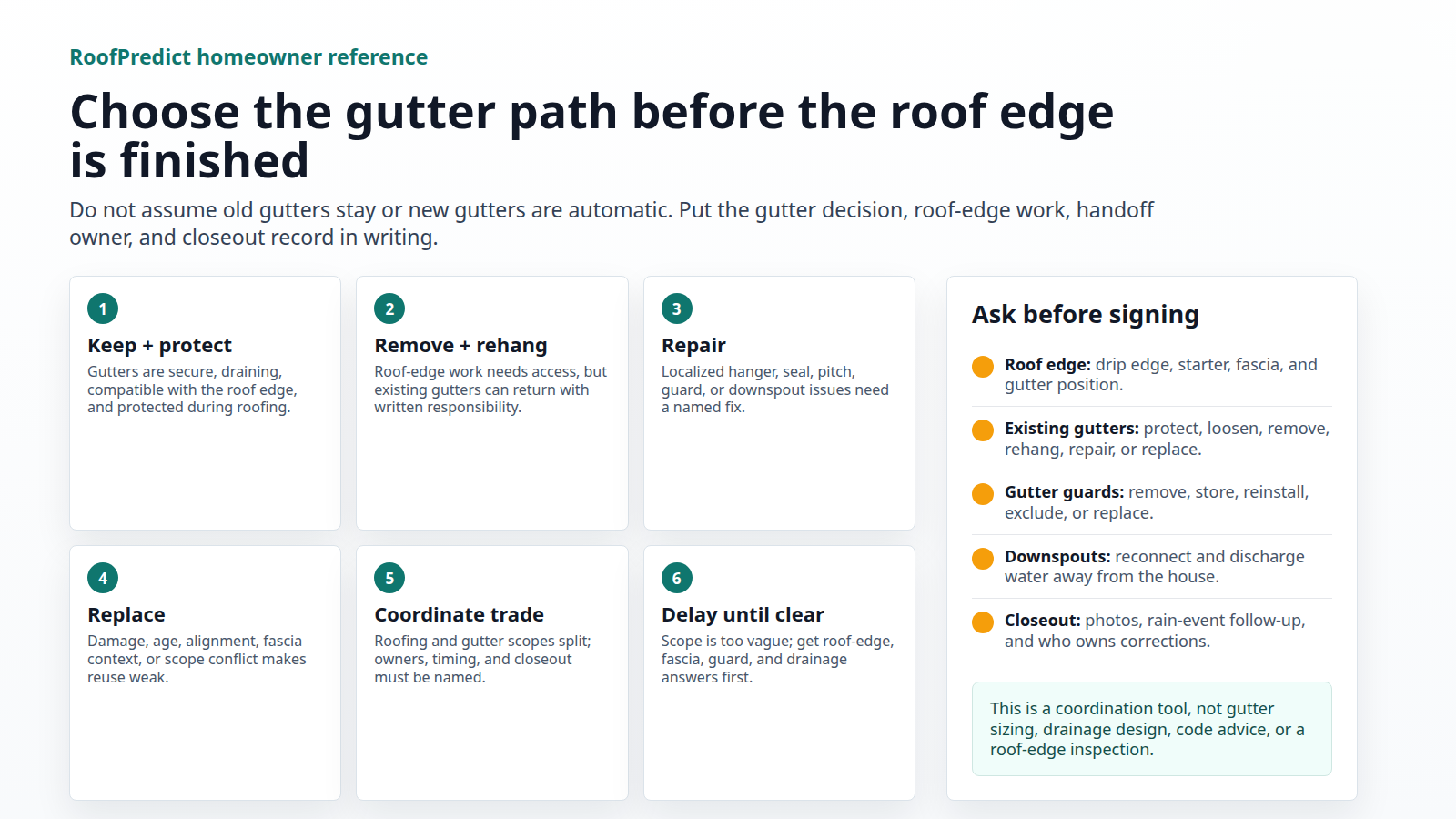
You do not automatically need to replace gutters when you replace a roof. You should review them at the same time because the roof edge, drip edge, fascia, gutters, downspouts, and drainage path all work together. The right answer may be keep and protect, remove and rehang, repair, replace, or coordinate with a separate gutter contractor.
Building America's roof edge protection guidance treats the roof edge as part of the water-control system, and its gutters and downspouts guidance explains that gutters and downspouts move rainwater down and away from the home. That does not mean every gutter must be replaced. It means the gutter question belongs in the roof-edge scope before work begins.
For roofing companies, that makes the gutter decision an operations issue as much as a sales issue. The rep, estimator, production manager, gutter partner, office coordinator, and closeout owner need the same roof-edge record so "gutters included," "protect gutters," or "rehang gutters" does not become a callback no one owns.
Sources checked: June 8, 2026.
The 60-Second Answer
Use six plain options:
| Option | Plain meaning | Best next question |
|---|---|---|
| Keep and protect | The existing gutters stay in place during roof work. | How will they be protected, and who documents damage? |
| Remove and rehang | The same gutters come off temporarily and go back after roof-edge work. | What is included in removal, storage, rehang, pitch check, and reconnecting downspouts? |
| Repair | A limited section, seam, hanger, outlet, or downspout gets fixed. | Which section is being repaired, with what parts, and by whom? |
| Replace | Existing gutter runs or downspouts are replaced. | What profile, material, hangers, outlets, elbows, color, guards, and discharge pieces are included? |
| Coordinate separate trade | The roofer and gutter contractor each own part of the project. | Who owns drip edge, fascia, gutter pitch, outlets, downspouts, guards, and closeout? |
| Delay with a written follow-up | The roof is urgent or gutter evidence is weak, so the gutter decision waits. | What temporary protection, photos, rain-event evidence, and follow-up date are written down? |
Those six options are more useful than asking, "Should I replace gutters with my roof?" The homeowner decision is rarely yes or no. It is usually a sequencing question: which gutter, fascia, drip-edge, drainage, and closeout steps belong before, during, and after the roof edge is rebuilt?
Keep, Repair, Replace, Or Coordinate?
Use this matrix before signing a roof contract.
| Path | When it may fit | What to put in writing |
|---|---|---|
| Keep and protect existing gutters | Gutters are secure, not leaking, aligned with the roof edge, compatible with the new drip edge, and downspouts discharge safely. | Who protects gutters during tear-off, who repairs accidental damage, and whether gutter guards are removed or left in place. |
| Remove and rehang | Gutters are usable, but roof-edge work, drip edge, fascia access, or gutter guards require temporary removal. | Removal, storage, reinstallation, sealant, fasteners, pitch/alignment check, and responsibility for damage. |
| Repair gutters | A limited issue exists: loose section, leaking seam, disconnected downspout, missing strap, minor impact damage, or one poorly draining run. | Exact section, repair method, parts, color-match limits, and whether the roofer or gutter contractor handles it. |
| Replace gutters | Gutters are rusted, cracked, sagging, pulling from fascia, poorly aligned, repeatedly overflowing, storm damaged, incompatible with roof-edge work, or tied to fascia/soffit replacement. | Gutter profile, material, gauge if applicable, hangers, downspouts, outlets, elbows, splash blocks, guards, color, and disposal. |
| Coordinate separate trade | The roofer does not install gutters, the drainage issue is complex, fascia/soffit repair is separate, or local stormwater routing matters. | Sequence, handoff date, who verifies drip edge/gutter relationship, and who owns water-flow testing after work. |
| Delay gutter decision | Roof is urgent, gutter evidence is weak, or the gutters need observation during rain. | Temporary protection plan, follow-up date, and photos or videos to collect from the ground. |
The decision should be based on condition and scope, not on a sales shortcut. Replacing gutters while the roof is open can be efficient when the roof edge, fascia, drip edge, or drainage path needs work. Keeping gutters can also be reasonable when they are sound and the roof contractor can protect them.
The Five-Minute Decision Ladder
If you are trying to decide before a sales call, use this ladder. It is not a technical inspection. It is a way to decide which conversation you need.
| Step | Question | If yes | If no |
|---|---|---|---|
| 1 | Are the gutters visibly loose, sagging, cracked, rusted, leaking, overflowing, or pulling from fascia from safe ground-level views? | Ask for repair or replacement scope before signing the roof contract. | Move to the roof-edge compatibility question. |
| 2 | Will the roof work change drip edge, starter, underlayment, fascia, soffit, gutter guards, or edge metal? | Ask whether gutters must be removed, protected, loosened, or rehung. | Move to water discharge. |
| 3 | Do downspouts discharge near foundation walls, walkways, basement windows, driveways, or neighboring property? | Ask for a downspout/discharge plan; do not assume new gutters fix the discharge point. | Move to trade ownership. |
| 4 | Does the roofer install gutters, or is another trade involved? | Ask for separate roof and gutter lines even if one company does both. | Ask for a handoff plan with dates and responsibilities. |
| 5 | Is there storm, insurance, warranty, HOA, or local drainage context? | Keep those records in separate lanes and ask process questions. | Keep the decision focused on condition, scope, and drainage. |
This ladder creates a starting answer:
- If the gutters are sound and do not block the roof edge, the likely conversation is protect and verify.
- If they are sound but must move for roof-edge work, the likely conversation is remove and rehang.
- If they have limited issues, the likely conversation is repair with defined sections.
- If they are failing, incompatible, or tied to fascia/soffit work, the likely conversation is replace or coordinate with a gutter contractor.
- If the roof is urgent but evidence is weak, the likely conversation is delay the gutter decision with a written follow-up plan.
Avoid the two bad shortcuts. Do not replace gutters only because the roof is being replaced. Do not keep gutters only because replacement feels like an upsell. The useful middle is to make the roof edge, water path, and trade ownership visible before the roof contract is final.
Roof-Edge Decision Scorecard
Use a scorecard when the gutter decision is stuck between "probably fine" and "replace everything." The score does not make the technical decision. It tells you which conversation needs to happen before signing.
| Factor | 0 Points | 1 Point | 2 Points |
|---|---|---|---|
| Visible gutter condition from safe ground view | Looks secure and continuous | One or two concerns such as loose strap, minor leak, or isolated sag | Multiple sagging, leaking, rusted, cracked, separated, or pulling sections |
| Roof-edge compatibility | Roofer says gutters do not block planned edge work | Temporary loosening or protection may be needed | Removal, rehang, drip edge, guard, fascia, or edge-metal conflict is likely |
| Fascia/soffit context | No visible concern and no contractor concern | Staining, gap, or limited concern needs review | Visible deterioration or contractor expects hidden work |
| Downspout discharge | Water appears to discharge away from vulnerable areas | One discharge point needs extension or observation | Multiple discharge points dump near foundation, walkways, driveways, or neighboring property |
| Trade ownership | One contractor owns roof/gutter scope clearly | Separate trade exists but handoff is written | Separate trade exists and handoff is vague |
| Records | Photos, estimate lines, closeout records are planned | Some records exist but not enough for closeout | No written protection, rehang, replacement, or follow-up record |
Interpret the score carefully:
| Total | What It Usually Means | Next Step |
|---|---|---|
| 0-3 | Keeping and protecting may be reasonable if the written scope is clear | Ask for baseline photos, protection method, and damage handling |
| 4-6 | The gutter decision needs a written clarification before signing | Ask for remove/rehang, repair, exclusion, or follow-up language |
| 7-9 | Replacement or separate-trade coordination may be worth pricing | Ask for a gutter scope, fascia/soffit boundary, and water-path plan |
| 10-12 | Do not treat gutters as a side note | Hold the roof-edge plan until responsibility, hidden conditions, and closeout records are clear |
The scorecard is most useful when two people disagree. A roofer may see roof-edge access problems. A homeowner may see gutters that look fine from the ground. A gutter contractor may care more about pitch, hangers, outlets, and discharge. Scoring each factor forces the conversation to separate condition, compatibility, drainage, ownership, and records.
Keep the score with the estimate. If the project changes during tear-off, update the score instead of arguing from memory.
The Roof-Edge Audit
Ask the contractor to walk through the roof edge in writing. A good roof-edge audit is not long. It should answer these questions:
Existing gutter condition:
Existing downspout condition:
Drip edge / roof-edge metal included:
Existing gutters block roof-edge work: yes / no / unknown
Gutter guards present: yes / no
Fascia or soffit concern: yes / no / unknown
Remove and rehang needed: yes / no / unknown
Separate gutter contractor needed: yes / no / unknown
Downspout discharge issue visible from ground: yes / no / unknown
Open items after roof completion:
The word unknown is allowed. It is better than a fake clean answer. If hidden fascia damage may appear after gutters are removed, say that. If gutter pitch cannot be evaluated until rehang, say that. If the roofer does not own gutter work, say who does.
Keep the audit close to the estimate. A roof contract that says "replace roof" and a verbal promise that "gutters will be fine" is weak. A roof contract that states existing gutters remain, roof-edge metal is included, gutter guards are excluded, accidental gutter damage is documented, and a separate gutter contractor handles pitch is much clearer.
The Roof-Edge Handoff
Most roof-and-gutter disputes come from a vague handoff. The roofer may own shingles, underlayment, drip edge, and roof-edge metal. The gutter contractor may own gutter pitch, outlets, hangers, elbows, and downspout extensions. A fascia or soffit repair may belong to either contractor or a third trade depending on the company. Before work starts, make the handoff explicit.
| Detail | Ask the roofer | Ask the gutter contractor | Record to keep |
|---|---|---|---|
| Drip edge and roof-edge metal | Is new metal included at eaves and rakes? Will existing gutters block access? | Will the gutter position work with the new roof-edge detail? | Estimate line, material note, roof-edge photo |
| Fascia and soffit | Is damaged fascia visible or suspected? Is repair included or excluded? | Will gutters be fastened to sound material? | Photos, repair allowance, exclusion note |
| Gutter hangers and attachment | Will roofing work disturb hangers or straps? | What hanger type and spacing are included if gutters are replaced? | Gutter estimate, material specification |
| Gutter guards | Must they be removed for roof-edge work? Who reinstalls them? | Are old guards compatible with the new gutter or roof edge? | Guard handling line item |
| Downspouts and discharge | Are extensions, splash blocks, or outlets moved during roof work? | Where will water discharge after the job? | Ground-level discharge photos |
| Closeout check | Who checks for obvious gaps, loose sections, or missing extensions? | Who handles pitch, seam leaks, and outlet flow? | Completion photos and open-items list |
This table does not replace a contractor's judgment. It gives the homeowner a simple way to prevent the roof estimate from silently excluding the gutter problem and the gutter estimate from silently excluding the roof-edge problem.
Owner Map: Who Owns Which Decision?
One reason gutters become confusing is that several parties can touch the same edge of the house. Write down who owns each decision before work starts.
| Decision | Usually needs input from | Written record |
|---|---|---|
| Existing gutter protection during tear-off | Roofer | Roof estimate or contract line |
| Temporary gutter removal | Roofer and/or gutter contractor | Removal/rehang scope and damage responsibility |
| Drip edge and roof-edge metal | Roofer | Roof material/scope line |
| Fascia or soffit repair | Roofer, carpenter, gutter contractor, or separate trade | Repair line, allowance, exclusion, or referral |
| Gutter pitch and hangers | Gutter contractor or roofer if they install gutters | Gutter estimate with hanger/spacing/material notes |
| Downspout extensions and discharge | Gutter contractor, yard/drainage contractor, drainage professional, or homeowner depending on complexity | Discharge plan and local/HOA caution |
| Gutter guards | Roofer, gutter contractor, or guard provider | Remove/reinstall/replace/exclude line |
| Insurance documentation if storm damage is involved | Homeowner, roofer for observations, insurer/agent for process | Photos, receipts, claim notes, insurer guidance |
| Warranty paperwork | Contractor and manufacturer documents | Product/workmanship warranty records |
| Final open-items list | Contractor responsible for the work | Closeout note and photos |
This owner map is not about blame. It prevents a handoff gap. If the roofer says gutters are by others, ask who confirms the new drip edge will work with the existing gutters. If the gutter contractor says fascia is by others, ask who confirms the fastening surface is sound. If downspouts discharge badly, ask whether the gutter contractor is solving only the downspout connection or the broader drainage route.
For RoofPredict, this is a natural packet structure: roof-edge scope, gutter scope, fascia/soffit notes, drainage photos, contractor messages, warranty paperwork, receipts, and open tasks. The product can keep the evidence together. It does not decide who is technically responsible or whether a drainage design is adequate.
Roof Edge Questions To Ask
Ask the roofer and, if needed, the gutter contractor:
- Will the roof work include drip edge at eaves and rakes where required or recommended?
- Do the existing gutters interfere with drip edge, starter, underlayment, leak barrier, fascia access, or tear-off?
- Are any gutters pulling away from fascia, bent, loose, corroded, leaking, or pitched poorly?
- Is fascia or soffit repair included or excluded?
- Will gutter guards be removed, reinstalled, replaced, or left alone?
- Are downspouts, outlets, elbows, splash blocks, and extensions included?
- Where will downspouts discharge after the roof work?
- Who is responsible if roof work damages existing gutters?
- Will the estimate include a water-flow check after reinstallation?
The Building America Solution Center gutter and downspout guidance explains that gutters and downspouts direct rainwater down and away from the home to reduce soil saturation around the foundation. The EPA downspout redirection guidance adds an important caution: downspout redirection may not fit every location, and homeowners should consider local regulations and where water will go to avoid property damage or unsafe conditions.
That means the gutter decision is not only "new or old." It is also "where does the water go?"
Map The Water Path From Roof To Ground
Do this from safe ground-level areas. You are not inspecting the roof. You are mapping where water is supposed to travel.
- Start at the roof plane. Which slopes drain toward each gutter run?
- Follow the gutter run. Is it continuous, sagging, leaking, blocked, or missing an outlet from what you can safely see?
- Find each outlet. Which downspout receives water from that run?
- Follow the downspout. Does it connect, terminate, discharge onto a roof below, dump near the foundation, cross a walkway, or point toward a neighbor?
- Photograph the discharge point. The ground-level destination matters as much as the roof-edge connection.
- Save old water evidence: splash marks, soil erosion, basement/crawlspace moisture notes, peeling paint, fascia staining, or recurring overflow videos during rain.
Use a simple table:
| Gutter run | Roof area draining to it | Downspout location | Discharge point | Open question |
|---|---|---|---|---|
| Front eave | Front main slope | Left corner | Splash block near walkway | Does extension need to move water farther away? |
| Rear eave | Rear slope and porch tie-in | Right rear | Yard slope toward fence | Any local/neighbor drainage concern? |
| Garage | Garage roof | Driveway side | Onto driveway | Is ice/slip risk or erosion a concern? |
This water-path map keeps the question practical. A new roof edge with poor discharge can still leave water near the foundation. New gutters without a downspout plan can still overflow at the wrong place. A downspout extension that solves one problem can create another if it sends water across a walkway, driveway, property line, or low area.
The EPA downspout guidance is useful here because it treats downspout redirection as location-specific. Water has to go somewhere. The useful question is not whether every homeowner should redirect downspouts the same way. The useful question is where the water will go and whether local, property, safety, or neighbor constraints apply.
Contractor Handoff Script
Use this when one company handles the roof and another handles gutters:
I want to avoid a handoff gap at the roof edge. Please confirm in writing:

1. Who owns drip edge and roof-edge metal?
2. Who owns gutter removal, storage, and rehang if needed?
3. Who confirms fascia or soffit is ready for gutter attachment?
4. Who owns gutter pitch, hangers, outlets, elbows, downspouts, and extensions?
5. Who handles gutter guards?
6. What happens if hidden fascia damage appears?
7. What photos or closeout notes will each contractor provide?
8. Who should I call if water overflows or drains poorly after the next rain?
This script is intentionally simple. It does not tell either contractor how to do the job. It asks them to identify responsibility. When responsibility is clear, the homeowner has fewer surprises after the roof is complete.
If one company handles both roof and gutters, still ask the same questions. A single company can have different crews, different warranties, and different exclusions for roof work and gutter work.
Gutter Guard Handoff Plan
Gutter guards need their own written line because they sit directly in the conflict zone between roof tear-off, roof-edge metal, old gutters, debris control, rehang work, and first-rain expectations. A homeowner may think of guards as part of the gutter. A roofer may see them as an obstruction. A gutter contractor may treat them as a separate product with its own warranty or fit limits. If nobody writes the guard plan down, the closeout conversation can get messy fast.
Start with one status label:
| Guard Status | What It Means | Written Question |
|---|---|---|
| Stay in place | Guards remain during roof work. | How will they be protected from tear-off debris and impact? |
| Remove and reinstall | Guards come off and go back on. | Who removes, stores, cleans, and reinstalls them, and what happens if clips or sections break? |
| Remove and discard | Guards are not reused. | Is disposal included, and is replacement priced separately? |
| Replace with gutters | Guards are part of a new gutter package. | What guard product, fit, color, warranty, and exclusions are included? |
| Separate review | Guard condition or compatibility is uncertain. | Who decides whether reuse is possible after roof-edge work? |
Then ask for a guard handoff row:
Gutter guard handling:
Existing guard type:
Affected gutter runs:
Remove before tear-off: yes/no/unknown
Storage method:
Cleaning/debris removal included:
Broken clip/section rule:
Reinstall owner:
Compatibility with new roof edge:
Compatibility with new gutters if replaced:
Warranty or product-document note:
First-rain follow-up owner:
This is not about choosing a guard product. It is about avoiding a scope gap. If the roofer removes guards but the gutter contractor owns reinstall, the handoff should say when the gutter contractor arrives and who stores the sections. If guards stay in place, the estimate should say who documents damage from falling debris. If guards are old, brittle, custom-cut, screwed through, or tied into the roof edge, the project may need a separate repair or replacement decision.
Use this table when guards are already installed:
| Guard Issue | Why It Matters During Roof Work | Scope Language To Request |
|---|---|---|
| Guards cover the gutter opening | Tear-off debris can collect on top or behind the guard. | Who cleans guards and gutter troughs after tear-off? |
| Guards fasten under or near roof-edge material | Roof-edge work may disturb the guard. | Who removes or reinstalls guards, and does the roof scope include it? |
| Guards are attached with clips or screws | Small hardware can break or disappear during removal. | What replacement clip or hardware rule applies? |
| Guards are custom-cut around corners or downspouts | Reinstall may not be as simple as putting sections back. | Which runs are guaranteed to be reinstalled, and which are conditional? |
| New gutters are proposed | Existing guards may not fit a different profile, size, or hanger layout. | Are guards reused, replaced, discarded, or excluded? |
| Existing guards have their own warranty | Removal or reuse may affect product terms. | Who reviews guard warranty or product instructions before removal? |
| Guards hide gutter condition | The gutter trough, hangers, or fascia may not be visible. | What hidden-condition rule applies after removal? |
Ask for photos before and after guard handling. Good guard photos are not dramatic. They show the run, corner, outlet, guard type, attachment method, and any section that was removed, damaged, discarded, or reinstalled. If a guard is not reinstalled, the packet should say why: broken section, incompatible new gutter, missing hardware, homeowner declined, separate trade needed, or excluded from the roof scope.
Do not let guards become a silent reason to replace gutters. Sometimes guards make replacement more practical. Sometimes they only need removal and careful reinstall. Sometimes they should be discarded because they are damaged, incompatible, or outside the scope. The homeowner needs the reason in writing, not a vague statement that "guards are a problem."
RoofPredict can store guard status as a separate field next to the gutter decision. That keeps guard removal, damage, storage, reinstallation, warranty notes, and first-rain follow-up visible. The product should not choose a guard system or decide whether reuse is technically correct. It should keep the handoff from vanishing after the roof is complete.
The Roof-And-Gutter Decision Note
Before the roof contract is signed, ask for a written decision note that names the gutter decision. This is the document that prevents "we talked about it" from becoming the only record.
Gutter decision:
Keep / protect / remove and rehang / repair / replace / separate trade / delay

Roof-edge work included:
Existing gutter handling:
Gutter guard handling:
Fascia/soffit handling:
Downspout/discharge handling:
Hidden-condition rule:
Photo record before work:
Photo record after work:
Closeout owner:
Rain-event follow-up if needed:
Use the note to catch weak scopes:
| Missing Field | Why It Matters | Fix |
|---|---|---|
| Gutter decision | Nobody knows whether gutters stay, move, or change | Choose one of the six decision paths |
| Existing gutter handling | Tear-off can damage or disturb gutters | State protection, removal, rehang, or exclusion |
| Guard handling | Guards can block access or fail to reinstall cleanly | State remove, reinstall, replace, or exclude |
| Fascia/soffit handling | Gutters need sound attachment | State included, excluded, allowance, or separate trade |
| Downspout/discharge handling | Water path may remain incomplete | State outlets, elbows, extensions, splash blocks, and discharge limits |
| Hidden-condition rule | Tear-off and removal can reveal damage | State unit price or change-order process |
| Closeout owner | Roof and gutter crews may each think the other owns final verification | Name who checks which items |
This decision note does not need to be a separate legal document. It can live as an estimate section, project note, or email summary if the contractor agrees and the contract references the same scope. The point is that every roof-and-gutter project should have one written answer to the same question: what happens to the roof edge and the water path before, during, and after roof work?
Keep-And-Protect Acceptance Test
Keeping existing gutters is a real scope decision. Treat it that way. If the gutters stay in place, the project should still have a baseline record, a protection plan, a closeout check, and a follow-up rule.
Use this acceptance test before you agree to keep the gutters:
| Acceptance item | What should be written down | Why it matters |
|---|---|---|
| Baseline condition | Ground-level photos of each gutter run, downspout, visible sag, guard, outlet, and discharge point before roof work. | Separates pre-existing issues from job damage. |
| Protection method | How gutters will be protected during tear-off, debris handling, ladder placement, and cleanup. | "Protect gutters" is too vague without a method. |
| Roof-edge access | Whether existing gutters block drip edge, starter, underlayment, fascia access, or edge metal. | A gutter that stays in place may still interfere with roof-edge quality. |
| Guard handling | Whether guards stay, come off, get cleaned, get damaged-at-owner-risk, or are excluded. | Guards often create disputes because they sit between roof and gutter work. |
| Damage rule | Who documents accidental damage and how repair responsibility is handled. | Prevents the closeout conversation from relying on memory. |
| Downspout status | Whether downspouts, elbows, extensions, and splash blocks stay connected or are restored after work. | A roof job can disturb discharge points even when gutter runs stay. |
| Closeout photos | Which contractor photos or homeowner ground photos will show the final roof edge and gutter condition. | Gives the homeowner a record before final payment. |
| Next-rain rule | What evidence to collect safely if overflow, dripping, or discharge problems appear later. | Some issues show only during rain. |
If the contractor cannot answer these items, keeping the gutters may still be possible, but the scope is not ready. The fix may be simple: add baseline photos, name the protection method, clarify guard handling, or schedule a rain-event follow-up.
Use this short acceptance card:
Existing gutters will stay: yes / no
Baseline photos saved:
Protection method:
Gutter guards:
Roof-edge access conflict: yes / no / unknown
Downspouts disturbed: yes / no / unknown
Damage documentation rule:
Closeout owner:
Next-rain follow-up:
The acceptance test protects the contractor too. If a gutter run was already sagging, the baseline record shows it. If tear-off damage happens, the damage rule shows how it will be handled. If water overflows after the next rain, the packet shows whether the problem is a new closeout issue, a pre-existing discharge issue, or an open question for a gutter contractor.
Remove-And-Rehang Acceptance Test
Remove and rehang sounds simple, but it can hide several different tasks. It may mean taking down existing gutters only long enough to complete roof-edge work. It may or may not include new hangers, sealant, pitch correction, guard handling, downspout reconnection, or replacement of damaged sections.
Before accepting a remove-and-rehang scope, ask for this level of detail:
| Rehang item | Ask for |
|---|---|
| Named runs | Which elevations or gutter runs come down. |
| Storage | Where gutters and guards will be stored and who protects them from bending or damage. |
| Hangers and fasteners | Whether old hangers are reused, replaced, supplemented, or excluded. |
| Sealant and seams | Whether obvious open seams are checked or whether seam repair is excluded. |
| Pitch/alignment | Whether the contractor checks obvious slope and alignment after rehang. |
| Downspouts | Whether outlets, elbows, straps, extensions, and splash blocks are reconnected. |
| Guards | Whether guards are removed, stored, reinstalled, replaced, or excluded. |
| Damaged sections | What happens if a section is too bent, brittle, rusted, or cracked to rehang cleanly. |
| Closeout record | Photos of rehung runs, downspout reconnections, and open items. |
Use this wording when the estimate is vague:
Please clarify whether remove and rehang includes only temporary removal,
or whether it also includes reinstallation details such as hangers, seams,
pitch/alignment check, downspout reconnection, guard handling, and closeout photos.
Do not treat remove and rehang as a cheaper version of replacement. It is a coordination path. It keeps usable gutters in service while giving the roofer access to the edge. If the existing gutters are already failing, remove and rehang may only delay the real decision. If the existing gutters are sound, remove and rehang can be the clean middle path between overbuying and under-coordinating.
What New Gutters Do Not Solve By Themselves
New gutters can help when the existing gutters are damaged, underspecified for the project, poorly attached, or incompatible with roof-edge work. They do not automatically solve every water problem around a home.
Do not treat gutter replacement as a cure-all for:
- roof leaks caused by flashing, penetrations, valleys, decking, or roof-covering problems;
- rotten fascia or soffit that needs repair before gutters can be attached securely;
- downspouts that still discharge against the foundation, walkway, driveway, or neighbor's property;
- grading, soil, basement, crawlspace, or foundation drainage issues;
- ice-dam risk tied to attic air leakage, insulation, ventilation, snow, and roof geometry;
- claim, warranty, or code questions that need the insurer, manufacturer, local official, or qualified contractor.
The practical question is narrower: will the gutter plan support the new roof edge and move water to an appropriate discharge point after the roof work is complete?
Special Situations That Change The Gutter Question
Some homes need extra coordination. Do not let the article become a universal yes/no answer.
| Situation | Why it changes the question | What to ask |
|---|---|---|
| Gutter guards | Guards can block roof-edge access, complicate tear-off, or fail to fit after changes | Who removes, stores, reinstalls, replaces, or excludes the guards? |
| Fascia damage | Gutters need sound attachment; hidden rot may appear after removal | Is fascia repair included, excluded, or priced by unit/change order? |
| Multiple roof layers | Tear-off debris and access can affect existing gutters | How will gutters be protected, and what damage documentation applies? |
| Steep roof or tall eaves | Access and safety may affect sequencing | Does the contractor need gutters removed before roof work? |
| Metal roof or specialty edge | Gutter placement and roof-edge details may differ from asphalt shingle assumptions | Who confirms compatibility with the roof system? |
| Solar, satellite, skylight, or chimney work | Other trades or penetrations may affect drainage and timing | What work happens before gutters are final? |
| HOA or historic district | Exterior color/profile/material rules may apply | What approval is needed before replacing visible gutters? |
| Basement or crawlspace moisture history | Downspout discharge may matter more than gutter replacement | Should a drainage professional, yard/drainage contractor, or foundation specialist review discharge? |
| Storm-damage context | Roof, gutter, siding, fascia, and interior records may need separate documentation | What photos and receipts should be saved for insurer/agent process questions? |
These situations do not automatically mean replace gutters. They mean the gutter question is bigger than a material line. It may involve schedule, access, local rules, hidden conditions, other trades, and documentation.
Overbuying And Under-Coordinating
Homeowners usually run into one of two mistakes.
The first mistake is overbuying: replacing gutters because it sounds efficient, even when the existing gutters are sound, compatible, and easy to protect. This can add cost without solving a real problem.
The second mistake is under-coordinating: keeping gutters because they look fine from the ground, while the roof-edge work, fascia access, drip edge, gutter guards, or downspout discharge plan is vague. This can create conflict after the roof is complete.
Use this decision rule:
Replace when condition, compatibility, or drainage justifies it.
Keep when condition and compatibility are documented.
Remove and rehang when access requires it.
Coordinate when different trades own different parts of the edge.
Delay only with a written follow-up plan.
That rule is more useful than a blanket recommendation. It also creates a better article lane for RoofPredict: the product helps organize evidence and follow-ups around the roof edge. It does not push every homeowner into the same gutter decision.
Estimate And Contract Boundaries
The gutter decision needs a written scope. The FTC home improvement guidance says written estimates should include work description, materials, completion date, and price. It also recommends multiple estimates, license and insurance checks where available, careful contract review, and caution around pressure, full payment up front, cash-only payment, and required permits shifted to the homeowner.
For a roof-and-gutter project, ask for separate lines:
- roof tear-off and replacement;
- drip edge and roof-edge metal;
- fascia or soffit repair;
- gutter removal and rehang;
- gutter replacement;
- downspout replacement or extension;
- gutter guard handling;
- disposal;
- change-order rules if hidden fascia damage appears.
Useful scope language is plain:
- "Existing gutters to remain. Roofer will protect gutters during tear-off and document accidental damage."
- "Existing gutters to be removed and rehung after roof-edge work. Rehang includes hangers, sealant check, pitch/alignment check, and reconnecting downspouts."
- "Gutter replacement is by separate contractor after roof completion. Roofer owns drip edge and roof-edge metal; gutter contractor owns gutter pitch, outlets, and downspout extensions."
- "Hidden fascia damage is excluded except for the listed unit price and written homeowner approval."
Avoid vague language such as "gutters included" or "we will handle drainage." Those phrases do not say which gutters, which downspouts, which accessories, which hidden conditions, or which contractor owns closeout.
If storm damage or a possible claim is involved, document roof and gutter damage separately. The NAIC homeowners claim guidance supports deductible awareness, photos and videos, damaged-property lists, insurer or agent contact if filing, and receipts. It does not say gutters are covered whenever a roof is covered.
Estimate Red Flags Specific To Gutters
Some vague lines are easy to miss because they sound normal. Slow down when you see these:
| Red flag | Why it is weak | Better request |
|---|---|---|
| "Gutters included" | It does not say keep, remove, rehang, repair, replace, guards, downspouts, or discharge. | Separate roof, gutter, downspout, guard, fascia, and discharge lines. |
| "Protect existing gutters" | Protection can mean almost anything. | Define pre-existing photo record, protection method, and accidental-damage handling. |
| "Rehang existing gutters" | Rehang may exclude sealant, hangers, pitch, downspouts, guards, and damaged sections. | Name the runs, reconnection, obvious pitch/alignment check, and exclusions. |
| "Fascia extra" | Hidden conditions may become a price dispute. | Unit price or change-order process with photo and homeowner approval. |
| "Downspouts by others" | The water path may be left unfinished. | State who reconnects outlets, elbows, extensions, splash blocks, and discharge points. |
| "Gutter guards handled" | Removal, storage, compatibility, and damage responsibility are unclear. | Remove/reinstall/replace/exclude guard handling explicitly. |
| "Drainage corrected" | Gutter contractors may not be designing broader site drainage. | Ask exactly what changes: gutter run, outlet, downspout, extension, splash block, or referral. |
| "Permit/code included" | Local requirements vary and may not apply the way a salesperson says. | Ask who verifies local requirements and where the answer is documented. |
Red flags do not prove a contractor is bad. They show where the written scope is not specific enough yet. A good contractor can often fix the issue with a clearer estimate line.
Sample Estimate Lines To Request
Use these examples to make the scope concrete. They are not contract language for every job. They show the level of specificity to ask for.
| Scenario | Weak wording | Better wording to request |
|---|---|---|
| Existing gutters stay | "Protect gutters" | Existing gutters to remain. Contractor will use reasonable protection during tear-off, note pre-existing damage before work, and document accidental damage with photos. |
| Remove and rehang | "Rehang gutters" | Remove existing gutter runs at named elevations, store on site, reinstall after roof-edge work, reconnect downspouts, check obvious pitch/alignment, and document damaged sections. |
| Gutter replacement | "New gutters included" | Install specified gutter profile/material/color at named elevations with hangers, outlets, elbows, downspouts, extensions/splash blocks, disposal, and exclusions listed. |
| Fascia uncertainty | "Fascia extra if needed" | Hidden fascia repair excluded except at listed unit price or written change order after photo documentation and homeowner approval. |
| Gutter guards | "Guards handled" | Remove/reinstall existing guards, replace guards, or exclude guard handling; state compatibility limits and damage responsibility. |
| Separate trade | "Gutters by others" | Roofer owns roof-edge metal/drip edge; gutter contractor owns gutter pitch/hangers/outlets/downspouts; homeowner coordinates installation after roof completion. |
| Drainage follow-up | "Downspouts connected" | Downspouts reconnected to existing discharge points; extensions/splash blocks included or excluded; local drainage concerns not evaluated unless separately stated. |
The exact wording can vary. What matters is that the estimate names the elevation or run, the work, the material, the excluded items, the hidden-condition rule, and the record you will receive.
Common Mismatches To Catch Early
Many roof-and-gutter problems are not caused by a bad decision to keep or replace. They are caused by a mismatch between two good decisions that were never coordinated.
| Mismatch | Example | How To Catch It |
|---|---|---|
| New roof edge, old gutter position | The roof gets new drip edge, but existing gutters sit too high, too low, or too tight for clean edge work | Ask whether gutters block edge work or need removal/rehang |
| New gutters, old fascia concern | New gutters are proposed, but fascia condition is uncertain | Ask who approves attachment surface and how hidden fascia damage is priced |
| Gutter guards, roof tear-off | Existing guards make tear-off or cleanup difficult | Ask who removes, stores, reinstalls, replaces, or excludes guards |
| Downspout extension missing | New gutters are installed, but water still dumps near a foundation or walkway | Ask where each downspout discharges after closeout |
| One contractor, two scopes | Same company sells roof and gutters, but warranties, crews, and exclusions differ | Ask for separate roof and gutter lines anyway |
| Separate contractors, no handoff | Roofer finishes edge work, gutter contractor arrives later, and each assumes the other checked compatibility | Ask for the handoff date, scope owner, and closeout owner |
| Storm file mixed together | Roof, gutter, siding, and interior photos are all saved as one vague damage folder | Save roof, gutter, fascia, siding, interior, and receipts as separate records |
Catch these mismatches before work begins. The fix is usually a clearer line item, not a dramatic change in plan. The homeowner does not need to solve the technical detail. The homeowner needs to make sure the right contractor owns the next step.
A Photo Packet For Roof-And-Gutter Decisions
Take safe photos before the job and ask contractors for labeled photos during/after the job. Do not climb ladders or roofs.
| Photo | Who can usually provide it | Why it helps |
|---|---|---|
| Front, rear, and side gutter runs from the ground | Homeowner | Shows baseline condition and obvious sagging/disconnection |
| Downspout discharge points | Homeowner | Shows where water goes after leaving the roof edge |
| Fascia/soffit stains or gaps visible from ground | Homeowner | Gives contractor a pre-work question without homeowner diagnosis |
| Gutter guard condition | Homeowner or contractor | Clarifies whether guards need handling |
| Drip edge / roof-edge work during install | Roofer | Shows roof-edge scope if gutters are removed or accessible |
| Hidden fascia damage | Roofer or gutter contractor | Supports change-order discussion |
| Reinstalled or replaced gutters | Responsible contractor | Supports closeout record |
| Splash blocks/extensions reconnected | Responsible contractor or homeowner from ground | Confirms discharge setup was not forgotten |
File names can be simple:
2026-05-29-front-gutter-baseline.jpg
2026-05-29-left-downspout-discharge.jpg
2026-05-29-rear-fascia-stain-question.jpg
2026-05-29-roofer-drip-edge-photo.jpg
2026-05-29-gutter-rehang-closeout.jpg
Keep original photos. If you mark up a copy, save the original too. A contractor photo with a label is stronger than an unlabeled close-up of metal or fascia.
Sequence The Work
The best gutter answer can change based on timing. Before tear-off, the roofer should explain whether existing gutters will stay in place, be loosened, be removed, or be protected. If gutter guards are present, ask whether they block roof-edge access or need separate handling. If the estimate says "protect existing gutters," ask what protection means in practice and how damage will be documented.
During roof work, the key question is responsibility. A roofer may install drip edge and shingles but exclude gutter pitch, seam repair, hangers, outlets, and downspout extensions. A gutter company may replace runs and downspouts but not repair fascia or evaluate roofing details. Those boundaries are normal only when they are clear. The problem is a vague handoff where each trade assumes the other trade will verify water movement after the roof is complete.
After the roof work, ask for a basic closeout check from the responsible contractor: are gutters secured, are fasteners in place, do downspouts connect, are splash blocks or extensions returned, are obvious leaks or gaps noted, and are photos available for your records? If the contractor cannot verify water flow without rain or a controlled test, write down what follow-up evidence you need to collect from the ground during the next safe rain event.
This sequence does not turn a homeowner into an inspector. It gives the homeowner a record of who owns each roof-edge and drainage question.
Four Common Homeowner Scenarios
The roof quote includes gutters, but the reason is unclear
Ask whether the gutters are being replaced because they are damaged, incompatible with roof-edge work, blocking access, tied to fascia repair, or simply bundled into the project. If the answer is "we usually do both," ask for the condition and scope reason. Bundling can be convenient, but convenience is not the same as necessity.
The roofer wants to remove gutter guards
Ask whether guards block tear-off, underlayment, drip edge, starter, or cleanup. Then ask who removes them, where they are stored, whether they are compatible with the finished roof edge, and who is responsible if they are damaged. Old guards may not reinstall cleanly. That should be known before the roof work starts.
Fascia damage appears after tear-off or gutter removal
Ask for photos, the location, whether the damage was visible before work, who owns the repair, and whether the contract has a unit price or change-order process. Do not let "bad fascia" stay as a verbal phrase. It needs a location, photo, price rule, and approval step.
Insurance is involved for the roof, but gutters are uncertain
Keep roof, gutter, siding, fascia, and interior records separate. A roofer can document observations and scope. The insurer or agent handles claim process and coverage questions. Save photos, receipts, estimates, and messages, but do not assume gutter coverage follows roof coverage.
Closeout: What To Verify Before The Last Payment
Before final payment, ask for a closeout list. The homeowner should not climb or perform technical inspection, but the responsible contractor can confirm what was completed and what remains open.
| Closeout item | Ask |
|---|---|
| Gutters that stayed | Were they damaged, loosened, or altered during roof work? |
| Gutters removed and rehung | Were they reattached, sealed where applicable, aligned, and reconnected to downspouts? |
| New gutters | What profile, material, color, hangers, outlets, elbows, and downspouts were installed? |
| Fascia/soffit | Was any hidden damage found, repaired, excluded, or referred to another trade? |
| Drip edge / roof-edge metal | What roof-edge work was completed before gutter closeout? |
| Gutter guards | Were they removed, reinstalled, replaced, damaged, or excluded? |
| Downspouts | Are extensions, splash blocks, or discharge points restored as agreed? |
| Photos | Which photos show completed edge/gutter work? |
| Documents | Which invoice, warranty, receipt, change order, permit, or open-item note should stay in the packet? |
If water-flow verification depends on rain, write that down. The next safe rain event can provide ground-level photos or videos of overflow, leaks, or discharge concerns. Do not climb during rain. Do not stand under active roof runoff or near electrical hazards. The record should show what was verified at closeout and what still needs observation.
What To Do If The Roof Is Done But Gutters Still Look Wrong
Sometimes the roof is finished and the gutter question is still unresolved. Slow down and separate facts from conclusions.
- Photograph the concern from the ground.
- Write the location: front left, rear right, garage, porch, upper/downspout side.
- Describe the visible issue without diagnosing it: loose section, dripping seam, disconnected downspout, missing extension, water behind gutter, bent guard, fascia gap.
- Check the contract: was gutter protection, rehang, replacement, or exclusion written?
- Contact the responsible contractor with the photo and contract line.
- If another trade owns the issue, ask for that handoff in writing.
- Keep receipts, messages, and closeout notes in the roof packet.
Do not assume the roofer caused every gutter concern. Do not assume the gutter contractor owns every roof-edge detail. The point of the packet is to identify the correct owner of the next question.
Rain-Event Follow-Up Log
Some gutter issues only appear during rain. If the contractor says water flow cannot be fully verified at closeout, create a rain-event log.
Rain date:
Approximate time:
Observed from:
Gutter run:
Downspout:
Discharge point:
What I saw:
Photo/video saved:
Safety concern:
Contractor contacted:
Open question:
Use neutral observations:
- "water overflowed at front left gutter near porch";
- "rear downspout extension was not connected";
- "water discharged onto driveway";
- "drip seen behind gutter at garage";
- "no visible overflow from ground during moderate rain."
Avoid conclusions you cannot prove from the ground:
- "gutter pitch is wrong";
- "roofer installed drip edge incorrectly";
- "new gutters failed";
- "insurance should cover it";
- "fascia is rotten."
The log keeps the next call factual. It also helps RoofPredict hold the project record: estimate, roof-edge scope, gutter scope, closeout photos, rain-event evidence, contractor messages, and open tasks.
Save one short video only when it is safe from a dry, protected place. A ten-second video of overflow from a doorway or window can be more useful than twenty close photos. Do not stand under runoff, walk on wet surfaces, or use a ladder during rain. Note whether the rain was light, steady, or heavy, and whether wind was pushing water sideways. Add the video to the same packet as the estimate and closeout photos. Keep the original file name if possible, then add a plain label with the gutter run and downspout location for follow-up. Include the date, time, and direction you were facing when recording the issue from indoors or a covered doorway. Send the clip with your question, not as a conclusion. Keep it boring and factual.
Two-Week Follow-Up: Separate Annoyance From Scope Problem
After roof work, small gutter concerns can show up in the first week or two. Some are simple cleanup or adjustment items. Others point back to a scope gap that should have been written before the job started. The homeowner's job is not to diagnose the system. The homeowner's job is to preserve the record and ask the right owner the next question.
Use this sorting table before sending a message:
| What you notice from the ground | First record to check | Who usually gets the first question | How to phrase it |
|---|---|---|---|
| Loose extension, missing splash block, or disconnected elbow | Closeout photos and downspout/discharge line | Contractor responsible for downspout closeout | "Can you confirm whether this discharge piece was included and whether it should be restored?" |
| Water spilling over one gutter run during rain | Rain-event video, gutter run label, and closeout notes | Gutter owner or roofer if they handled rehang | "Here is a safe ground-level video of overflow at this run. Who should review the connection, debris, or rehang status?" |
| Water dripping behind gutter near the roof edge | Roof-edge photos, drip edge line, rehang/protection language | Roofer first if the question involves roof-edge work | "Can you confirm whether the finished roof edge and existing gutter position were reviewed at this location?" |
| Bent guard, missing guard section, or guard not sitting as before | Guard handling line and before/after photos | Party named for guard removal/reinstall | "The guard record shows this section was to be reinstalled. Can you compare it with the before photo?" |
| Fascia gap or damaged trim visible after work | Fascia/soffit line, hidden-condition rule, closeout photos | Contractor named for fascia/soffit or the party who exposed it | "Is this an open fascia item, a pre-existing condition, or a separate trade issue?" |
| New discharge point causing walkway or foundation concern | Downspout/discharge plan and EPA/local caution notes | Gutter contractor or drainage professional, depending on scope | "Where was this discharge point intended to send water, and does it need a follow-up plan?" |
Do not combine all concerns into one emotional message. Send one short note with the photo, location, contract line if you have it, and the question. If there are several locations, number them by gutter run or downspout. That makes it easier for the contractor to answer and harder for the project record to collapse into memory.
Also separate annoyance from scope. A missed splash block may be a closeout item. A hidden fascia repair may be a change-order item. A discharge problem may be outside the original gutter scope. A roof-edge leak concern may need a roof contractor review before anyone blames the gutter. The written record should show which lane each issue belongs to.
For RoofPredict, this follow-up phase is important because it closes the loop on the original property report. The same packet can hold the roof estimate, gutter estimate, before photos, closeout photos, rain-event log, contractor replies, receipts, and open items. A homeowner gets a calmer next step. A roofing company gets fewer vague callbacks. The record stays useful for warranty, maintenance, future sale, or later storm documentation without turning the homeowner into an inspector.
If The Roof Quote Bundles Gutters Into One Price
Bundled roof-and-gutter quotes can be convenient, but they need the same clarity as separate quotes. A single total price should not hide which crew owns the gutter decision, which materials are included, whether old gutters are removed, how hidden fascia is handled, and what happens after the first rain.
Ask the contractor to split the bundle into reviewable parts:
| Bundle item | What to ask for |
|---|---|
| Roof scope | Shingle system, underlayment, drip edge, starter, edge metal, tear-off, disposal, ventilation if relevant, and roof warranty documents |
| Gutter scope | Gutter profile, material, color, hanger type, outlets, elbows, downspouts, extensions, splash blocks, guards, and disposal |
| Existing gutter handling | Keep/protect, remove/rehang, repair, replace, coordinate separate trade, or delay with follow-up |
| Fascia/soffit status | Included, excluded, allowance, separate trade, or unknown until gutters/roof edge are opened |
| Damage rule | Who documents and repairs accidental damage to existing gutters or guards |
| Closeout rule | Which photos, invoice lines, warranty records, and first-rain follow-up notes will be provided |
The goal is not to force two separate contracts. The goal is to make the bundled price explain itself. If gutters are included because the existing runs are failing, the estimate should say that. If gutters are included because removal makes roof-edge work cleaner, the estimate should say that. If gutters are included because the company prefers to sell both together, the homeowner still needs a condition and scope reason before treating replacement as necessary.
Use this question:
Can you split the roof-and-gutter bundle into roof scope, gutter scope, fascia/soffit assumptions, existing-gutter handling, damage responsibility, and closeout records so I can compare it fairly?
That question is especially useful when another roofer quotes the roof only. A roof-only quote may be incomplete for a home with failing gutters. A bundled quote may be overpriced or underspecified. The fair comparison is not bundle versus no bundle. The fair comparison is written scope versus written scope.
Hidden Fascia And Attachment Rule
Gutters need a sound attachment surface. Fascia, rafter tails, trim, or other edge materials can be hidden partly by gutters, gutter guards, drip edge, or old repairs. A homeowner should not assume hidden fascia is fine, and a contractor should not leave hidden fascia as an unlimited surprise.
Ask for a hidden-condition rule before work begins:
| Hidden condition | Written rule to request |
|---|---|
| Rotten or soft fascia found after gutter removal | Photo, location, repair owner, price rule, and approval step |
| Fascia stain but no confirmed rot | Note whether repair is included, excluded, or referred |
| Gutter cannot fasten securely | Who pauses work, who approves repair, and whether a gutter contractor or carpenter is needed |
| Drip edge or roof-edge metal conflicts with gutter position | Who decides whether gutter removal/rehang is needed |
| Gutter guards conceal the edge | Who removes guards, stores them, and decides whether reinstall is possible |
The phrase "bad fascia" is not enough. Ask for the location, photo, repair owner, and price rule. If the contractor cannot know until removal, write that down. Unknown is acceptable when the approval path is clear.
Do not let hidden fascia turn into a blame argument. It may be pre-existing, storm-related, age-related, water-path-related, or exposed by necessary work. The record should focus on what was found, who can fix it, what it costs, and whether the roof/gutter sequence needs to change.
First-Rain Acceptance Criteria
Some gutter problems cannot be fully judged on a dry closeout day. A first-rain check gives the homeowner and contractor a practical follow-up point without asking anyone to climb or inspect unsafely.
Before final closeout, write the first-rain rule:
If safe rain conditions occur within the first 30 days, homeowner will document gutter overflow, dripping behind gutter, disconnected downspout, missing extension, or unsafe discharge from ground level or indoors. Contractor will review photos/videos tied to the contract line and identify whether the item is included closeout, warranty/workmanship follow-up, maintenance, separate trade, drainage issue, or outside original scope.
Keep the acceptance criteria narrow:
- Gutters should be attached and visibly continuous from safe ground views.
- Downspouts and extensions included in the scope should be connected.
- Removed/reinstalled guards should match the agreed handling rule.
- Splash blocks or extensions included in the scope should be placed.
- Any overflow, drip-behind-gutter, or discharge concern should be tied to a gutter run and downspout location.
- The contractor should identify whether debris, pitch, outlet sizing, edge position, guard condition, discharge location, or separate drainage work is the next question.
This does not guarantee perfect water behavior during every storm. Heavy rain, wind, debris, ice, roof geometry, grade, and local drainage can all matter. The point is to avoid a vague callback. A first-rain note turns "the gutters still seem wrong" into location, evidence, contract line, and next owner.
Maintenance And Timing
If you are not replacing gutters, ask how they will be maintained after the roof work. NRCA's homeowner resources describe homeowner maintenance through seasonal checks and cleaning gutters filled with leaves and debris. A new roof can still have drainage problems if debris, poor discharge, damaged fascia, or misaligned gutters remain.
Timing also matters. If gutters are replaced before roofing, they may be exposed during tear-off. If gutters are replaced after roofing, the roofer and gutter contractor need to agree on drip edge and fascia details. If both are handled by one contractor, the estimate should still separate the roof and gutter scopes.
A One-Page Roof-And-Gutter Worksheet
Copy this into your project notes before signing.
Project address:
Roof contractor:
Gutter contractor if separate:
Roof start date:
Gutter work date:

Existing gutter condition:
Existing downspout condition:
Gutter guards present:
Fascia/soffit concerns:
Drip edge / roof-edge metal included:
Gutters interfere with roof work: yes / no / unknown

Decision:
Keep and protect / remove and rehang / repair / replace / separate trade / delay

Roof estimate lines:
Gutter estimate lines:
Fascia/soffit lines:
Downspout/discharge lines:
Gutter guard lines:
Hidden-condition/change-order rule:

Photos saved:
Open questions:
Closeout documents expected:
Rain-event follow-up needed:
This worksheet is a practical RoofPredict packet seed. It gives the contractor and homeowner the same structure for scope, photos, estimates, receipts, and open tasks.
Safety Boundary
Do not climb ladders or roofs to inspect gutters for a roof estimate. OSHA's roof inspection, tarping, and repair guidance describes hazards involving ladders, raised surfaces, steep or slippery surfaces, deteriorated roofs, tools, power lines, and fall protection.
Use safe evidence: ground-level photos, photos from windows only when safe, interior water-stain photos, downspout discharge photos from the ground, old invoices, inspection reports, and contractor photos.
Where RoofPredict Fits
RoofPredict is built around property intelligence for roofing teams: roof age, storm exposure, scored routes, branded homeowner reports, and CRM-connected inspection opportunities. For a roof-and-gutter conversation, that context can help a roofing company show up with a clearer property report and a more specific inspection conversation instead of a generic pitch.
That matters because roof-and-gutter decisions are often split across trades. The roofer talks about roof edge and fascia access, the gutter company talks about pitch and outlets, and the homeowner may have storm dates or drainage photos. A better property report does not decide the gutter scope, but it can give the contractor and homeowner a cleaner starting point for the inspection, estimate, and follow-up questions.
RoofPredict does not design drainage, size gutters, inspect fascia, verify damage, decide repair or replacement, approve safety, interpret warranties, choose contractors, or decide insurance coverage.
For Roofers: Make The Roof Edge A Production Handoff
Roofers can use this checklist as a company standard, not only as homeowner education. The roof edge is where sales promises, tear-off access, drip edge, fascia, gutter guards, downspouts, separate trades, and first-rain expectations collide. If those items are not written before production, the company often pays for the ambiguity later through callbacks, unhappy reviews, supplement confusion, or office time spent reconstructing what was said.
Use a roof-edge handoff record for every replacement where gutters, guards, fascia, soffit, downspouts, or drainage concerns come up:
| Company Role | What To Capture | Why It Matters |
|---|---|---|
| CSR or intake coordinator | Homeowner words about leaks, overflow, sagging, guards, storm date, basement moisture, or prior gutter work | Keeps symptoms separate from diagnosis and gives the estimator a focused field check |
| Sales rep | Baseline gutter photos, roof-edge access limits, guard status, fascia/soffit concern, downspout discharge, and whether gutters are keep/protect, remove/rehang, repair, replace, separate trade, or delayed | Prevents a vague roof-only estimate from swallowing a roof-edge problem |
| Estimator | Separate roof, gutter, guard, fascia, downspout, disposal, hidden-condition, and closeout lines where relevant | Makes bundled pricing reviewable without forcing the company into unnecessary gutter replacement |
| Production manager | Which runs stay, which come down, where removed sections or guards are stored, what hidden conditions trigger approval, and which crew owns closeout photos | Reduces field improvisation during tear-off |
| Gutter partner or crew | Gutter profile, hangers, outlets, elbows, extensions, guard handling, pitch/alignment review, and first-rain follow-up owner | Keeps gutter work from being treated as a loose add-on after the roof is finished |
| Office follow-up | First-rain log, callback owner, warranty/workmanship lane, maintenance lane, separate-trade lane, and open-item status | Turns "the gutters still look wrong" into a location, record, and next owner |
This standard also helps with directory and profile trust signals. A roofing company can show that it documents roof-edge conditions, separates roof and gutter scope, writes hidden fascia rules, labels guard handling, and owns closeout records. Those are stronger claims than saying "we do gutters too." They describe a process a customer, production team, and future reviewer can understand.
Keep the claim narrow. A roof-edge handoff does not prove drainage design, gutter sizing, storm causation, code compliance, warranty eligibility, or insurance coverage. It proves the company identified the roof-edge decision, wrote the scope status, captured the evidence, and named the next owner.
Checklist Before Signing
Use this checklist before you decide:
- Photograph gutters, downspouts, discharge points, water stains, and fascia from safe ground-level areas.
- Ask whether gutters interfere with roof-edge work.
- Ask whether drip edge, fascia, soffit, gutter guards, and downspouts are included or excluded.
- Ask if gutters will be protected, removed and rehung, repaired, replaced, or handled by a separate contractor.
- Ask where downspouts will discharge after work.
- Ask whether local drainage, HOA, permit, or stormwater rules may apply.
- Ask who is responsible for damage to existing gutters during roofing.
- Get roof and gutter scopes as separate estimate lines.
- Compare written estimates by materials, completion date, price, and exclusions.
- Keep storm or claim documentation separate from contractor scope.
- Do not climb ladders or roofs.
- Keep photos, estimates, receipts, warranty documents, and follow-up notes organized so the roofer, gutter contractor, insurer, or warranty administrator can see the same record.
Source Limits
| Source | Use it for | Do not use it for |
|---|---|---|
| Building America roof-edge and gutter guides | Roof-edge water-control context and gutter/downspout purpose. | Project-specific installation approval, local code interpretation, drainage design, or warranty decision. |
| EPA downspout guidance | Downspout redirection and local/property-damage cautions. | Gutter sizing, drainage design, or legal advice. |
| NRCA resources | Maintenance context and gutter/debris awareness. | Replacement criteria or contractor endorsement. |
| FTC | Written estimates, contracts, license/insurance checks, payment and pressure red flags. | Roofing or gutter technical judgment. |
| NAIC | Claim documentation and insurer or agent contact. | Coverage promise or scope decision. |
| OSHA | Roof and ladder hazard boundary. | Homeowner roof or gutter work training. |
| RoofPredict | Property intelligence, roof age, storm exposure, branded homeowner reports, and inspection workflow context for roofing teams. | Drainage design, gutter sizing, damage verification, safety approval, coverage, warranty, or contractor selection. |
FAQ
Should gutters always be replaced with a roof?
No. Gutters should be reviewed during roof replacement, but the right path may be keep and protect, remove and rehang, repair, replace, coordinate a separate gutter contractor, or delay with a written follow-up plan.
Can old gutters be reused after roof replacement?
Sometimes. Reuse may fit if the gutters are secure, draining properly, compatible with the new roof edge, and protected during roofing. Ask the contractor to put protection, rehang responsibility, and damage handling in writing.
What if the new roof needs drip edge?
Ask whether existing gutters block roof-edge work or need temporary removal. Drip edge and local requirements should be handled in the written roof scope, not left as a verbal assumption.
Should gutters be replaced before or after the roof?
Often the roof edge should be settled before final gutter installation, but sequencing depends on the project. Ask whether existing gutters must be protected, loosened, removed, or rehung during roof work, and ask who owns the gutter closeout after the roof edge is finished.
What should remove and rehang include?
Ask for the named gutter runs, removal, storage, reinstallation, reconnection to downspouts, obvious pitch or alignment check, guard handling, damage responsibility, and closeout photos. Do not let "rehang gutters" stand alone if it affects price or responsibility.
What if gutter guards are already installed?
Ask whether the guards block tear-off, drip edge, cleanup, or rehang work. The estimate should say whether guards are removed, stored, reinstalled, replaced, damaged-at-owner-risk, or excluded.
Do gutter guards change whether gutters should be replaced?
They can, but guards should not be the only reason unless the written scope explains why. Existing guards may affect tear-off access, debris cleanup, roof-edge work, reinstallation, hidden gutter condition, warranty terms, or compatibility with new gutters. Ask for a guard handoff row before treating replacement, reuse, or removal as settled.
What if the roof quote bundles gutters into one price?
Ask for the bundle to be broken into roof scope, gutter scope, existing-gutter handling, fascia or soffit assumptions, hidden-condition rules, damage responsibility, and closeout records. A bundled price can be convenient, but it still needs enough detail to compare against other estimates.
Who pays if gutters are damaged during roof tear-off?
The answer should be written before work starts. Ask whether existing gutters are protected, removed and rehung, damaged-at-owner-risk, repaired by the roofer, handled by a gutter contractor, or excluded. Baseline photos and a damage rule prevent disputes.
Can I delay gutter replacement until after the roof is done?
Sometimes, especially when the roof is urgent and the gutter evidence is weak. Use a written follow-up plan that names temporary protection, what photos to collect, who reviews the roof edge after the roof is complete, and when the gutter decision will be revisited.
What should I check after the first rain?
From a safe ground-level or indoor location, note overflow, dripping behind gutters, disconnected downspouts, missing extensions, guard problems, water near the foundation, or unsafe discharge. Tie each item to a gutter run, downspout, photo or video, and contract line before asking the responsible contractor for the next step.
Will insurance pay for gutters if it pays for the roof?
Not automatically. Document roof, gutter, fascia, siding, and interior damage separately, then ask your insurer or agent how the policy and claim process apply to each item.
Can RoofPredict tell me whether to replace gutters?
No. RoofPredict can organize roof age, storm context, photos, estimates, reports, receipts, and follow-up tasks around the roof-and-gutter conversation. The gutter scope decision belongs to qualified contractors and the homeowner's written project plan.
The Roofline by RoofPredict
Stay Ahead of Roofing Market Changes
Join The Roofline by RoofPredict for weekly roofing intelligence: material price signals, storm demand, insurance and regulatory updates, sales tactics, and local contractor opportunities.
Sources
- Roof Edge Protection — basc.pnnl.gov
- Soak Up the Rain: Disconnect / Redirect Downspouts — epa.gov
- Gutters and Downspouts — basc.pnnl.gov
- Resources — nrca.net
- How To Avoid a Home Improvement Scam — consumer.ftc.gov
- What You Need to Know When Filing a Homeowners Claim — content.naic.org
- Roof Inspection, Tarping, and Repair — osha.gov
- RoofPredict — roofpredict.com