
How to Talk to a Roofer Without Knowing Roofing Terms
On this page
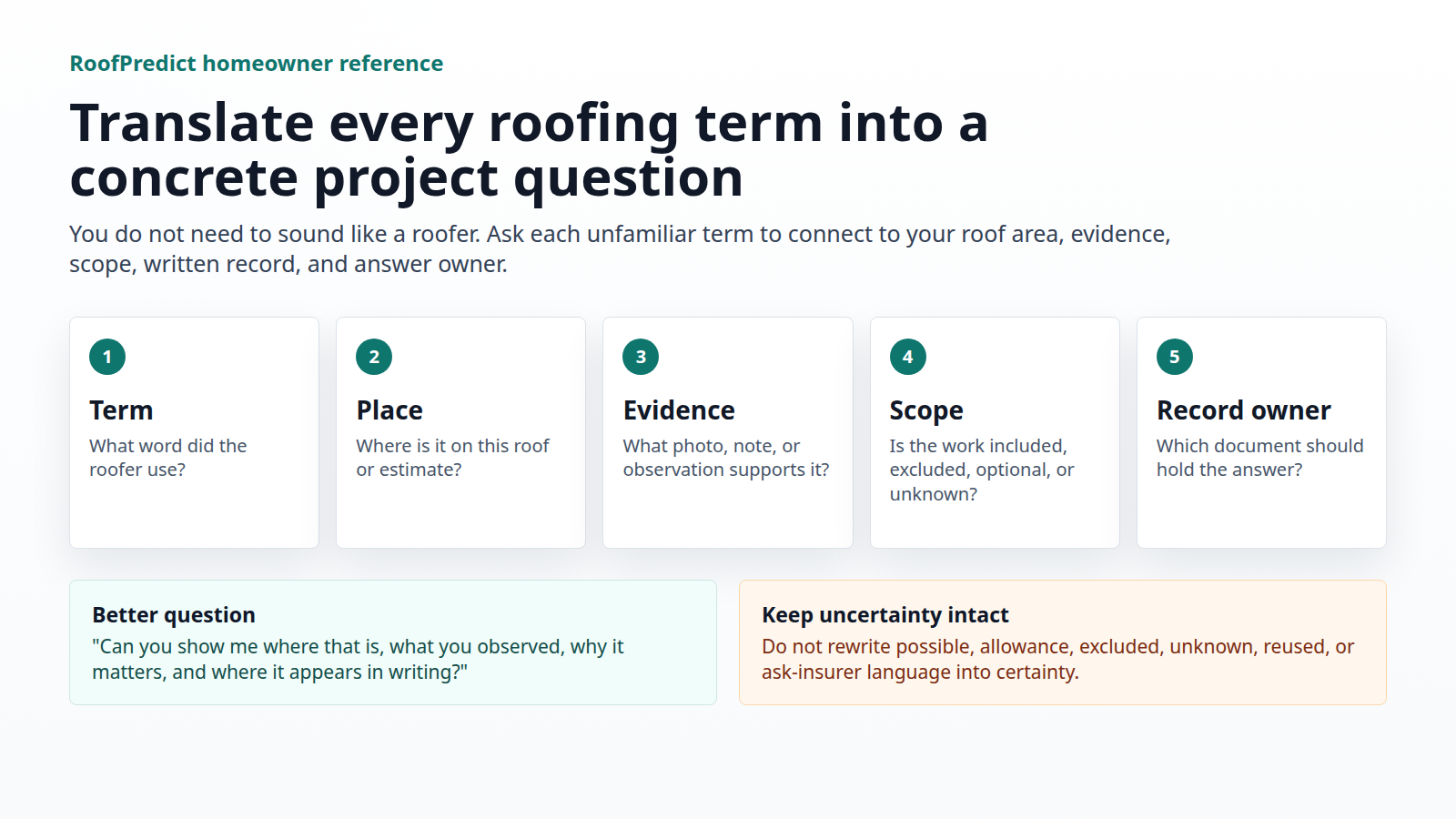
You do not need to sound like a roofer to have a useful conversation with one. You need to ask the roofer to translate every unfamiliar term into five things: where it is on your roof, what they observed, why it matters, what work they recommend, and what record you will receive.
Roofing vocabulary helps only when it makes the scope clearer. If a roofer says "flashing," "underlayment," "decking," "valley," or "ventilation," the next question is not "Can I memorize that?" The next question is, "Can you show me the photo, mark the roof area, explain the risk, and put the scope in writing?"
The NRCA glossary is useful for translating roofing vocabulary. Building America's asphalt shingle roof guidance and roof penetration flashing guidance are useful for understanding why roof assemblies include more than visible shingles. Those sources do not decide whether your roof needs repair or replacement. That still requires qualified evaluation, written scope, safe evidence, and clear contract terms.
For roofing companies, the same translation system can become a sales, production, and closeout standard. Clear term handling reduces confused callbacks, estimate-comparison friction, change-order disputes, and post-job warranty questions because homeowners, office staff, sales reps, production managers, and follow-up teams can all read the same packet.
Sources checked: June 8, 2026.
The Five-Part Translation Rule
Use the same request whenever a term sounds unfamiliar:
Please translate that term into the roof area, the photo or observation, the risk, the proposed work, and the record I will receive.
That one sentence reduces common misunderstandings. A term without a roof area is hard to verify. A roof area without a photo or note is hard to compare later. A recommendation without a written scope is hard to price. A scope without a record is hard to remember when another contractor, insurer, warranty administrator, or buyer asks about the same issue.
This does not mean every roofer needs to provide a formal report before answering a simple question. It means the important terms should end up attached to something concrete: a labeled photo, a roof plane, an estimate line, a material name, a warranty document, a change order, or a follow-up task.
The 60-Second Translation Card
When the conversation moves quickly, use a short card instead of trying to remember every roofing word. The card turns a term into a decision note.
Term:
Roof area:
What was observed:
What is recommended:
Included, excluded, allowance, or unknown:
Record I will receive:
Question owner if not the roofer:
Here are three examples.
| Term | Roof Area | What Was Observed | Recommendation | Scope Status | Record |
|---|---|---|---|---|---|
| Flashing | Chimney on rear slope | Roofer photo shows lifted metal at uphill side | Replace chimney flashing during roof work | Included if line item lists chimney flashing; otherwise clarify | Labeled photo and estimate line |
| Decking | Unknown until tear-off | Not fully visible before old shingles come off | Replace deteriorated sheets if discovered | Allowance or unit price should be written | Change order with photo |
| Ventilation | Ridge and soffit/intake area | Roofer recommends adding ridge vent | Confirm intake review and product compatibility | Included only if materials and work area are listed | Estimate line plus closeout photos |
The "question owner" line matters. Some questions belong to the roofer. Some belong to the local permit office, manufacturer, insurer, agent, warranty administrator, lender, buyer's inspector, or another trade. The roofer can explain what they observed and what they propose to do. That does not mean the roofer owns every legal, coverage, warranty, safety, or code conclusion.
Use the card during three moments:
- During the inspection review, when the roofer explains photos.
- During estimate comparison, when you are trying to compare included work.
- During production, when an unexpected condition changes the original scope.
The card also prevents a common homeowner mistake: turning a tentative note into a definite conclusion. If the roofer says "possible decking issue," write "possible." If the estimate says "reuse flashing unless damaged during tear-off," do not rewrite that as "flashing replacement included." If the roofer says "ask your insurer," do not file that under roofing scope. Preserve the exact status because the status is often what prevents confusion later.
The Conversation Map
Most homeowner confusion comes from mixing five different conversations into one call. A roofer may be talking about the roof surface, the hidden assembly below it, the estimate, the contract, or a future unknown condition after tear-off. Those are related, but they are not the same.
Use this map to slow the conversation down:
| Conversation stage | What the roofer may say | What you need to ask for | Good record |
|---|---|---|---|
| Scheduling | Leak, storm, age, inspection, emergency, estimate | What should I photograph before you arrive, and what should I avoid doing? | Intake notes and photo checklist |
| Inspection | Flashing, boot, valley, decking, granules, ventilation | Where is it, what did you observe, and is it visible now? | Labeled photo and inspection note |
| Estimate | Scope, allowance, tear-off, disposal, material, warranty | What is included, excluded, priced by unit, or unknown until work starts? | Written estimate with quantities and conditions |
| Contract | Payment schedule, start date, completion date, permit, change order | What promises from the conversation are written into the contract? | Signed contract with no blanks |
| Production | Hidden decking, rotted fascia, unexpected flashing, weather delay | What changed, who approves it, and what photo supports it? | Change order and photo |
| Closeout | Warranty, invoice, permit, final photos, maintenance | What documents should I keep, and who handles future questions? | Final packet |
If a term appears in the wrong stage, ask the roofer to move it into the right record. For example, "decking may need replacement" belongs in the estimate as an allowance or unit price. "Pipe boot is cracked" belongs in the inspection notes and photos. "Manufacturer warranty" belongs in the contract and closeout packet. "Insurance coverage" belongs with the insurer or agent, not inside the roofing vocabulary discussion.
Before The Roofer Arrives
You can make the first conversation easier without learning roofing jargon. Prepare a small packet that gives the roofer context and gives you a place to store answers.
Bring:
- the address and best contact information;
- the age of the home if you know it;
- the roof age if you have a record, but label it as "homeowner-provided" unless documented;
- photos of leaks, ceiling stains, attic areas you can access safely, and exterior areas visible from the ground;
- the date you first noticed the issue;
- any previous roof invoice, warranty document, inspection report, disclosure, or seller note;
- questions about gutters, fascia, soffit, skylights, chimneys, satellite mounts, solar attachments, or other roof-adjacent items;
- insurance claim number only if you already opened a claim and want the roofer to know the documentation context.
Do not climb onto the roof, pull shingles, remove flashing, or open areas you cannot access safely. The goal is not to inspect your own roof. The goal is to give the roofer enough context to explain what they see in plain language.
Use this opening:
I do not know roofing terms well. Please label photos and estimate lines so I can understand which roof area we are discussing, what you observed, what you recommend, what is unknown, and what record I will receive.
That sentence sets the right standard without sounding adversarial. It tells the roofer you want clarity, not a vocabulary contest.
Roofing Terms To Turn Into Questions
Use this table during a call, inspection review, or estimate comparison.
| Term | Plain meaning | Ask the roofer |
|---|---|---|
| Decking or sheathing | The structural surface that roofing is installed over, often plywood or boards. | Is any decking soft, damaged, missing fastener hold, or unknown until tear-off? How is replacement priced? |
| Underlayment or roof deck protection | A water-shedding layer under the visible roof covering. | What type is included, where will it be installed, and does it match the roof material and warranty requirements? |
| Flashing | Metal or similar material used where the roof meets walls, chimneys, skylights, valleys, vents, or other interruptions. | Which flashing is being reused, replaced, or repaired? Can I see photos of each area? |
| Valley | The low line where two roof planes meet and water concentrates. | Is the valley part of the scope, and what material or method will be used? |
| Ridge vent or attic ventilation | Openings and products that help move heat and moisture out of the attic. | Did you check intake and exhaust ventilation, and is the proposed work changing either one? |
| Penetration | Anything that passes through the roof, such as pipe boots, vents, skylights, or chimneys. | Which penetrations are being replaced, flashed, sealed, or excluded? |
| Eave, fascia, soffit, gutter | Edges and trim around the roof perimeter and drainage path. | Are gutters, fascia, soffit, drip edge, or drainage problems part of this scope or a separate trade? |
| Starter strip and hip/ridge cap | Special pieces used at roof edges and roof peaks. | Are these listed as separate materials, and are they part of the manufacturer system being quoted? |
| Tear-off | Removing old roof covering before new material is installed. | How many layers are coming off, what disposal is included, and what hidden conditions may change price? |
| Re-cover or overlay | Installing over existing roofing in places where allowed. | Is this allowed by local code, manufacturer instructions, and the existing roof condition? What risks remain? |
| Allowance | A placeholder amount for unknown work, such as decking replacement. | What unit price applies if the allowance is exceeded? |
| Change order | A written change to scope, price, or schedule after work starts. | Who approves it, when, and how will photos or notes support the change? |
| Workmanship warranty | The contractor's promise about their labor, separate from product warranties. | What is covered, for how long, who honors it, and what voids it? |
| Manufacturer warranty | Product warranty from the manufacturer, with its own limits and paperwork. | What documents will I receive, what registration or transfer is needed, and what is excluded? |
The point is not to challenge every word. The point is to make sure every technical word connects to a roof area, photo, written line item, material choice, price, schedule, warranty boundary, or follow-up question.
Translate Terms By Roof Area
A glossary is easier to use when it is tied to places on the house. During a call, ask the roofer to connect the term to one of these areas before discussing price or urgency.
| Roof area | Terms you may hear | Plain-language question |
|---|---|---|
| Roof field | Shingle, tile, panel, membrane, granules, blistering, cracking, fasteners | Are we talking about the main roof surface, and what condition did you observe? |
| Edge | Eave, rake, drip edge, starter, fascia, soffit, gutter | Is this roof edge work included in the roofing scope or handled separately? |
| Water path | Valley, cricket, saddle, slope, drainage, ponding | Where does water concentrate, and what material or method is included there? |
| Openings | Pipe boot, vent, skylight, chimney, exhaust, satellite, solar mount | Which opening is included, who owns it, and what flashing or seal detail changes? |
| Hidden layers | Decking, sheathing, underlayment, leak barrier, ice barrier | Is this visible now or unknown until tear-off, and how is it priced if discovered? |
| Ventilation | Intake, exhaust, ridge vent, baffle, attic ventilation | Did you check both intake and exhaust, and is the roof work changing airflow? |
| Contract language | Allowance, exclusion, change order, workmanship warranty, manufacturer warranty | Where is that written, and what event changes price, timing, or responsibility? |
This area-first approach prevents a common problem: a homeowner hears a term, searches the term, and then argues about a generic definition instead of the actual roof. The useful question is narrower. "Which pipe boot, which slope, what did you observe, and where is the line item?" beats a perfect definition of pipe boot.
If the roofer cannot place the term, ask for the limitation. Sometimes the honest answer is that the area cannot be confirmed until tear-off, attic access, a second visit, or another trade's review. That answer is useful when it is written down. It is not useful when it becomes a vague surprise after work starts.
The Answer Quality Ladder
Not every answer from a roofer has the same value. Use this ladder to decide whether you have enough clarity.
| Answer level | What it sounds like | How useful it is |
|---|---|---|
| Level 1: term only | "The flashing is bad." | Weak. You have a word, but no location, evidence, or scope. |
| Level 2: term plus location | "The chimney flashing is bad." | Better, but still vague. |
| Level 3: term plus observation | "The chimney flashing is lifted on the uphill side in this photo." | Useful because it connects term, location, and evidence. |
| Level 4: observation plus recommendation | "The chimney flashing is lifted on the uphill side; we recommend replacing that flashing during the roof work." | Stronger because it adds scope. |
| Level 5: recommendation plus record | "The chimney flashing is lifted on the uphill side; replacement is included in line 8, and hidden decking will use the listed unit price if found." | Best because it ties the term to evidence, scope, price boundary, and record. |
Your goal is not to force every small comment to Level 5. Your goal is to get important money, safety, warranty, insurance, or hidden-condition terms to Level 4 or Level 5 before you sign.
Good Answer, Better Answer, Written Answer
Some homeowner questions deserve a spoken answer. Others deserve a written answer because they affect price, responsibility, warranty, schedule, or future records.
Use this table when the roofer answers in trade shorthand:
| Homeowner Question | Weak Answer | Better Spoken Answer | Written Record To Request |
|---|---|---|---|
| What is wrong with the flashing? | "It is bad." | "The sidewall flashing on the left elevation is lifted in these photos." | Estimate line saying repair, replace, reuse, or exclude |
| What happens if decking is bad? | "We will handle it." | "Decking is not fully visible until tear-off, so replacement uses the listed sheet price." | Unit price, approval rule, and photo requirement |
| Is ventilation included? | "Yes, venting is included." | "The estimate includes ridge vent; intake review is separate/not included/included here." | Product, roof area, intake/exhaust note, and exclusions |
| What does warranty mean? | "You get a warranty." | "There is a workmanship warranty from us and a product warranty from the manufacturer." | Both warranty documents and any registration/transfer steps |
| What is excluded? | "Nothing major." | "Gutters, skylight repair, chimney masonry, and solar detachment are not part of this scope." | Exclusion list in the estimate or contract |
| What changed during tear-off? | "We found more work." | "Three sheets of deteriorated decking were found on the rear slope." | Photos, change order, quantity, unit price, and approval |
The written record does not need to be complicated. A revised estimate, email note, photo label, line-item note, change order, or closeout packet can be enough if it clearly connects the term to the roof area and scope.
Use a higher standard when the term affects money. For example, "decking" is more than vocabulary if it creates a per-sheet charge. "Flashing" is more than vocabulary if it is excluded from one estimate and included in another. "Ventilation" is more than vocabulary if the roofer is changing the attic airflow path. "Warranty" is more than vocabulary if product and workmanship responsibilities are being mixed together.
The best answer is usually boring: specific, written, limited, and easy to compare.
A One-Page Cheat Sheet
Use this during calls:
| If the roofer says... | Ask... |
|---|---|
| "Flashing" | Which roof transition, and is it reused, repaired, replaced, or excluded? |
| "Decking" | Is this visible now or unknown until tear-off, and what unit price applies? |
| "Underlayment" | What type is included and where is it installed? |
| "Ventilation" | Did you check intake and exhaust, and is anything changing? |
| "Valley" | Which valley and what method or material is included? |
| "Penetration" | Which pipe, vent, skylight, chimney, satellite, or solar detail is included? |
| "Allowance" | What triggers extra cost and who approves it? |
| "Warranty" | Is this workmanship, manufacturer product coverage, or both? |
| "Code" | Who verifies local requirements and where is that written? |
| "Insurance" | What did you observe, and what should I ask my insurer or agent? |
| "Change order" | What photo, note, and signature are required before cost changes? |
| "Excluded" | Who owns that work if it becomes necessary? |
Print this table or keep it in your notes. The best question is usually not technical. It is simply: "Where is that shown, what does it mean for the scope, and what record will I get?"
Seven Questions That Work With Any Roofing Term
When a roofer uses a term you do not know, use the same seven questions:
- Can you show me where that is on my roof?
- What did you observe there?
- Is that a current problem, a future risk, a code or permit question, a manufacturer instruction, or a normal roof part?
- What happens if we repair it, replace it, monitor it, or leave it out of scope?
- What material, method, and quantity are included?
- What is unknown until work begins?
- What photo, report, invoice, permit record, warranty document, or change order will I receive?
The IBHS/RICOWI roofing guide supports evaluating roof condition with age, weathering, local codes and standards, manufacturer instructions, accepted safety practices, and qualified professional judgment. That is why the best roofer conversations separate observations from conclusions. "The pipe boot is cracked in this photo" is an observation. "Replace the pipe boot and inspect surrounding shingles" is a scope. "Insurance will pay for it" is not the roofer's decision.
Photo Labels That Make Terms Understandable
Ask for photos that answer a question instead of only showing a close-up. A close-up of a shingle or flashing detail may be useful to a roofer, but a homeowner also needs orientation.
For important findings, ask for three photo types:
| Photo type | What it shows | Why it helps |
|---|---|---|
| Wide photo | The roof plane, elevation, room, or general area | Helps you know where the issue is |
| Medium photo | The roof feature, flashing, vent, valley, gutter edge, or stain area | Connects the term to the component |
| Detail photo | Crack, hole, lifted edge, rust, soft decking, fastener, boot, or stain | Shows the specific observation |
Good labels are plain:
Rear slope - pipe boot - cracked rubber collarFront left valley - debris and water pathKitchen ceiling stain - homeowner photo before appointmentGarage eave - fascia/soffit/gutter transitionAttic access - visible daylight near penetration, needs roofer review
Weak labels create confusion:
DamageBad flashingNeeds replacementStormInsurance
The weak labels skip the most important details: where the photo was taken, what component is visible, what was observed, and what conclusion is still open. A better label does not need to be technical. It needs to be traceable.
A Simple Call Script
Use plain language. You do not need to know the technical word before the roofer explains it.
Start with the roof area:
- "Which side or section of the roof are we talking about?"
- "Can you label that photo or mark it on the estimate?"
- "Is this visible from the ground, from the attic, from the roof, or only after tear-off?"
Then separate what the roofer saw from what they recommend:
- "What did you actually observe?"
- "What are you assuming because it cannot be seen yet?"
- "Is the recommended work a repair, replacement, monitoring item, or separate trade?"
Then make the scope measurable:
- "What material, quantity, and installation area are included?"
- "What is excluded?"
- "What price changes if hidden decking, flashing, ventilation, or fascia problems appear?"
Close with records:
- "What photos, estimate lines, warranty documents, permit notes, receipts, or change orders will I receive?"
- "Can you put that answer in the estimate or in a follow-up email?"
If the roofer can explain the issue plainly, show the roof area, and put the scope in writing, you can compare the answer even if you never become fluent in roofing terms.
Three Realistic Conversations
The same translation rule works in different homeowner moments. The term changes, but the job stays the same: locate it, describe what was observed, connect it to scope, and preserve the record.
| Situation | Term you hear | Weak response | Better homeowner question | Record to request |
|---|---|---|---|---|
| Active leak visit | Pipe boot, flashing, penetration, water path | "So is the roof bad?" | "Can you show which penetration or flashing area you mean, what you saw, and whether this is a repair, monitoring item, or hidden-condition question?" | Labeled photo, roof area, interior stain photo if relevant, repair line, follow-up note. |
| Replacement estimate | Tear-off, underlayment, starter, ridge cap, drip edge | "Is that included?" | "Which of those materials are included in the written estimate, which are excluded, and which would require a change order?" | Estimate line, material list, exclusion list, change-order rule. |
| Post-storm inspection | Bruise, granule loss, collateral mark, test square | "Does that mean insurance covers it?" | "What did you observe, where is it, what photos support it, and what questions belong to the insurer or other reviewer?" | Photo map, observation note, inspection summary, claim-boundary note. |
| Old roof discussion | Decking, ventilation, soft spot, prior repair | "Do I need a new roof?" | "Is this a visible condition, age clue, repair history issue, or something that cannot be confirmed until tear-off?" | Roof-age record, inspection note, hidden-condition rule, maintenance note. |
| Final walkthrough | Punch list, closeout packet, warranty registration | "Are we done?" | "Which items are complete, which records will I receive, and which maintenance or warranty steps remain?" | Final invoice, completion photos, warranty documents, change orders, permit/inspection records where applicable. |
Here is how that sounds in a real call:
I do not need the technical term first. I need the roof area, what you observed, what you recommend, where it appears in the estimate, and what record I should keep. If part of the answer depends on tear-off, insurance, warranty, code, or another trade, please label that separately.
That sentence prevents two common problems. First, it stops the homeowner from pretending to understand a term that may change the scope. Second, it stops a normal roofing explanation from turning into an unsupported diagnosis, coverage conclusion, or contractor-selection rule.
The conversation should leave behind one useful record. If the issue is visible, the record might be a labeled photo and estimate line. If the issue is hidden, the record might be a unit price, allowance, and approval step. If the issue belongs to an insurer, manufacturer, permit office, mason, electrician, solar company, gutter installer, or warranty administrator, the record should name that lane instead of forcing the roofer to answer outside the roofing scope.
Make The Estimate Do The Heavy Lifting
If the words are clear but the estimate is vague, you still have a problem.
The FTC home improvement guidance says a written estimate should include the work description, materials, completion date, and price. It also recommends multiple estimates, license and insurance checks where available, careful contract review, contractor identity, start and completion dates, promises made during conversations, and filled-in blanks. It warns against pressure for immediate decisions, full payment up front, cash-only payment, asking the homeowner to get required permits, and contractor-arranged loans.
For roof work, ask the estimate to spell out:
- roof area or slope;
- tear-off, disposal, and layer count;
- decking allowance and unit price;
- underlayment, leak barrier, flashing, drip edge, starter, ridge cap, ventilation, and penetrations;
- gutters, fascia, soffit, skylight, chimney, satellite, solar, or other exclusions;
- permit and inspection handling;
- warranty documents;
- start date, completion estimate, payment schedule, cancellation terms, and change-order process.
If two roofers use different words, compare the included work instead of the vocabulary. "Synthetic underlayment" and a branded product line may not mean the same scope, warranty, or price as another estimate. Ask each roofer to show the line item, product, and roof area.
When A Roofing Term Changes The Price
Some terms are harmless vocabulary. Others change scope, schedule, warranty paperwork, or price. When one of these terms appears, ask for the written trigger.
| Term | Why it can affect price | Ask for |
|---|---|---|
| Decking replacement | The amount may not be known until tear-off | Unit price, approval process, and photo requirement |
| Flashing replacement | Some flashing can be reused, repaired, replaced, or excluded | Each area listed separately |
| Ventilation correction | Intake and exhaust changes can affect materials and labor | What was checked and what is changing |
| Penetration flashing | Pipe boots, vents, skylights, chimneys, and solar mounts may have different responsibilities | Owner of the work and excluded trades |
| Valley work | Valleys concentrate water and may use specific materials or methods | Which valleys and what material |
| Tear-off layers | Disposal and labor can change with layer count | Number of layers included and what happens if more are found |
| Code, permit, or inspection | Requirements vary by location and project | Who handles local requirements and where they appear in writing |
| Warranty registration | Paperwork may affect future questions | Who registers, what documents you receive, and what exclusions apply |
Do not ask the roofer to make a legal or code ruling on the phone. Ask where the requirement is coming from and where it appears in the written scope. If a term changes price, the estimate should say what triggers the change and how approval happens.
How To Compare Two Roofers Who Use Different Words
Two estimates can sound different and still cover similar work. They can also sound similar while hiding major scope differences. Translate both estimates into the same comparison table.
| Question | Roofer A | Roofer B |
|---|---|---|
| What roof areas are included? | ||
| Is tear-off included? | ||
| How many layers are assumed? | ||
| What underlayment or roof deck protection is listed? | ||
| What flashing is reused, replaced, repaired, or excluded? | ||
| How are valleys handled? | ||
| How are penetrations handled? | ||
| Are gutters, fascia, soffit, skylights, chimney, solar, or satellite items included? | ||
| What decking allowance or unit price is listed? | ||
| What warranty documents will you receive? | ||
| What is unknown until work begins? | ||
| What is the change-order process? |
This table keeps the conversation fair. You are not asking one roofer to copy another roofer's words. You are asking both to define scope in comparable terms. If an estimate is cheaper because it excludes flashing, ventilation, gutters, permits, disposal, or hidden-decking unit prices, the lower price may not mean the same work.
Scope Gap Triage
When two estimates use different words, do not try to decide which roofer has the better vocabulary. Look for scope gaps. A scope gap is an important piece of work, responsibility, or documentation that appears in one estimate and is vague or missing in another.
Use this triage:
| Gap Type | What It Looks Like | Why It Matters | What To Ask |
|---|---|---|---|
| Included work gap | One estimate lists drip edge, starter, ridge cap, flashing, or ventilation; the other does not | The lower price may not include the same roof system details | Is this included, excluded, or unnecessary? Where is that written? |
| Hidden condition gap | One estimate gives a decking unit price; the other says "as needed" | Unknown work can change price during production | What triggers extra cost and who approves it? |
| Responsibility gap | Skylight, chimney, solar, gutters, fascia, or satellite work is unclear | Another trade or owner may be responsible | Who owns this work if it becomes necessary? |
| Record gap | One roofer promises photos and closeout documents; the other does not mention records | Future warranty, resale, and maintenance questions need documentation | What photos, warranty documents, permits, receipts, and closeout notes will I receive? |
| Warranty gap | Product and workmanship warranty language is blended together | Different parties may honor different promises | Which warranty comes from the contractor and which comes from the manufacturer? |
| Schedule gap | Start, completion, weather delay, or material timing is vague | The homeowner cannot plan access, payment, or follow-up | What dates are estimates, what changes them, and how will I be notified? |
| Payment gap | Deposit, progress payment, final payment, or financing terms are unclear | Payment disputes often come from vague timing | What is due, when, and what must be complete first? |
After you identify the gap, ask for a narrow clarification. Do not ask the roofer to rewrite the whole estimate if one line is unclear. Ask for the missing status:
Can you mark this as included, excluded, allowance, owner responsibility, separate trade, or unknown until tear-off?
That one request often resolves the problem. It gives the roofer several honest answers besides "yes" or "no." It also gives you a cleaner way to compare bids without accusing anyone of hiding something.
If a roofer refuses to clarify a scope gap that affects price, warranty, responsibility, or safety, treat that refusal as useful information. You still do not need to diagnose the roof yourself. You need a written scope you can understand.
The Clarification Request Board
A homeowner can ask for clearer language without turning the estimate review into a fight. The best clarification requests are narrow. They point to one term, one line, one photo, or one missing status.
Build a small board before asking for revisions:
| Estimate line or term | Current wording | Why it matters | Requested wording |
|---|---|---|---|
| Decking | "Replace decking as needed" | Price can change during tear-off | Unit price, photo requirement, approval rule, and whether labor/disposal are included |
| Flashing | "Reuse existing flashing" | Reuse may be fine or may create a leak/warranty question | Which flashing areas are reused, replaced, excluded, or unknown until tear-off |
| Ventilation | "Install ridge vent" | Exhaust may be incomplete without intake review | Product name, old vent removal, intake status, baffle/exclusion note |
| Warranty | "Warranty included" | Product and labor coverage may be different | Workmanship warranty length, manufacturer warranty document, registration/transfer steps |
| Permit | "Permit by owner" | Permit responsibility can affect timing and compliance | Who pulls permit if required, who schedules inspection, and where that is written |
Then send one focused note:
I am comparing the estimate and want to make sure I understand the terms correctly. Can you revise or add notes for these lines so I know what is included, excluded, an allowance, owner responsibility, a separate-trade item, or unknown until tear-off?
That message gives the roofer a practical task. It does not accuse the roofer of hiding anything. It also helps the homeowner avoid a worse habit: trying to solve uncertainty by searching generic definitions. A definition of "flashing" does not tell you whether chimney flashing is reused, replaced, excluded, or unknown on your house.
Use the board for any term that affects money, schedule, warranty, safety, permit responsibility, another trade, or future records. Do not use it to nitpick harmless vocabulary. A homeowner does not need every word rewritten. A homeowner needs important project terms attached to a status.
Build A Second-Opinion Handoff Sheet
Sometimes the first conversation creates enough clarity to hire the roofer. Sometimes it creates a good reason to get another written estimate, ask a household decision-maker to review the options, send documents to an insurer or agent, or preserve the issue for a buyer, warranty administrator, lender, property manager, or HOA. In those moments, the main risk is not that the homeowner uses the wrong technical word. The bigger risk is that the homeowner repeats the first roofer's words as if they were a confirmed conclusion.
Use a handoff sheet when a roofing term needs to travel from one conversation to another.
| Handoff Field | What To Write | Why It Matters |
|---|---|---|
| Exact phrase heard | The roofer's actual wording, not your improved version | Keeps "possible soft decking" from becoming "rotted decking" |
| Source of phrase | Inspection call, photo review, estimate, contract, text, invoice, or change order | Shows whether the phrase was casual, priced, approved, or completed |
| Roof area | Front slope, rear valley, chimney, skylight, ridge, eave, attic, ceiling stain, or unknown | Prevents a general term from floating without location |
| Attached record | Photo, estimate line, product sheet, warranty note, text, email, or no record yet | Separates documented facts from memory |
| Current status | Included, excluded, allowance, owner responsibility, separate trade, unknown until tear-off, or ask another reviewer | Keeps the next person from guessing scope |
| Homeowner translation | Your plain-language understanding | Lets the next person correct misunderstandings early |
| Question for next reviewer | One specific question, not a broad challenge | Makes the handoff useful instead of adversarial |
| Answer received | The next reviewer's wording and date | Preserves differences between opinions |
Here is a clean example:
Exact phrase heard: "Some decking may be soft near the back valley."
Source of phrase: first roofer inspection call and estimate note.
Roof area: rear valley above kitchen.
Attached record: one labeled photo and estimate line saying decking replaced as needed.
Current status: unknown until tear-off; unit price not yet written.
Homeowner translation: there may be hidden deck damage, but it has not been confirmed.
Question for next reviewer: Can you review the same rear-valley area from safe access and tell me whether your estimate includes a written decking unit price and approval process?
Answer received: pending.
This protects the second conversation. The next roofer is not being asked to agree with a rumor. The roofer is being asked to review a location, a record, and a scope question. That is fairer to the contractor and more useful for the homeowner.
The same sheet works inside the household. If one person meets the roofer and another person approves the contract, the first person should not summarize the whole conversation as "the flashing is bad" or "the roof needs ventilation." A better summary is: "The roofer showed a chimney flashing photo, recommended replacement during the roof work, and the estimate line says flashing replacement is included. Ventilation was discussed, but intake review is still unclear." That difference matters before money moves.
Use three labels when sharing roofing terms with anyone else:
| Label | Meaning | Example |
|---|---|---|
| Direct quote | The exact words from the roofer or document | "Reuse existing flashing unless damaged during tear-off" |
| Homeowner translation | Your plain-language version | "They may reuse flashing unless tear-off reveals a problem" |
| Open question | What still needs a written answer | "Which flashing areas are reused, replaced, excluded, or unknown?" |
Do not combine those labels. A direct quote is stronger than a memory. A homeowner translation is useful, but it can be wrong. An open question is not a conclusion. Keeping the labels separate makes the packet easier for another roofer, insurer, agent, buyer, warranty administrator, or family member to review.
If you show a second roofer the first roofer's estimate, do it carefully. You can say, "I am not asking you to copy this estimate or beat the price. I am trying to understand the terms and scope. Please tell me how your own written scope handles these same areas." That framing reduces the chance that the second conversation becomes a price-match exercise. It keeps the focus on whether the two estimates include the same roof areas, hidden-condition rules, material names, warranty path, records, exclusions, and change-order process.
RoofPredict can store this as a handoff packet: phrase, source, roof area, record, status, translation, open question, and answer received. The value is not automated certainty. The value is that every reviewer sees the same chain instead of receiving a shortened retelling of a technical conversation.
Terms That Cannot Be Confirmed Until Tear-Off
Some roofing terms cannot be fully resolved during the sales visit. Decking is the common example. A roofer may not know how many sheets are damaged until old materials come off. Hidden flashing conditions, rotted fascia, concealed leaks, wet insulation, and old repairs can also stay partly unknown.
Unknown does not have to mean uncontrolled. Ask for the unknown-condition rule:
| Unknown term | What should be written before work starts |
|---|---|
| Decking | Unit price, sheet size if relevant, labor/disposal inclusion, photo proof, approval step |
| Hidden flashing | What is included now, what triggers replacement, and how price changes |
| Fascia or trim rot | Whether the roofer handles it, excludes it, or refers it to carpentry |
| Sheathing or structural concern | Who can approve repair scope and when work pauses |
| Ventilation path | Whether intake/exhaust can be verified before tear-off or during tear-off |
| Previous repair | Whether old repair work is reused, removed, corrected, or excluded |
A clean hidden-condition rule protects both sides. The contractor does not have to promise what cannot be seen. The homeowner does not have to accept an open-ended surprise. The important point is that "unknown" should be a written status with a trigger, price rule, approval method, and photo record.
Use these words carefully:
Possiblemeans not confirmed.Unknown until tear-offmeans the answer depends on opening the roof.Allowancemeans there is a pricing assumption or placeholder.Excludedmeans it is not part of the current scope.Owner responsibilitymeans the homeowner must handle the item or hire another party.Separate trademeans another specialist may need to handle the work.
Do not rewrite those labels into certainty. If a note says possible decking damage, keep possible. If a line says owner responsibility, keep owner responsibility. The status is part of the record.
Contract And Closeout Alignment
Roofing terms travel through several documents. A term can be explained during the call, priced in the estimate, revised in the contract, changed during production, and finalized in the closeout packet. Confusion often happens when the term changes locations but the homeowner keeps only the first explanation.
Use this alignment check before signing:
| Term | Sales conversation | Estimate | Contract | Closeout |
|---|---|---|---|---|
| Flashing | Area discussed and photos reviewed | Included, reused, replaced, or excluded | Same scope and price rule | Photos and final note |
| Decking | Hidden condition explained | Unit price or allowance listed | Approval and change-order rule | Photo, quantity, final invoice |
| Ventilation | Intake/exhaust question explained | Product and scope listed | Exclusions and old vent handling listed | Installed product and photos |
| Warranty | Product and workmanship separated | Warranty documents named | Registration/transfer duties stated | Final warranty packet |
| Permit | Responsibility discussed | Permit cost/owner listed if relevant | Responsibility confirmed | Inspection/permit record kept |
If a term appears in the sales conversation but disappears from the estimate or contract, ask where it went. If the estimate says one thing and the contract says another, resolve it before signing. If production changes the term, ask for a change order. If closeout documents do not match the final work, ask for the packet to be corrected.
The goal is continuity. You should be able to trace one important term from first conversation to final record. That trace is more valuable than memorizing the perfect definition.
A Mini Estimate Walkthrough
Use a small fictional example to practice translating terms into scope:
Line 8: Replace pipe boots, all roof penetrations, standard black neoprene.
Line 11: Replace deteriorated decking as needed, $95 per sheet.
Line 14: Reuse existing chimney flashing unless damaged during tear-off.
Line 18: Install ridge vent. Intake ventilation not included.
That estimate gives you useful clues, but it still needs questions.
| Estimate line | What is clear | What is still open |
|---|---|---|
| Pipe boots | The roofer plans to replace penetration boots | How many penetrations, which roof areas, and are skylights/chimneys/solar mounts excluded? |
| Decking | There is a unit price for replacement | Who approves extra sheets, what photo is required, and does the price include labor/disposal? |
| Chimney flashing | Reuse is assumed | What does "damaged during tear-off" mean, and what price applies if replacement is needed? |
| Ridge vent | Exhaust ventilation is proposed | Was intake checked, and could adding exhaust without intake review create an incomplete ventilation conversation? |
The goal is not to rewrite the roofer's estimate for them. The goal is to identify the terms that deserve clarification before you compare bids or sign. This example also shows why a cheap line can be incomplete. "Install ridge vent" sounds specific, but ventilation is a system conversation. "Reuse chimney flashing" may be acceptable on one project and a bad assumption on another. The homeowner does not need to decide the technical answer. The homeowner needs to know which question is still open.
Turn any estimate line into four notes:
Term:
Roof area:
Included work:
Open condition or approval trigger:
If the line cannot fill those four notes, ask for a written clarification.
Turn The Conversation Into A Record Packet
After the call, write down each unfamiliar term in a small table. This keeps the conversation from turning into a memory test.
| Term used | Roof area | Evidence | Proposed work | Open question |
|---|---|---|---|---|
| Flashing | Chimney, wall, skylight, valley, or other roof interruption | Photo label, inspection note, or estimate line | Replace, repair, reuse, seal, monitor, or exclude | Which flashing is included, and what happens if hidden damage appears? |
| Decking | Roof plane or area found during inspection or tear-off | Photo, moisture note, soft spot note, or tear-off finding | Included sheets, unit price, or change order | What approval is needed before extra sheets are replaced? |
| Ventilation | Ridge, intake, attic, static vent, powered vent, or baffle area | Attic note, roof photo, product line, or calculation note | Add, replace, leave unchanged, or refer to another specialist | Is this required for the proposed roof system or a recommended improvement? |
| Penetration | Pipe boot, vent, skylight, chimney, satellite, solar, or other opening | Close photo plus wider photo | Replace, flash, seal, remove, or exclude | Who is responsible if another trade owns the penetration? |
The packet does not need to be fancy. A folder with labeled photos, the estimate, follow-up emails, warranty documents, and open questions is enough. The value is that every technical word has a place to land.
Keep A Personal Roof Dictionary
After one or two roofing conversations, you will have a small dictionary that matters more than a national glossary because it is tied to your property.
Use this format:
| My term | My house location | What the roofer meant | Record to keep |
|---|---|---|---|
| Pipe boot | Rear slope above bathroom | Rubber boot around plumbing vent; recommended replacement during roof work | Photo plus estimate line |
| Decking allowance | Unknown until tear-off | Possible plywood replacement if soft or deteriorated areas are found | Unit price and change-order rule |
| Valley | Front left intersection of two slopes | Water-concentration area; included in underlayment/flashing scope | Wide photo plus material line |
| Workmanship warranty | Contractor labor warranty | Separate from manufacturer product warranty | Written warranty document |
This personal dictionary helps months later when the project is done and someone asks what changed. It also helps if you sell the home, call the roofer for a warranty question, compare a second estimate, or upload records to RoofPredict. Do not make the dictionary sound more certain than the records. If the roofer said "possible decking issue," keep the word possible. If the estimate says "allowance," do not rewrite it as "included replacement."
The best homeowner dictionary uses normal language:
- "where we saw it";
- "what was observed";
- "what the roofer proposed";
- "what is still unknown";
- "what document proves the answer."
That style is easier to understand than a copied glossary paragraph.
If The Conversation Happens By Text Message
Many roofing conversations now happen in text threads: a homeowner sends ceiling-stain photos, a roofer sends roof photos, someone mentions flashing or decking, and the estimate arrives later. Texting can be useful, but it can also scatter the record.
Use one rule: every text thread should still create a clean packet entry.
When a roofer texts a term, reply with a short structure:
Thanks. To keep my notes straight, can you label:
1. the roof area,
2. what you observed,
3. what work you recommend,
4. whether it is included or excluded in the estimate,
5. what document or photo I should keep?
That request is short enough for text and specific enough to prevent vague answers. It also avoids sounding like you are challenging the roofer's expertise. You are asking for labels.
Save text-message evidence carefully:
| Text item | Save it as | Why |
|---|---|---|
| Roofer photo | Original photo plus sender/date | Keeps the image tied to the person who provided it |
| Term explanation | Screenshot or copied note with date | Preserves what the term meant in that project |
| Price or scope comment | Ask for it in the estimate too | Text alone may not be enough as the contract record |
| Scheduling or access note | Calendar note or project note | Prevents missed appointment or access confusion |
| Unknown-condition warning | Estimate note or change-order rule | Makes hidden work easier to handle later |
Do not let a text thread replace the final written scope. Texts can clarify, but the estimate and contract still need to carry the important commitments: work description, materials, price, timing, exclusions, payment schedule, warranty terms, and change-order process.
If the text thread gets long, send one reset message:
I want to avoid losing anything in the thread. Can you summarize the roof areas, findings, included work, exclusions, and open conditions in the estimate or a follow-up email?
That message turns scattered vocabulary back into a reviewable record.
Also keep homeowner photos separate from roofer photos. A ceiling stain photo you took before the appointment is a homeowner observation. A roof close-up sent by the roofer is a professional-provided image, but it still needs a label and scope connection. A neighbor's storm photo is neighborhood context, not your roof record. Mixing those three image types can make a simple vocabulary question look like a damage conclusion. Label the source before you label the term, and preserve the original message date. That small habit keeps the file useful months later, even after closeout.
A Follow-Up Email You Can Send
After the appointment, send a short email while the conversation is fresh. This protects both sides from memory drift.
Use this template:
Thanks for reviewing the roof today. I want to make sure I understood the terms correctly before comparing the estimate.

1. The main roof areas discussed were:
2. The terms I need clarified are:
3. The observations you made were:
4. The recommended work is:
5. The work that is excluded or unknown until tear-off is:
6. The photos or labels I should keep are:
7. The documents I should expect are:
8. The questions that belong with my insurer, warranty administrator, local office, or another specialist are:

Please correct anything I misunderstood and add the answers to the estimate or a follow-up note where appropriate.
This email does not accuse the roofer of anything. It simply asks for a clean record. Clear written expectations help both sides before work begins.
Red Flags In Term Explanations
Some explanations make a homeowner less informed, not more informed. Slow down when you hear these patterns:
| Pattern | Why it is a problem | Better request |
|---|---|---|
| "Do not worry about the details." | You cannot compare scope without details. | Please show the roof area, observation, recommendation, and written line item. |
| "Everyone includes that." | Estimates vary. | Please point to where it appears in this estimate. |
| "Insurance always pays for this." | The roofer does not decide coverage. | Please separate the roof observation from insurance questions. |
| "We will figure it out after tear-off." | Hidden work may be real, but approval should be clear. | What unit price and change-order process apply? |
| "You need to sign today." | Pressure can prevent careful review. | I need the written scope and time to compare. |
| "Just pay cash up front." | Payment and documentation matter. | Please provide the payment schedule in the contract. |
| "You need to get the permit." | FTC flags this as a warning sign in home improvement contexts. | Please explain who handles required permits and where that is written. |
Not every awkward explanation means a contractor is bad. Sometimes a roofer is busy or uses trade shorthand out of habit. The test is whether they can translate the term when asked and put important scope in writing.
Insurance Words Belong In Their Own Lane
If the roofer visit follows storm damage or a possible claim, keep insurance terms separate from roofing terms.
The NAIC homeowners claim guidance supports knowing your deductible, making a damaged-property list, taking photos and videos, contacting the insurer or agent if filing, and keeping receipts. Those actions support the claim file. They do not let a contractor decide coverage.
Ask the roofer for a claim-neutral explanation: observed damage, photos, roof areas, recommended scope, temporary protection, and price. Ask the insurer or agent about coverage, deductible, depreciation, policy requirements, claim process, and documentation.
Safety Boundary
Do not climb onto the roof so a term makes sense. OSHA's roof inspection, tarping, and repair guidance describes hazards involving ladders, work above ground, tools, power lines, steep or slippery surfaces, deteriorated roofs, and fall protection.
Ask for safe evidence instead: labeled roof photos, drone or ladder photos from qualified professionals where appropriate, ground-level photos, attic or interior photos from safe accessible areas, inspection notes, and written estimates.
Where RoofPredict Fits
RoofPredict can organize the roofer conversation packet: unfamiliar terms, labeled photos, roof areas, inspection notes, estimates, material lists, warranty documents, permit questions, claim questions, receipts, and follow-up tasks.
That matters because the homeowner may understand the call in the moment and lose the thread later. RoofPredict helps keep "flashing at chimney," "decking allowance," "ridge vent," "pipe boot," and "change order" attached to photos, estimates, and next actions.
RoofPredict does not inspect roofs, diagnose damage, approve scope, verify technical terms, choose contractors, interpret warranties, decide insurance coverage, approve safety, or replace the contract.
Use these packet fields:
| Field | Example |
|---|---|
| Term | Flashing |
| Plain-language meaning | Material at a roof interruption or transition |
| Roof area | Chimney, sidewall, skylight, valley, vent, or pipe |
| Evidence | Wide photo, close photo, inspection note |
| Observation | Rusted, lifted, missing, reused, excluded, or unknown |
| Proposed work | Replace, repair, reuse, seal, monitor, or separate trade |
| Estimate line | Line number, product, quantity, or allowance |
| Open question | What happens if hidden damage appears? |
| Record needed | Photo label, estimate update, warranty document, change order, or receipt |
The value is not that RoofPredict makes the decision. The value is that the homeowner can return to the same packet after the call, during estimate comparison, after a change order, or before a future inspection.
For Roofers: Turn Vocabulary Into A Handoff System
Roofing companies can use the same framework before a homeowner ever searches a glossary. The operational goal is simple: every important technical term should leave the sales appointment attached to a location, evidence, scope status, and next owner. That makes the estimate easier to approve, easier to produce, and easier to defend later without overclaiming what the roofer knows.
Use this field standard across intake, inspection review, estimate writing, production, and closeout:
| Team Moment | Term Risk | Roofer-Side Standard | Good Record |
|---|---|---|---|
| CSR intake | The homeowner says "leak," "storm," "soft spot," or "bad shingles" without context | Capture the homeowner's words as homeowner-provided symptoms, not diagnosis | Intake note with date, room/area, photos requested, and safety reminder |
| Sales inspection | The rep uses shorthand such as flashing, decking, valley, ventilation, or penetration | Translate the term into roof area, observation, scope status, and record before leaving | Labeled photo, inspection note, estimate task, or open question |
| Estimate writing | A term affects price, warranty, schedule, hidden work, or another trade | Mark included, excluded, allowance, owner responsibility, separate trade, or unknown until tear-off | Estimate line, exclusion, unit price, allowance, or change-order rule |
| Production handoff | The crew needs to know what was promised versus what is unknown | Separate sold scope from watch items and approval triggers | Production notes, photo map, material list, and change-order protocol |
| Closeout | The homeowner may forget what each term meant after the job | Match major terms to completed work and final documents | Completion photos, invoice, warranties, permits where applicable, and maintenance notes |
This is especially useful for companies with more than one salesperson or production coordinator. A homeowner may ask the office, estimator, crew lead, supplement contact, or owner the same vocabulary question at different times. If each person answers from memory, the company creates inconsistent language. If everyone uses the packet, the answer stays bounded:
Here is the term, here is the roof area, here is the photo or note, here is the current scope status, and here is the document that controls the next step.
For a roofing directory or contractor profile, this kind of documentation also becomes a trust signal. A company does not need to promise that every homeowner will understand every detail. It can show that its process labels photos, explains exclusions, separates workmanship and manufacturer warranty documents, uses written change orders, and routes insurance, code, licensing, electrical, solar, chimney, gutter, or warranty-administrator questions to the right owner.
Do not turn the handoff system into a legal, insurance, code, or warranty approval script. The roofer-side standard is narrower and stronger: explain observations, show evidence, write scope status, preserve uncertainty, and identify who owns the next answer. That is enough to make homeowner conversations clearer without asking the roofing company to decide questions outside its lane.
What Not To Ask A Roofer To Decide
Some questions should be routed elsewhere or treated carefully:
| Question | Better route |
|---|---|
| Will insurance cover this? | Insurer or agent |
| Does this satisfy local code? | Contractor plus local authority where required |
| Does this preserve my manufacturer warranty? | Contractor plus manufacturer/warranty documents |
| Is this contractor legally licensed for my project? | State, county, or local licensing source where available |
| Is it safe for me to climb up and look? | Do not climb; ask for safe evidence |
| Should I sign today? | Review written scope, contract, payment terms, and alternatives |
| Is this definitely storm damage? | Qualified evaluation, documentation, and insurer process if applicable |
The roofer can still help by explaining observations and scope. The boundary is decision authority. Keep technical observations, contract terms, insurance questions, warranty questions, code questions, and safety questions in their proper lanes.
When The Term Belongs To Another Trade Or Reviewer
Some words come up during a roof conversation even though the final answer may not belong only to the roofer. That does not mean the roofer should ignore the issue. It means the homeowner should ask who owns the next answer before approving work, signing a change order, or assuming the roof scope includes everything.
Use this routing table when a term sounds roof-related but may involve another person:
| Term Or Issue | Why It Comes Up In Roofing | Who May Need To Answer | Homeowner Question |
|---|---|---|---|
| Chimney masonry | Flashing may meet brick, mortar, crown, cap, or counterflashing. | Roofer plus mason or chimney specialist. | Is the roofing scope only flashing, or does masonry need a separate review? |
| Skylight | The roof opening, curb, flashing kit, glass, seal, and interior finish may be separate. | Roofer, skylight installer, manufacturer, or interior repair trade. | Is replacement, reflashing, interior trim, or warranty paperwork included? |
| Solar attachment | Mounts, wiring, detach/reset, flashing, roof access, and warranty issues can overlap. | Roofer, solar company, electrician, manufacturer, or warranty reviewer. | Who detaches, stores, reinstalls, flashes, and warranties the solar equipment? |
| Gutter, fascia, or soffit | Roof edge work can affect water path, trim, intake ventilation, and drainage. | Roofer, gutter installer, carpenter, painter, or ventilation reviewer. | Which edge pieces are included, excluded, protected, replaced, or handled by another trade? |
| Attic ventilation | Ridge, soffit, baffles, intake, exhaust, insulation, and attic access may all matter. | Roofer, insulation/ventilation specialist, energy professional, or local authority. | What did you observe, what are you changing, and what is outside the roofing scope? |
| Electrical or power lines | Storm damage, service masts, roof penetrations, and unsafe access can overlap. | Electrician, utility, roofer, or local authority. | What roof work is paused until the electrical or utility issue is safely handled? |
| Interior stain or drywall | The roof may be one possible source, but interior repair is a separate scope. | Roofer, mitigation company, drywall/painter, insurer/agent, or other reviewer. | Which roof area may correspond to the stain, and who handles interior repair? |
| Permit or code wording | A roofer may mention permit, inspection, drip edge, ventilation, or local requirements. | Contractor plus local permit office or authority having jurisdiction. | Where is the requirement written, and who confirms it for this property? |
| Manufacturer warranty | Product terms, registration, transfer, accessories, and exclusions may matter. | Roofer plus manufacturer or warranty administrator. | Which warranty is contractor workmanship, which is manufacturer product, and what documents will I receive? |
The point is not to make the call longer. The point is to avoid buying an assumption. If the roofer says "the chimney flashing is included," ask whether that includes masonry. If the estimate says "skylight flashing," ask whether the skylight unit, glass, curb, interior trim, and warranty paperwork are included or separate. If the roof has solar panels, ask who owns detach/reset and who is responsible for roof and solar warranties after the work.
Use plain wording:
I understand this term touches the roof, but I want to know who owns the next answer. Is this included in your roofing scope, excluded from your scope, or something another trade/reviewer needs to handle?
That question keeps the roofer conversation fair. A good roofer may be able to identify a concern without being the right person to finish every related repair, warranty, utility, code, or interior answer.
Which Document Should Own The Answer?
Many roofing disputes start because a term was explained in one place but needed to appear somewhere else. A sales conversation can help you understand the issue, but it may not be the document that controls price, timing, or responsibility.
Use this ownership map:
| Question | Best Record | Why |
|---|---|---|
| What did the roofer observe? | Labeled photo or inspection note | Observations need location and evidence |
| What work is included? | Written estimate or contract | Scope needs to be priced and reviewable |
| What work is excluded? | Written estimate or contract | Exclusions prevent assumption disputes |
| What is unknown until tear-off? | Estimate note, allowance, or unit price | Hidden conditions need an approval process |
| What changed after work started? | Change order | Scope, price, and schedule changes need approval |
| What product was installed? | Invoice, material list, or closeout packet | Future warranty and maintenance need product records |
| What does the manufacturer cover? | Manufacturer warranty document | Product coverage is separate from contractor workmanship |
| What does the contractor cover? | Workmanship warranty | Labor promises should be clear and separate |
| What does insurance cover? | Insurer or agent communication | Coverage is not decided by roofing vocabulary |
| What should a future buyer know? | Final roof file | Future questions need organized history |
This map keeps the conversation grounded. A phrase like "we take care of flashing" may sound reassuring, but the useful question is where that promise lives. If flashing replacement is included, it belongs in the scope. If flashing is reused, that belongs in the scope. If flashing is unknown until tear-off, the approval and price rule belong in the scope. If another trade owns it, the exclusion belongs in the scope.
Do the same for closeout. A warranty discussed during sales should become a warranty document. A product named during the estimate should appear in the invoice or closeout packet. A change discussed by phone should become a change order. The homeowner does not need perfect vocabulary. The homeowner needs the right answer in the right record.
After The Job: Close The Vocabulary Loop
The end of the project is when many homeowners stop organizing records. That is also when the terms finally become real documents.
Before closeout, ask:
- Which terms from the estimate changed during production?
- Were any decking, flashing, ventilation, fascia, soffit, gutter, penetration, or accessory items added, removed, or left unchanged?
- Which photos show the completed work?
- Which warranty documents apply to products and which apply to workmanship?
- Which permit, inspection, invoice, receipt, lien-release, or closeout documents should stay with the roof file?
- Which maintenance or follow-up terms should I remember next year?
Then update the packet:
| Record | Why it matters |
|---|---|
| Final invoice | Shows what was actually billed |
| Signed change orders | Explains any scope, price, or schedule change |
| Completion photos | Connects terms to finished work |
| Warranty documents | Separates manufacturer and workmanship responsibilities |
| Permit/inspection record if applicable | Helps future buyers, insurers, or contractors understand the work history |
| Open maintenance notes | Keeps future questions from being lost |
This closeout step is part of talking to a roofer. A conversation that ends with unclear records can become confusing again a year later. A conversation that ends with a clean packet becomes useful history.
If You Remember Only One Thing
Ask for the chain: term, place, evidence, scope, record. The term is the word the roofer used. The place is the roof area. The evidence is the photo, note, or condition. The scope is what the roofer proposes to do. The record is what you can keep after the conversation.
That chain works for almost every roofing word. Flashing at the chimney with a photo and a replacement line is understandable. Decking allowance with a unit price and change-order rule is understandable. Ridge vent with an explanation of intake and exhaust is understandable. A vague term with no place, no evidence, no scope, and no record is not enough for a confident decision.
Checklist Before You Hire a Roofer
Use this checklist during the call or estimate review:
- Ask the roofer to translate every unfamiliar term into a photo, roof area, risk, scope, and record.
- Ask what was observed versus what is assumed.
- Ask what is included, excluded, and unknown until work begins.
- Ask for material names, quantities, and warranty documents.
- Ask how decking, flashing, ventilation, valleys, penetrations, and gutters are handled.
- Ask who handles permits and inspections when required.
- Get the work description, materials, completion date, and price in writing.
- Compare more than one estimate when practical.
- Verify license and insurance where available.
- Do not pay the full project amount up front.
- Keep insurance questions with the insurer or agent.
- Do not climb onto the roof.
- Store terms, photos, estimates, receipts, and follow-ups in RoofPredict or another organized folder.
What These Sources Can And Cannot Do
| Source | Use it for | Do not use it for |
|---|---|---|
| NRCA glossary | Roofing vocabulary and component names. | Diagnosis, contractor endorsement, warranty approval, or scope decision. |
| Building America roof guides | Roof assembly, asphalt shingle, and penetration/flashing context. | Local code interpretation, project-specific installation approval, or contractor selection. |
| FTC | Written estimates, contracts, license/insurance checks, payment and pressure red flags. | Roofing technical judgment or state-specific contract law. |
| IBHS/RICOWI | Qualified roof evaluation, age, weathering, local codes, manufacturer instructions, safety practices. | Property-specific diagnosis, legal advice, or insurance decision. |
| NAIC | Claim documentation, deductible awareness, insurer or agent contact. | Coverage promise, claim approval, or roof scope decision. |
| OSHA | Roof-access hazard boundary. | Homeowner roof-work training. |
| RoofPredict | Organizing terms, photos, estimates, records, and follow-ups. | Technical verification, inspection, safety approval, coverage, warranty, or contractor selection. |
FAQ
What should I say if I do not understand a roofing term?
Say: "Can you show me where that is, what you observed, why it matters, and how it appears in the written estimate?" A good answer should connect the term to photos, roof areas, scope, materials, price, or records.
Which roofing terms matter most for homeowners?
Decking, underlayment, flashing, valleys, ventilation, penetrations, tear-off, allowance, change order, and warranty boundaries are worth understanding because they often affect scope, cost, and future disputes.
Should I ask for photos?
Yes. Ask for labeled photos by roof area. Photos do not decide everything, but they make the conversation more concrete and help you compare estimates.
How do I ask about a roofing term if I only have photos?
Ask the roofer to label the photo by roof area, visible component, observation, and next decision. Do not ask for a final diagnosis from a photo alone. A useful answer says what is visible, what remains uncertain, and whether the next step is repair, inspection, monitoring, tear-off confirmation, or another reviewer.
What if two roofers use different words?
Ask each one to define the term, show the roof area, and list the included work. Compare scope, materials, exclusions, warranties, price, and vocabulary together.
Should I show a second roofer the first roofer's estimate?
You can if you are comfortable sharing it, but label it as a prior record rather than a fact the second roofer must accept. Ask the second roofer to explain their own observations, scope, exclusions, hidden-condition rules, warranty path, and records. Do not turn the second conversation into a price-match request if your real question is whether the terms mean the same scope.
Should I learn a roofing glossary before calling a roofer?
You can skim a glossary, but do not make memorization the goal. It is more useful to ask the roofer to connect each important term to your roof area, the observation, the included or excluded work, and the record you will receive.
What if a roofer seems annoyed when I ask for plain-language explanations?
Stay calm and ask for the missing record. You are not asking the roofer to teach a class; you are asking for the roof area, observation, scope, and written note that affect your project. If a price, warranty, hidden condition, or responsibility is involved, clarification is reasonable.
What if the term changes after tear-off?
Ask for a change order or written note that shows the roof area, photo, new finding, proposed work, price effect, schedule effect, and approval. Hidden conditions can be real, but they still need a clear record before the project moves forward.
How do I ask a roofer to revise unclear estimate wording?
Point to the specific line and ask for status language: included, excluded, allowance, owner responsibility, separate trade, or unknown until tear-off. Keep the request narrow. You are asking for a clearer record, not asking the roofer to rewrite the entire estimate.
What if a roofing term cannot be confirmed until tear-off?
Ask for the hidden-condition rule before work starts. The estimate or contract should explain the unit price or allowance, photo requirement, approval step, schedule effect, and who decides whether the work proceeds. Unknown should still have a written process.
Should roofing terms appear in the contract or only the estimate?
Important terms should appear in the document that controls the decision. Included work, exclusions, price triggers, payment, warranty duties, permit responsibility, and change orders belong in the estimate, contract, or written change order. A spoken explanation is helpful, but it should not be the only record for material scope.
How do I keep roofing terms straight after the job is done?
Build a closeout packet with the final invoice, product list, warranty documents, permits or inspection records if applicable, completion photos, change orders, and open maintenance notes. Match major terms from the estimate to the finished records so a future roofer, buyer, insurer, or warranty reviewer can understand what happened.
Can RoofPredict translate roofing terms for me?
RoofPredict can organize terms, photos, estimates, warranty documents, permits, claim questions, and follow-ups. It does not verify technical findings or replace a roofer, inspector, insurer, attorney, warranty administrator, or code official.
The Roofline by RoofPredict
Stay Ahead of Roofing Market Changes
Join The Roofline by RoofPredict for weekly roofing intelligence: material price signals, storm demand, insurance and regulatory updates, sales tactics, and local contractor opportunities.
Sources
- Glossary — nrca.net
- Asphalt Shingle Roofs — basc.pnnl.gov
- Flashing of Penetrations in Existing Roofs — basc.pnnl.gov
- How To Avoid a Home Improvement Scam — consumer.ftc.gov
- RICOWI Best Practices Guide for Roofing — ibhs.org
- What You Need to Know When Filing a Homeowners Claim — content.naic.org
- Roof Inspection, Tarping, and Repair — osha.gov
- RoofPredict — roofpredict.com