
How to Read a Roofer Inspection Report as a Homeowner
On this page
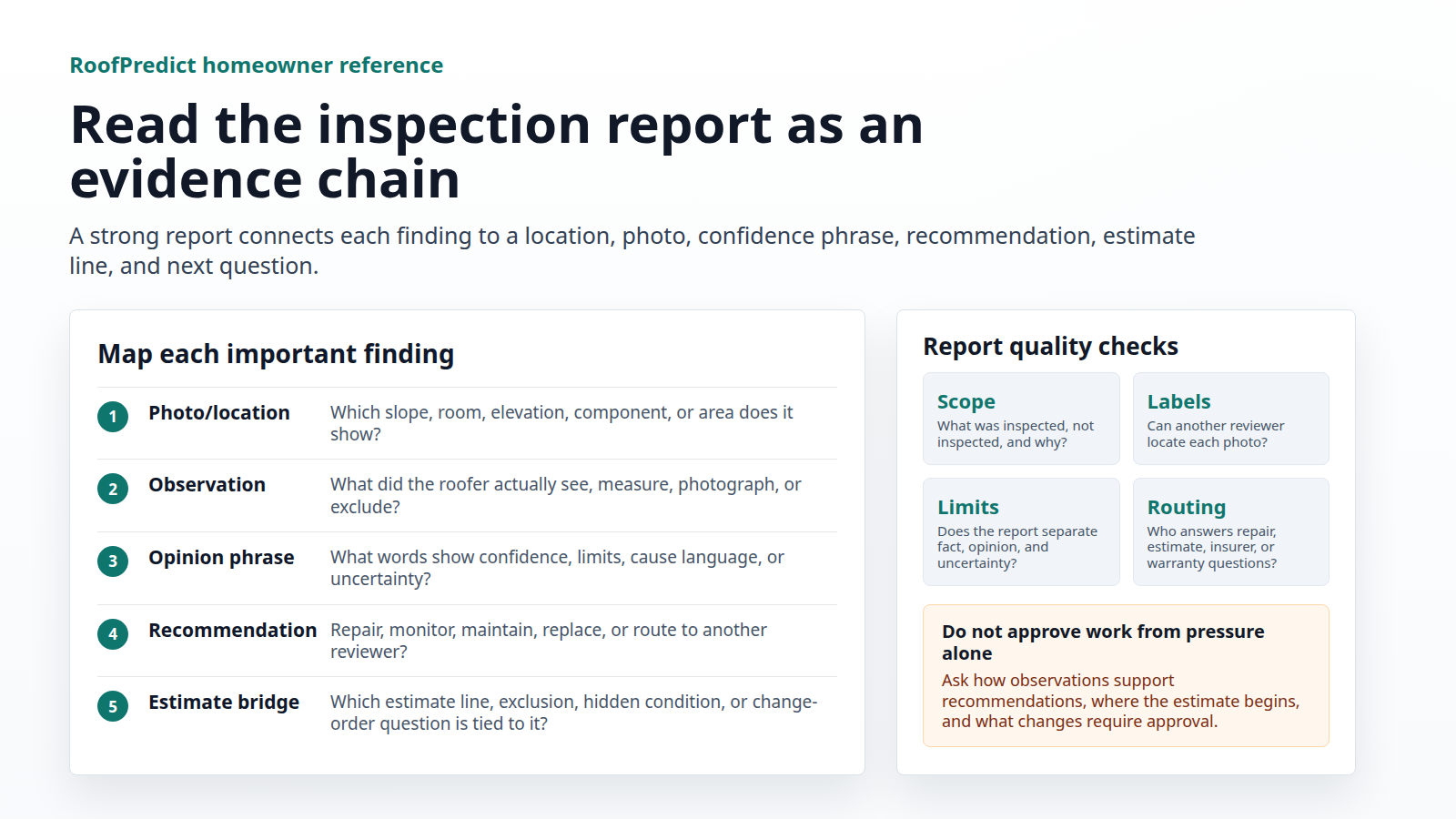
A roofer inspection report is easiest to read as a packet of evidence and next questions. Start with what was inspected, what was not inspected, which photos support each finding, what the roofer observed, what the roofer thinks those observations mean, and what action the roofer recommends. Do not treat the report by itself as an insurance decision, a warranty approval, a finished repair scope, or proof that every suggested item must be replaced.
The safest first pass is simple: read the report without trying to decide who is right. Circle missing labels, unclear photos, undefined terms, not-inspected areas, urgent items, and any sentence that jumps from a condition to a conclusion. Then send the roofer a short follow-up list. A good report becomes more useful when every observation can be tied to a location, photo, limit, and next step.
Consumer sources point in the same direction. The CFPB contractor guidance emphasizes written estimates, records, permits, materials, dates, warranties, receipts, and careful review before signing. The NAIC claims guidance and Ready.gov disaster recovery guidance both support a careful damage record. The OSHA roof inspection, tarping, and repair guidance is a reminder that reading a report is not the same as climbing up to verify it yourself.
For roofing companies, the same method is report quality control. A report that clearly separates inspection limits, photo labels, observations, confidence language, recommendations, estimate bridge, and follow-up owner is easier for homeowners to trust and easier for managers to review before the file becomes a callback, supplement dispute, warranty question, or real estate handoff.
Sources checked: June 8, 2026.
The Two-Pass Reading Method
Do not start by arguing with the recommendation. Start by sorting the report. A roofer inspection report becomes easier to read when you make two passes through it.
On the first pass, read for structure. Do not decide whether the roof needs work. Mark the report header, inspection date, inspected areas, not-inspected areas, photo labels, observations, opinions, recommendations, estimate attachment, contract language, insurance notes, warranty notes, and follow-up plan. If those pieces are mixed together, write a short label in the margin.
On the second pass, read for proof. For every important recommendation, ask four questions:
- What exact condition was observed?
- Where was it observed?
- Which photo, video, moisture reading, attic note, room note, storm date, or previous document supports it?
- What is the next step, and who owns that next step?
This keeps the report from becoming a vague argument about whether the roof is "bad." A useful report is more than a list of bad-looking things. It is a chain from inspection scope to evidence to interpretation to next action.
Use a simple color system if you are reading a PDF:
| Mark | Meaning | Example |
|---|---|---|
| Blue | A fact or label | Inspection date, front slope, attic not accessed |
| Yellow | A condition observed | Missing shingle, ceiling stain, lifted flashing |
| Orange | An opinion or cause phrase | Possible wind damage, consistent with hail, age-related |
| Red | Urgent or safety-related item | Active water entry, temporary protection, unsafe access |
| Green | Follow-up owner | Homeowner, roofer, insurer, agent, warranty reviewer |
If the report is printed, use circles and short notes. If it is digital, use comments. The format matters less than the separation. You want to know which sentences describe evidence and which sentences ask you to make a decision.
The same method helps contractors too. A roofing company that sends a report with clear labels, limits, photos, and next-step routing will usually get better homeowner questions than a company that sends a photo dump with a price attached.
Start With The Report Header And Limits
The header is not filler. It tells you whether the report can be matched later to a property, date, storm event, appointment, estimate, or insurance file. Confirm the address, inspection date, inspection company, inspector name, roof type if listed, and why the inspection happened. A report written after a hailstorm, a roof leak, a real estate sale, or a routine maintenance visit may use similar photos but answer different questions.
Next, find the scope and limits. A useful report tells you what the roofer inspected: exterior slopes, gutters, flashing, vents, chimney area, skylights, attic, ceilings, interior stains, garage, or ground-level collateral items. It also tells you what was not inspected and why. Examples include unsafe pitch, wet surface, no attic access, locked gate, snow cover, tree obstruction, interior room unavailable, or visible power-line risk.
Do not punish a report for naming limits. A clear limit is better than silence. The NWS after-severe-weather guidance tells people to check property only after the threat has ended, avoid damaged buildings, and contact local authorities around downed power lines. OSHA describes roof inspection, tarping, and repair as work involving ladders, work above ground, tools, power lines, and steep, slippery, or deteriorating surfaces. If the report says a section was not safely accessible, your next question is not "why did you skip it?" It is "what is the safest way to evaluate that area next?"
The Inspection Report Reading Matrix
Use this matrix before you react to the recommendation.
| Report section | What a useful report includes | How to read it | What to ask if missing | What it cannot decide by itself |
|---|---|---|---|---|
| Header | Address, date, company, inspector, inspection reason | Match it to the appointment, storm date, estimate, or claim file | Who inspected and when? | Coverage, payment, warranty, or repair approval |
| Scope | Roof areas, interior areas, attic areas, exterior items | Shows what the roofer actually looked at | Which areas were included? | Full-home condition if areas were outside scope |
| Limits | Unsafe areas, blocked access, weather, no attic access | Shows where the report is incomplete | How should this area be checked safely? | Hidden damage, unseen leaks, or unseen deck issues |
| Photo index | Wide shots, close-ups, labels, room names, slope names | Connects each picture to a finding | Which photo supports this line? | Cause, coverage, or repair need alone |
| Observations | Missing shingles, lifted flashing, stains, dents, granule loss | These are field notes | Where was it seen? | Why it happened in every case |
| Opinion language | Appears, possible, consistent with, likely, caused by | These words carry different confidence levels | What observation supports that phrase? | Legal, insurance, or warranty outcome |
| Recommendation | Monitor, repair, temporary protection, further inspection, replacement estimate | This is the roofer's next-step view | Is this urgent, temporary, or permanent? | Whether you must sign a contract |
| Estimate attachment | Line items, materials, quantities, labor, permits, exclusions | This may be a separate pricing document | Where does the report end and the estimate begin? | Final price without contract review |
| Insurance or warranty notes | Claim number, adjuster appointment, manufacturer mention, policy note | Treat as a routing note | Who needs to review this next? | Coverage, payment, depreciation, deductible, or warranty approval |
| Follow-up plan | Questions, next inspection, repair option, safety step, documentation request | Turns the report into action | What happens next and who owns it? | Final decision without reviewer input |
The point is not to make the report longer. The point is to make it easier to audit. A homeowner, roofer, adjuster, warranty reviewer, or future buyer should be able to tell which sentence came from a photo, which sentence came from judgment, and which sentence is a recommendation.
Report Quality Scorecard
Use a scorecard when you are not sure whether the report is clear enough to act on. The score does not decide whether the roof needs work. It tells you whether the document gives you enough structure to ask good follow-up questions.
| Factor | 0 Points | 1 Point | 2 Points |
|---|---|---|---|
| Header and identity | Missing address, date, inspector, or company | Most identity fields present but one is unclear | Address, date, company, inspector, and inspection reason are clear |
| Scope and limits | No inspected/not-inspected areas | Some limits named, but important gaps remain vague | Inspected areas, not-inspected areas, and safe follow-up are clear |
| Photo labeling | Photos are mostly unlabeled close-ups | Some labels exist, but location or finding is missing | Photos connect to slope, room, elevation, condition, or recommendation |
| Evidence chain | Recommendations float without support | Some findings connect to photos or notes | Major recommendations connect to observation, location, photo, and limit |
| Confidence language | Cause phrases sound certain without support | Careful words appear but are not explained | Possible, appears, consistent with, likely, and recommend are tied to evidence |
| Estimate bridge | Estimate is attached with no finding connection | Some estimate lines connect to findings | Major estimate lines map to report findings, assumptions, and exclusions |
| Reviewer routing | Insurance, warranty, safety, or code issues are mixed into contractor conclusions | Some routing is named | Roofer, insurer/agent, warranty reviewer, local authority, and homeowner tasks are separated |
| Follow-up plan | No next step or owner | Next step exists but owner/timing is vague | Each important item has owner, question, timing, and record |
Interpret the score:
| Total | What It Usually Means | Next Step |
|---|---|---|
| 0-5 | The report is too vague for a major decision | Ask for a clarified version before approving work |
| 6-10 | The report has useful evidence but needs follow-up | Send a focused question list and ask for photo/report labels |
| 11-14 | The report is usable if the estimate and reviewer boundaries are also clear | Bridge report findings to estimate lines and route open questions |
| 15-16 | The report is strong as a decision packet | Save it with the estimate, version notes, and follow-up records |
Do not use the score to punish a roofer for naming uncertainty. A report can score well while saying an area was not inspected or a cause is only possible. That is honest if the limit and next step are clear. The weak version is silence: no limit, no evidence chain, no confidence language, and no owner for the next question.
For roofing companies, this scorecard is also a quality-control tool. If reports often score low on photo labels or estimate bridge, the fix is operational: label photos better, connect recommendations to findings, and separate the report from the sales document.
Build A One-Page Report Map
Before calling the roofer back, reduce the report to one page. This is not busywork. It keeps the follow-up call from bouncing between photos, price, insurance, and vague concern.
Use this structure:
Property:
Inspection date:
Inspection reason:
Inspector/company:
Report version or file name:

Areas inspected:
Areas not inspected:
Reason for limits:
Safe next step for limits:

Most important observations:
1.
2.
3.

Cause or confidence phrases used:
1.
2.
3.

Recommendations:
Temporary protection:
Repair:
Monitor:
Further inspection:
Replacement estimate:

Photos that need better labels:
Questions for roofer:
Questions for insurer/agent:
Questions for warranty reviewer:
Documents to save:
Decision deadline:
This worksheet is especially useful when multiple people are involved. One person may have met the roofer. Another may be reading the report later. An insurer, agent, property manager, buyer, seller, warranty administrator, or second contractor may ask for the same information. A one-page map keeps the conversation from depending on memory.
Do not use the map to rewrite the roofer's conclusion. Use it to preserve the report's actual words. If the report says "possible," keep "possible." If it says "not inspected," keep "not inspected." If it says "recommend further evaluation," do not turn that into "confirmed replacement needed." Precision protects everyone.
A Report Can Be Useful Even When It Is Incomplete
Some homeowners treat any missing area as a sign that the report is worthless. That is not the right standard. Roof work has real safety limits. Wet roofs, steep slopes, snow, unstable decking, damaged ladders, downed lines, blocked attic access, locked gates, animals, and active weather can all limit inspection.
The question is whether the report names the limit clearly and explains the next safe step. A weak report says, "roof inspected" with no mention of the area that could not be reached. A stronger report says, "rear upper slope was not walked due to pitch and wet surface; photos were taken from ground and ladder position; recommend follow-up when dry by qualified personnel." That statement does not finish the inspection, but it makes the gap visible.
Treat incomplete areas as open tasks:
| Limit in report | What to ask |
|---|---|
| No attic access | Which interior or attic evidence would help, and who can access it safely? |
| Roof too steep or wet | Can the area be reviewed from ground, drone, photos, or a later safe visit? |
| Snow, debris, or tree cover | Should the report be updated after clearing or weather change? |
| Locked gate or unavailable room | Can the homeowner provide safe access for a follow-up? |
| Power line or storm hazard | Should the next step wait for utility or local authority clearance? |
| Interior stain but no roof access above it | Which roof area is likely above the room, and what evidence is missing? |
The goal is not to pressure someone into unsafe access. The goal is to stop hidden uncertainty from becoming a silent assumption.
Read Photos Like Evidence, Not Decoration
Photo-heavy reports can look persuasive even when the photos are hard to interpret. Your first task is to connect every important photo to a location and finding.
A wide photo is useful because it orients the reader. It may show the front slope, left slope, rear elevation, chimney side, valley, gutter line, skylight, attic area, or interior ceiling. A close-up is useful because it shows the condition. Close-ups without a wide shot can leave a reviewer guessing where the condition sits on the roof. A useful report often needs both.
Use this photo label decoder:
| Photo label | Homeowner meaning | Follow-up if unclear |
|---|---|---|
| Front slope wide | Orientation photo | Which finding is on this slope? |
| Rear slope close-up | Condition detail | Can you add a wide shot or mark the location? |
| Interior ceiling stain | Possible leak symptom | Which roof area is above this room? |
| Gutter or downspout dent | Collateral observation | Is this tied to a weather event or only noted as damage? |
| Flashing detail | Water-entry or installation area | Is this repair, maintenance, or monitor? |
| Attic photo | Interior support context | What area of the roof does this correspond to? |
| Not inspected | Access or safety limit | What safe next step would complete the review? |
Ready.gov and NAIC both support keeping photos, videos, lists, and receipts as part of a damage record. That does not mean every photo proves cause or coverage. It means photos become more useful when they are labeled, dated, and connected to the report text.
What Good Photo Labeling Looks Like
Photo labels do not need to be fancy. They need to be unambiguous. A homeowner who opens the report six months later should be able to tell where the photo was taken and why it matters.
Weak labels look like this:
- "IMG_4821"
- "damage"
- "roof issue"
- "hail?"
- "bad flashing"
- "leak"
Stronger labels look like this:
- "Front slope wide view from driveway"
- "Rear left valley close-up, debris at valley"
- "Kitchen ceiling stain under rear slope"
- "West elevation gutter dent, ground-level view"
- "Plumbing vent boot, right rear slope"
- "Attic view above upstairs bathroom, staining noted"
Good labels do three jobs. They orient the reader, connect the photo to the report text, and reduce later disagreement about what the image was meant to show. A close-up of a shingle mark is more useful when the report also includes a wide view of the slope. An interior ceiling stain is more useful when the report names the room and the roof area above it. A gutter dent is more useful when the report says whether it is merely noted or tied to a broader weather discussion.
Ask for labels when they are missing. You do not have to ask for a rewritten report. A short photo index may be enough:
Photo 3: front slope wide view, used for orientation.
Photo 4: front slope close-up, missing shingle at lower left.
Photo 5: upstairs hallway ceiling, stain below front slope.
Photo 6: attic above hallway, no active dripping visible at inspection.
Photo 7: right elevation gutter, dent noted but no coverage opinion.
That kind of index is valuable for the homeowner, roofer, and any later reviewer. It also discourages overreading. A photo index can say, "dent noted," without saying, "insurance owes for this gutter." Those are different claims.
Avoid The Photo Dump Problem
A photo dump is a report with many images and not enough connection between images and findings. It may feel detailed because the file is long, but length is not clarity.
Watch for these signs:
- many close-ups with no wide shots;
- photos with no slope, room, or elevation labels;
- duplicate photos that do not add new information;
- no separation between storm photos, maintenance photos, and estimate photos;
- screenshots from weather apps with no explanation of why they are included;
- interior stain photos with no roof-area discussion;
- gutter or siding photos mixed into roof conclusions without labels;
- estimate pages attached without showing which finding each line item addresses.
The fix is usually a short follow-up, not a fight. Ask the roofer to connect the important photos to the important recommendations. If a finding is material enough to change the next step, it should be clear enough to locate.
Separate Observations, Opinions, And Recommendations
Many homeowner misunderstandings start when a report mixes three different things in one paragraph.
An observation is something seen or documented: missing shingles on the rear slope, staining on the upstairs ceiling, cracked boot at a plumbing vent, granule accumulation in gutters, dented soft metal, lifted flashing, exposed fastener, loose ridge cap, or unsealed shingle tab.
An opinion interprets the observation: possible wind-related uplift, condition consistent with hail impact, age-related granule loss, maintenance issue, installation issue, ventilation concern, product concern, or active leak path. Opinion language needs support from photos, location, surrounding conditions, and the inspector's limits.
A recommendation says what to do next: monitor, clean debris, reseal, repair flashing, install temporary protection, request further inspection, get an estimate, ask the insurer or agent what process applies, ask about warranty review, or consider replacement. Recommendations are not all equal. Some are urgent safety or water-intrusion steps. Some are maintenance. Some are pricing conversations. Some require insurer, manufacturer, engineer, code, or legal review before anyone treats them as final.
Cause language deserves extra care. IBHS explains that hail can damage roof coverings and other property, but it also names look-alikes such as mechanical marks, blisters, general granule loss, manufacturer defects, installation marks, and natural weathering. The Canadian Roofing Contractors Association steep-roof troubleshooting guidance also shows why reported conditions need roof-specific interpretation rather than shortcut labels. So if a report says "consistent with hail," "possible wind damage," or "appears age-related," ask what observed facts support that phrase. Do not rewrite the report into a stronger statement than it actually makes.
Read Confidence Words Carefully
Inspection reports often use confidence words. Those words are not all the same.
| Phrase in report | Plain-English meaning | Follow-up question |
|---|---|---|
| "Observed" | The inspector says they saw it | Where is it shown or located? |
| "Visible" | It was apparent from the inspection position | Was any area blocked or not inspected? |
| "Possible" | The report is not making a firm conclusion | What additional evidence would raise confidence? |
| "Appears" | The inspector is giving a visual judgment | What facts support that appearance? |
| "Consistent with" | The condition resembles a known pattern | What look-alikes were considered? |
| "Likely" | Stronger judgment, still not always final | What evidence makes it likely? |
| "Requires further evaluation" | Current evidence is incomplete | Who should evaluate it, and by when? |
| "Recommend" | Proposed next step | Is it urgent, temporary, repair, monitor, or replacement-related? |
This is one of the most important parts of reading a report. If a roofer uses careful language, do not punish that carefulness. Ask for the evidence behind it. Careful language may be more honest than a report that states every cause as a certainty.
At the same time, do not let vague confidence words carry the whole recommendation. A report that says "possible storm damage" should still explain the observed condition, location, photo support, inspection limits, and next step. A report that says "age-related" should still say what visible age or maintenance indicators were observed. A report that says "active leak" should explain what active evidence was seen at the time, such as dripping, wet insulation, moisture reading, staining pattern, or recent interior damage.
Build A Date Chain Before You Accept A Cause Story
Dates are part of the evidence. A roof report can look convincing while leaving the timeline blurry: a storm happened in the area, a leak was noticed later, a roofer inspected the roof after that, the estimate was written a few days after the inspection, and an insurer, buyer, warranty reviewer, or second roofer may see the file weeks later. If those dates are not separated, everyone may read a different story into the same packet.
Build a date chain before you accept any cause story. The date chain does not prove storm damage, age-related wear, installation error, warranty eligibility, or insurance coverage. It keeps the report honest about sequence. It also gives the roofer a fair chance to correct the record before a wrong date spreads into an estimate, claim file, real estate repair request, or warranty packet.
Use this table:
| Date or time window | Why it matters | Follow-up question if unclear |
|---|---|---|
| Roof installation or approximate age | Helps frame ordinary aging, material expectations, and prior warranty context | What source supports this roof age: permit, seller disclosure, invoice, satellite-age estimate, or homeowner memory? |
| Prior repair or maintenance date | Prevents old repairs from being mistaken for new damage | Was this condition present before the current inspection reason? |
| Storm or weather date | Gives context for storm-related language without making the weather record decide the roof condition | Which event is the report referencing, and is it only context or part of the evidence chain? |
| Leak discovery date | Separates when water was noticed from when the roof condition may have started | When was the stain, drip, odor, wet insulation, or ceiling change first observed? |
| Temporary protection date | Shows whether tarping, sealing, or emergency work changed later evidence | Was any temporary work completed before photos were taken? |
| Inspection date and time | Ties the report to surface conditions, access limits, and what was visible that day | Was the roof wet, covered, unsafe, shaded, snow-covered, or partially inaccessible? |
| Report date | Shows when the findings were written down | Was the report written the same day as the inspection or later from notes and photos? |
| Estimate date | Prevents the estimate from being treated as the inspection itself | Did the estimate use the same findings, or were assumptions added after the report? |
| Revision date | Preserves what changed after follow-up questions | What changed from the previous version: photo labels, scope, wording, estimate lines, or limits? |
| Outside-review date | Keeps insurer, warranty, buyer, lender, HOA, or property-manager review separate from the roofer's report | Who reviewed it, what did they review, and what decision did they actually make? |
The weakest timeline is vague: "after the storm," "recent leak," "old roof," "previous repair," "inspection completed," "estimate sent." Those phrases may be enough for a casual conversation, but they are weak inside a report packet. Ask for dates, date ranges, or a clear note that the date is unknown.
Use five rules while building the date chain.
First, separate event dates from discovery dates. A hailstorm date, wind event date, leak-discovery date, ceiling-stain date, and inspection date can all be different. A report that collapses them into one phrase may make the file sound more certain than it is.
Second, separate homeowner memory from records. Homeowner memory can start the conversation, but records are stronger: invoice, permit, prior inspection, seller disclosure, property-management note, dated photo, weather alert, prior claim correspondence, warranty paperwork, or contractor message. The CFPB contractor guidance emphasizes written records, receipts, materials, dates, warranties, and careful review before signing. A date chain is one way to make those records usable instead of scattered.
Third, treat weather as context until the report connects it to roof evidence. NWS after-severe-weather guidance is useful for safety timing and post-storm caution, but a weather date alone is not a roof-condition finding. The report still needs location, observation, photo support, confidence language, and inspection limits.
Fourth, mark any evidence that changed before inspection. A tarp, temporary seal, emergency repair, cleared debris pile, removed branch, cleaned gutter, or interior cleanup may be necessary, but it can change what the roofer sees later. The report should say if a condition was observed directly, reported by the homeowner, shown in older photos, or inferred from the remaining signs.
Fifth, preserve revision history. If the roofer clarifies a date, relabels photos, changes "storm damage" to "possible storm-related condition," adds a limit, or moves an item from replacement to further evaluation, save the old version and the new version. Do not silently overwrite the old PDF on your side. Name the new file with the revision date so future reviewers know which document they saw.
Here is a practical example:
Roof age: believed 2014, source pending seller disclosure.
Prior work: pipe boot repaired 2022, invoice saved.
Weather context: hail reported in the area on April 11, exact property impact not decided by report.
Leak discovery: bedroom stain noticed April 19.
Temporary action: bucket placed April 19; no roof tarp before inspection.
Inspection: roofer inspected exterior and bedroom ceiling April 22; attic not accessed.
Report: PDF sent April 23.
Estimate: replacement estimate sent April 24; decking listed as allowance.
Clarification: roofer added photo labels April 26 and kept attic access as open limit.
Outside review: homeowner plans insurer/agent call April 27 before signing.
That timeline still does not decide the answer. It does something more useful: it shows what is known, what is reported, what is missing, and which next question belongs to which person. It also protects good roofers. If the report is careful, the date chain shows that carefulness. If the report is sloppy, the date chain exposes the weak spots without turning the conversation hostile.
For roofing companies, this is a strong operational habit. A branded homeowner report should carry roof age, inspection reason, storm-exposure context when relevant, inspection date, report date, and follow-up owner as structured fields. RoofPredict can support that workflow by giving the roofer roof-age and storm-exposure context before the appointment, then helping the company route follow-up tasks after the report is delivered. The contractor still owns the inspection judgment, wording, photos, estimate, and customer conversation.
If the timeline is wrong, ask for a corrected report instead of trying to explain the error verbally. Use a short note:
Can you revise the report date chain before I use this packet?
The report lists the leak as happening on May 8, but I first noticed the ceiling stain on May 11.
The May 8 date appears to be the storm-date context, not the leak-discovery date.
Please separate storm date, leak discovery date, inspection date, report date, and estimate date.
This kind of correction matters because report packets travel. The roofer, homeowner, insurer or agent, warranty reviewer, buyer, seller, property manager, lender, or second contractor may each see only part of the file. A clean date chain keeps the file readable after it leaves the first conversation.
Sort Findings By Decision Type
Not every finding asks for the same kind of decision. Mixing them together makes a report feel more alarming than it may be.
Use five buckets:
| Bucket | Examples | Homeowner action |
|---|---|---|
| Safety or active water | Active leak, unsafe access, exposed opening, temporary protection | Ask what immediate safe step is recommended and who should do it |
| Repair detail | Vent boot, flashing detail, missing shingle, lifted edge | Ask for scope, material, warranty, timing, and photos |
| Maintenance | Debris, clogged gutter, sealant wear, minor exposed fastener note | Ask whether it is routine maintenance or tied to a larger issue |
| Further evaluation | Hidden decking, attic access, steep slope, moisture source unclear | Ask who evaluates it and what evidence is needed |
| Replacement or major project | Full roof replacement, slope replacement, broad system concern | Ask for written scope, exclusions, estimate, alternatives, and reviewer boundaries |
This sorting helps you avoid two bad reactions. The first is ignoring an urgent item because the full report feels confusing. The second is treating every small maintenance note as proof that a full project is needed.
If the report includes many low-severity notes, ask the roofer to rank them:
Which items are urgent?
Which items should be repaired soon?
Which items are maintenance?
Which items can be monitored?
Which items require another reviewer before a decision?
That short list often produces more clarity than a long debate over individual photos.
Inspection Finding Versus Repair Scope
An inspection report and a repair estimate can travel in the same PDF, but they are not the same document.
The inspection finding says what was observed. The repair scope says what work is proposed. The estimate prices the proposed work. The contract governs what you are agreeing to buy. Those boundaries matter because a homeowner may agree with an observation, need more detail on the recommendation, and still want more than one bid before signing.
The CFPB recommends written estimates, careful contractor questions, signed contracts, warranties, guarantees, receipts, and records of materials, quantities, dates, prices, payment schedule, permits, and verbal promises. When the roofer report includes a scope or estimate, read it with those categories in mind:
- Does the report identify the observed problem?
- Does the estimate explain which work fixes that problem?
- Does the document separate temporary protection from permanent repair?
- Does it name exclusions and assumptions?
- Does it say who handles permits if permits are required?
- Does it distinguish materials, labor, disposal, ventilation, flashing, decking, gutters, interior work, or other trades?
These are clarity questions. They are not accusations.
Compare The Report To The Estimate Without Merging Them
When the inspection report and estimate arrive together, homeowners often read them as one statement: "the report found damage, therefore the estimate is the answer." Sometimes that may be reasonable. Sometimes the estimate includes optional work, code-related assumptions, upgrade choices, temporary measures, or items that were not fully established by the inspection.
Make a simple bridge table:
| Report finding | Supporting photo or note | Estimate line | Question |
|---|---|---|---|
| Missing shingle on rear slope | Photo 7, rear slope close-up | Replace damaged shingle area | Is this repair area or full slope work? |
| Ceiling stain in bedroom | Photo 12, interior stain | No interior line | Is interior repair excluded? |
| Vent boot cracked | Photo 9, roof penetration | Pipe boot replacement | What material and warranty apply? |
| Attic not accessed | Limit note | Decking allowance | What happens if hidden decking is found? |
| Hail-like marks noted | Photos 14-18 | Full replacement estimate | What evidence supports replacement versus repair or further review? |
This table does not decide the right work. It shows whether the estimate follows the report. If the estimate has lines with no related finding, ask why. If the report has important findings with no estimate line, ask whether they are excluded, deferred, or handled by another trade.
The CFPB contractor guidance supports getting written estimates and records. Use that idea narrowly: you are asking for written clarity, not trying to turn a public consumer page into legal or contract advice.
Hidden Conditions And Change Orders
Roof reports often include phrases about hidden decking, concealed damage, rotted fascia, deteriorated underlayment, code items, ventilation, or other conditions that may not be fully visible before work starts. Those phrases can be reasonable, but they should not be invisible in the budget conversation.
Ask three questions before signing:
- What hidden conditions are possible based on this report?
- How will the contractor document them if they are found?
- How will pricing, approval, timing, and photos be handled before extra work is done?
This is not the same as asking the roofer to guarantee what is hidden. It is asking for a process. A strong report-and-estimate packet explains the known condition, known limits, possible hidden conditions, and change-order process in plain language.
Keep the boundary clear. A homeowner should not climb up to verify hidden conditions. A homeowner can ask for photos, explanation, and written approval steps.
Insurance And Warranty Mentions
A roofer report may mention insurance, claim numbers, adjusters, deductibles, replacement cost, actual cash value, manufacturer warranty, installation warranty, or product concerns. Treat that language as a routing note until the right reviewer weighs in.
| If the report says... | What it can support | What it cannot decide |
|---|---|---|
| "Send to insurer" | A documentation packet may be useful for a claim conversation | Coverage, payment, deductible, or depreciation |
| "Storm related" | A question about weather, photos, and observed conditions | Final cause or claim approval |
| "Warranty concern" | A question for installer, manufacturer, or warranty reviewer | Warranty eligibility |
| "Replacement recommended" | A proposed next step based on the roofer's view | Contract approval or insurer agreement |
| "Temporary repair needed" | A possible mitigation or protection step | Whether the policy reimburses it |
| "Further inspection required" | A limit in current evidence | Hidden condition or final repair scope |
The CFPB disaster property guidance supports contacting the right insurer and asking for a policy copy when needed. NAIC guidance supports documenting losses and keeping receipts. Those sources do not turn a roofer report into coverage advice. Keep the report clean: observed condition, supporting photo, limit, recommendation, and who needs to review it next.
Four Report Scenarios And How To Respond
Different inspection reports need different follow-up. Use the report's purpose to choose the next conversation.
The report follows a storm
A storm-related report should preserve dates, locations, photos, interior symptoms, collateral observations, and inspection limits. Ask the roofer which observations were made and which weather or cause language is only context. Keep insurer and agent questions separate from contractor scope questions.
Good follow-up:
Can you identify which photos show observed roof conditions, which photos are collateral observations, and which parts of the report are weather context rather than a coverage opinion?
Avoid:
Can you say the insurer has to replace the roof?
The report follows a leak
A leak report should separate symptoms from source. Interior staining, wet insulation, ceiling damage, or dripping may show a problem, but the exact roof entry point may need more evidence. Ask what was seen, what was not accessible, whether temporary protection is needed, and whether interior documentation should be saved.
Good follow-up:
Which roof area corresponds to the interior stain, what evidence supports the likely entry point, and what temporary or follow-up step is recommended?
Avoid:
Is this definitely the only leak source?
The report is for a real estate transaction
A transaction-related report may become part of a broader negotiation, disclosure, inspection, appraisal, or financing conversation. Keep the roofer's role narrow. The roofer can explain visible roof conditions, limits, and repair or replacement scope. Other parties handle contract, disclosure, valuation, and legal questions.
Good follow-up:
Can you separate maintenance items, recommended repairs, further-evaluation items, and replacement-related recommendations so the parties can route them correctly?
Avoid:
Can you tell us what the seller has to pay?
The report is routine maintenance
A routine maintenance report should not sound like a crisis unless there is an actual urgent condition. Ask for a priority list. Separate cleaning, sealant, small repair, monitoring, and future replacement planning.
Good follow-up:
Which items are routine maintenance, which are repair recommendations, and which items should simply be monitored until the next inspection?
Avoid:
Does every item in the report mean the roof is failing?
Red Flags In A Roofer Inspection Report
Red flags do not prove bad intent. They tell you to slow down and ask for written clarification. The FTC's home improvement guidance also warns homeowners to be careful with pressure, payment, verbal promises, and contractor claims.
Watch for:
- no inspection date;
- no property address;
- no inspector or company name;
- no limits or not-inspected areas;
- many unlabeled close-up photos;
- cause conclusions with no supporting observations;
- strong insurance or warranty promises from the contractor;
- pressure to sign before you can ask questions;
- estimate lines that do not connect to report findings;
- no distinction between temporary protection and permanent work;
- no exclusions, assumptions, or change-order process;
- no safety boundary around roof access;
- unclear handling of interior damage, gutters, fascia, decking, ventilation, or other trades.
Your response should be calm and specific:
Before I decide anything, can you send a clearer version that labels the key photos, identifies any not-inspected areas, separates observations from recommendations, and connects each estimate line to the report finding it addresses?
That request is reasonable. It asks for clarity, not perfection.
When The Report Feels Like A Sales Pitch
Some reports are part inspection, part proposal, and part sales follow-up. That is not automatically wrong. A roofing company may inspect a roof and provide recommended work in the same packet. The problem starts when the document makes it hard to tell where evidence ends and persuasion begins.
Watch for these patterns:
| Pattern | Why It Creates Confusion | Better Request |
|---|---|---|
| Every finding leads to the same replacement recommendation | The report may not be weighing repair, monitor, temporary protection, or further evaluation separately | Ask for a priority list and alternatives considered |
| Strong urgency with weak evidence | Pressure can outrun the report | Ask which photos, limits, or active conditions justify urgency |
| Insurance language inside sales language | Coverage and contractor scope can get mixed together | Ask which sentences are documentation and which are contractor recommendations |
| Many warnings but few locations | The homeowner cannot verify what area each warning refers to | Ask for slope, room, elevation, or photo labels |
| Verbal promises not reflected in the document | Later reviewers may only see the written packet | Ask for the promise in the estimate, contract, or follow-up email |
| Optional upgrades presented as required findings | The report may mix needed work with preference or upgrade choices | Ask what is repair, replacement, upgrade, maintenance, or optional |
Use a neutral reset:
I understand that the report may lead to recommended work. Before I approve anything, can you separate the observed findings, inspection limits, recommended repairs or replacement, optional upgrades, and estimate lines?
That message keeps the conversation professional. It does not accuse the roofer of overselling. It asks for the packet to be readable by someone who was not on the roof.
If the answer still blends evidence, urgency, insurance, and price into one claim, slow the decision down. The stronger the recommendation, the more important the evidence chain becomes.
Version Control For Roof Reports
Roof reports often change. A contractor may add photos, correct an address, update an estimate, add an attic note, attach an insurance claim number, or send a revised scope after a second visit. Save versions instead of letting newer emails replace older ones.
Use boring file names:
2026-05-29_roof-inspection-report_original.pdf
2026-05-30_roof-inspection-report_photo-labels-added.pdf
2026-06-02_roof-estimate_revised-scope.pdf
2026-06-03_roofer-follow-up-answers.txt
2026-06-04_interior-stain-photos.zip
Keep a short version note:
| Date | File | What changed | Who sent it | Open question |
|---|---|---|---|---|
| May 29 | Original report | First inspection report | Roofer | Photo labels missing |
| May 30 | Label update | Added slope labels | Roofer | Attic still not accessed |
| June 2 | Revised estimate | Added decking allowance | Roofer | Change-order approval process |
This protects the homeowner from confusion. It also helps the contractor. If everyone knows which report version is being discussed, fewer decisions get made from stale information.
Where RoofPredict Fits
RoofPredict is useful here when a roofing team wants to turn property context into a clearer homeowner follow-up. RoofPredict is a contractor-facing sales and report workflow: it helps teams prioritize homes by roof age and storm exposure, send branded homeowner reports, and route interested homeowners back into a CRM-connected inspection process.
That is different from a private insurance file, warranty file, or legal record system. Keep policy, claim, warranty, and legal documents only in systems approved for that purpose, and share them only with permission. A roofer using RoofPredict can still use the same report-reading framework to make the inspection conversation cleaner:
- report date and inspection reason;
- roof age and storm exposure context;
- branded homeowner report or summary;
- photo labels by slope, elevation, room, or issue;
- observed conditions that need follow-up;
- limits and not-inspected areas;
- open homeowner questions;
- inspection request, CRM status, and next-step routing.
RoofPredict should not be positioned as a substitute for the roofer, insurer, adjuster, manufacturer, attorney, engineer, or safety professional. A qualified roofing professional still has to inspect and explain the property-specific condition.
For roofing teams, the practical opportunity is consistency. A report that follows the same pattern each time is easier for a homeowner to trust and easier for a sales manager to review:
Property context:
Inspection reason:
Inspection limits:
Photo index:
Observed conditions:
Confidence language:
Recommendation type:
Estimate attachment:
Follow-up owner:
CRM next step:
That is where RoofPredict can support the workflow without pretending to be the decision maker. Roof age and storm exposure can shape the conversation. A branded homeowner report can make outreach easier to understand. CRM routing can reduce dropped follow-ups. None of that replaces the field inspection or the homeowner's need for written answers.
For Roofers: Use The Report As A QA Artifact
Roofing teams should treat each inspection report as a quality artifact, not a photo folder with a price attached. The report is often the first document that has to survive outside the sales call. A homeowner may forward it to a spouse, property manager, buyer, insurer, agent, warranty reviewer, lender, HOA, or second roofer. If the report is unclear, the company loses control of the meaning as soon as the PDF leaves the inbox.
Use a pre-send QA checklist:
| Report Element | Manager Check | Why It Matters |
|---|---|---|
| Property identity | Address, inspection date, inspection reason, inspector, and report version are present | Prevents reports from being detached from the right appointment or storm context |
| Scope and limits | Inspected areas and not-inspected areas are named | Makes safety limits and missing evidence visible instead of implied |
| Photo index | Major findings have wide/location photos and close evidence photos | Reduces homeowner confusion and second-review disputes |
| Observation language | The report separates observed facts from possible cause language | Prevents careful notes from turning into unsupported certainty |
| Recommendation lane | Each recommendation is urgent, repair, maintenance, monitor, further evaluation, or replacement-related | Keeps every finding from sounding like the same sales conclusion |
| Estimate bridge | Major estimate lines map back to report findings, assumptions, or exclusions | Helps the homeowner compare scope instead of reacting only to price |
| Reviewer routing | Insurance, warranty, code, safety, engineering, and other-trade questions have the right next owner | Keeps the roofer inside the proper decision lane |
| Follow-up owner | Clarification questions, revised photos, estimate changes, and CRM tasks have an owner and date | Prevents the report from becoming a dead-end document |
This is where RoofPredict can support a roofer-first workflow. Roof age and storm exposure can prepare the rep before the appointment. A branded homeowner report can set context. The inspection report can then become the field artifact: what was inspected, what was limited, what was observed, how confident the roofer is, what work is proposed, and who owns the next question. CRM routing keeps the answer from disappearing after the homeowner replies.
Keep the claims narrow. A clean report does not prove coverage, warranty eligibility, storm cause, code compliance, future performance, or final scope. It proves that the roofing company documented what it saw, named its limits, explained its recommendations, preserved uncertainty, and gave the homeowner a readable next step.
Sample Follow-Up Message To The Roofer
You do not need a long message. Send a specific one.
Hi [Name],

Thanks for sending the inspection report. Before I decide on next steps, can you help me clarify a few items?

1. Which areas were inspected, and which areas were not inspected?
2. For the main findings, can you connect each finding to the photo number or label?
3. Which recommendations are urgent, which are repair items, which are maintenance, and which should be monitored?
4. Are any estimate lines tied to hidden conditions or assumptions?
5. If insurance, warranty, or another reviewer is involved, which parts of the report are meant only as documentation rather than a final decision?

I am not trying to re-inspect the roof myself. I just want the report, photos, estimate, and open questions organized before I approve anything.

Thanks,
[Name]
A clear contractor should be able to answer those questions or explain why more inspection is needed. If the answer is "just trust us," slow down.
What To Save After The Call
After the follow-up call or email, save the answers next to the report. Do not rely on memory.
Save:
- original report PDF;
- revised report PDF if any;
- photo index or labeled photo set;
- estimate or scope;
- written answers from the roofer;
- date and time of calls;
- notes about not-inspected areas;
- temporary protection recommendation if any;
- receipts, invoices, warranties, and permits if work starts;
- insurer, agent, warranty, or other reviewer messages when relevant and allowed.
Keep sensitive policy, claim, warranty, and legal documents in systems approved for that purpose. RoofPredict should be used for the roofing team's approved workflow context, not as a substitute private claim or legal file.
After The Roofer Answers Your Questions
A clarification call or email should change the report packet. Do not let the answer disappear into a text thread. Add a short dated update that shows what changed, what stayed open, and which decision lane each item belongs to.
Use this update table:
| Update field | What to record | Why it matters |
|---|---|---|
| Answer date | Date and method: call, email, revised PDF, photo set, estimate update | Keeps the sequence clear |
| Report item answered | The finding, photo, estimate line, hidden condition, or not-inspected area | Prevents the answer from floating away from the original issue |
| What changed | New label, new photo, revised recommendation, new exclusion, or corrected assumption | Shows whether the report became clearer |
| What did not change | Item still open, area still uninspected, cause still uncertain, price still estimated | Keeps uncertainty visible |
| Decision lane | Monitor, repair, temporary protection, further inspection, estimate review, insurer/agent question, warranty question, or hold | Stops every answer from becoming a yes/no replacement decision |
| Record saved | Revised report, email, photo index, estimate version, receipt, warranty note, or open-items list | Gives future reviewers the same file trail |
Here is a simple example:
Update: June 2
Roofer clarified photos 8-12 as front slope marks.
Rear upper slope still not inspected because access was unsafe during the first visit.
Estimate line 4 is tied to temporary protection, not final repair.
Decking note remains a hidden-condition item with photo approval needed if opened.
Next owner: roofer for safe follow-up inspection, homeowner for insurer/agent process question.
This update is more useful than a vague note that says "roofer explained everything." It separates the clarified items from the items that still need attention. It also keeps temporary protection, repair work, monitor items, hidden conditions, and insurer or warranty questions in separate lanes.
If the roofer sends a revised report, save it as a new version. Do not delete the old one. The old version shows what you received first. The new version shows what was clarified later. A future buyer, insurer, warranty reviewer, property manager, second contractor, or company manager may need to see that sequence.
RoofPredict should support this type of report lifecycle. The useful product record is not only the first homeowner report. It is the sequence: property context, inspection reason, report version, photo labels, clarification questions, answer owner, revised estimate, CRM status, and next follow-up. That sequence helps the roofing team stay organized while keeping coverage, warranty, safety, and legal decisions with the right reviewer.
Who Should Receive Which Version Of The Report
A roofer inspection report can end up in several conversations: the original roofer, a second contractor, an insurer or agent, a warranty reviewer, a real estate party, a mortgage servicer, or a property manager. Do not forward every file to every person by habit. Send the version that matches the question, and keep private policy, claim, legal, payment, and warranty records in the right system.
Use this routing table before forwarding the report:
| Recipient | Send First | Include Only If Relevant | Keep Separate |
|---|---|---|---|
| Original roofer | The report version, your clarification card, photo-label questions, not-inspected-area questions, and estimate bridge questions. | Interior photos, prior repair notes, or safe homeowner photos that help the roofer answer the report question. | Insurer claim strategy, private policy documents, legal advice, or unrelated bids. |
| Second roofer | The report, labeled photos, open questions, and a note asking for independent review of observed conditions. | Estimate attachment if scope comparison is part of the assignment. | The first roofer's private pricing conversation unless comparison is the reason for the review. |
| Insurer or agent | Damage record, report, photos, receipts, dates, and the questions you need answered under your policy process. | Contractor estimate, temporary protection invoices, mitigation records, and insurer-requested forms. | Contractor sales notes, warranty speculation, or unsupported cause statements. |
| Warranty reviewer or manufacturer | Product identity, install date, affected area, photo map, report findings, sample status, and warranty questions. | Prior repair records, ownership/transfer records, and manufacturer-requested documents. | Insurance coverage conclusions, broad storm conclusions, or pressure language. |
| Buyer, seller, or agent | The report version, known open questions, repaired items, deferred items, and who performed the work. | Paid invoices, permits, transferable warranty documents, or follow-up inspection notes. | Private claim details, payment disputes, or statements that overstate what the report proves. |
| Mortgage servicer or lender | Only the documents specifically requested for a claim-check, repair, escrow, or property-protection process. | Invoices, completion photos, contractor license or tax forms, or inspection confirmations if requested. | Unrequested private notes, unrelated bids, or speculative cause arguments. |
| Property manager or HOA | Exterior findings, access questions, community rule questions, and scheduling notes. | Photos, repair timing, or architectural review documents if the issue touches shared rules. | Insurance, warranty, or payment records that the manager does not need. |
This table does not replace legal, insurance, or warranty advice. It is a document-control habit. A report becomes easier to use when each recipient gets the smallest complete packet for their role. The original roofer needs clear questions. A second roofer needs enough context to avoid repeating confusion. An insurer or agent needs the claim-process records they ask for. A warranty reviewer needs product and evidence details. A buyer or agent needs what affects the transaction. A lender or servicer needs only the requested claim-check or repair documentation.
Before sending, write a one-line cover note:
I am sending this report for [specific purpose]. The open questions are [one to three questions]. Please do not treat the attached report as a coverage, warranty, code, or legal conclusion unless your role is to review that issue.
That note keeps the document from becoming more confident as it gets forwarded. It also protects the homeowner from accidentally turning a roofer's observation into a warranty claim, an insurance statement, a real estate disclosure conclusion, or a signed scope approval.
When Two Reports Disagree
Two roofers can inspect the same property and write reports that feel completely different. That does not automatically mean one report is dishonest. The inspection reason, access, weather, roof area viewed, photo labels, estimate attachment, and business context may be different. Treat disagreement as a comparison task before turning it into a trust problem.
Start by lining the reports up by finding, not by company:
| Comparison Item | Report A | Report B | Question To Ask |
|---|---|---|---|
| Inspection date and weather | Date, surface condition, access limits | Date, surface condition, access limits | Did one roofer inspect under safer or clearer conditions? |
| Areas inspected | Slopes, attic, interior rooms, gutters, flashing | Slopes, attic, interior rooms, gutters, flashing | Did both reports look at the same areas? |
| Main observation | Exact words from report | Exact words from report | Are they describing the same condition or different conditions? |
| Photo support | Photo numbers and labels | Photo numbers and labels | Which photos actually show the disputed item? |
| Confidence language | Possible, consistent with, observed, recommend | Possible, consistent with, observed, recommend | Is one report more certain, or just worded differently? |
| Recommendation | Monitor, repair, temporary protection, replacement, further inspection | Monitor, repair, temporary protection, replacement, further inspection | Is the disagreement about condition, urgency, or scope? |
| Estimate bridge | Lines tied to finding | Lines tied to finding | Does the price difference come from different work, assumptions, or exclusions? |
The goal is to find the exact disagreement. "One roofer says repair and one says replace" is too broad. A useful comparison says, "Both reports note front-slope granule loss; Report A recommends monitoring and Report B recommends replacement, but Report B does not identify which photos support full replacement." That is a question you can ask.
Use neutral language when you send the comparison:
I have two reports that appear to differ on [item]. I am not asking you to comment on the other contractor. I am asking which observations, photos, limits, and assumptions support your recommendation so I can compare the reports accurately.
This keeps the conversation professional and protects the homeowner from becoming the messenger in a contractor argument. If the reports still conflict after clarification, the next step may be another qualified review, an insurer or agent process question, a warranty reviewer, an engineer, a local authority, or simply more time and monitoring depending on the issue. Do not force every disagreement into a same-day yes/no decision.
Build A Decision Board Before Signing
Before approving work from an inspection report, make a small decision board. The board should separate what is confirmed, what is recommended, what is assumed, what is optional, and what is still open.
| Board Column | What Goes There | Example |
|---|---|---|
| Confirmed observation | Reported condition tied to location and photo | "Photo 14: cracked pipe boot on rear right slope." |
| Recommendation | What the roofer proposes | "Replace pipe boot and seal surrounding area." |
| Assumption | Hidden or uncertain item that may affect work | "Decking condition unknown until opened." |
| Optional item | Upgrade, maintenance, or preference item | "Replace older but functioning roof accessories while crew is onsite." |
| Outside reviewer | Insurer, agent, warranty reviewer, engineer, local authority, or second roofer | "Ask warranty reviewer whether product documentation is needed." |
| Owner and deadline | Who owes the next answer | "Roofer to send revised estimate by Friday." |
| Signing condition | What must be clear before approval | "Estimate must show hidden-decking unit price and photo approval process." |
This board is useful because many inspection-report disputes are actually category problems. A homeowner may think a hidden-condition allowance is a confirmed defect. A roofer may think an optional accessory replacement is obviously efficient. An insurer may treat a contractor note as documentation, not as a coverage decision. A warranty reviewer may need product identity before reviewing anything. The board keeps those lanes visible.
If the decision is simple, the board can be short. If the decision involves major money, hidden conditions, insurance routing, warranty routing, real estate timing, or safety, the board should be written before signing. A written board is not a legal document. It is a way to make sure the report, estimate, and open questions are pointing to the same decision.
Clarification Request Card
Before you use the report to approve work, send one concise card for the items that drive the decision. This is more effective than sending a long list of every typo or minor photo.
Report item:
Photo/location:
What I understand:
What is unclear:
Decision affected:
Who should answer:
Record needed:
Examples:
| Report Item | What Is Unclear | Decision Affected | Record Needed |
|---|---|---|---|
| "Possible wind damage on rear slope" | Which marks support wind language, and which areas were not inspected? | Claim routing and repair/replacement discussion | Photo labels and confidence explanation |
| "Replace roof recommended" | Which observations make full replacement the recommendation instead of repair or further review? | Major project approval | Finding-to-estimate bridge |
| "Decking may be damaged" | What is visible now, what is hidden, and how is pricing approved? | Change-order budget | Unit price, photo requirement, approval process |
| "Temporary protection advised" | What condition makes it urgent and who should perform it safely? | Immediate action | Scope, timing, safety boundary, and receipt |
| "Warranty concern" | Which product, installer, or manufacturer document is relevant? | Warranty routing | Warranty document and reviewer owner |
The card forces the question into a decision lane. If the item affects money, timing, insurance routing, warranty routing, safety, or scope, ask for a record. If it is a minor note that does not affect any decision, do not turn it into a large dispute.
For a roofing team, the same card can become a standard reply template. It helps staff answer homeowner questions without improvising cause, coverage, or warranty language.
The Inspection Report Ledger
When a report is confusing, build a ledger. This is the strongest single tool in the workflow because it forces every important sentence into a lane.
| Report sentence or claim | Type | Photo/location | Limit | Confidence word | Next reviewer | Exact question |
|---|---|---|---|---|---|---|
| "Possible storm damage on front slope" | Opinion | Photos 8-12, front slope | Rear slope not inspected | Possible | Roofer, insurer/agent if claim is open | What observed marks support this, and what areas were not inspected? |
| "Recommend replacing pipe boot" | Recommendation | Photo 14, rear right slope | None listed | Recommend | Roofer | Is this repair urgent, and what material/warranty applies? |
| "Interior stain below upstairs hallway" | Observation | Photo 20, hallway ceiling | Attic not accessed | Observed | Roofer, insurer/agent if claim is open | Which roof area is above this room, and what evidence is still missing? |
| "Decking may need replacement" | Hidden condition | Estimate note | Decking concealed | May | Roofer | How will hidden decking be photographed, priced, and approved before work continues? |
Use the ledger for the handful of sentences that drive a decision. Do not ledger every minor note. The goal is to find the statements that affect urgency, scope, money, claim routing, warranty routing, or follow-up inspection.
The ledger also exposes overreach. If a strong recommendation has no photo, no location, no inspected area, no confidence language, and no next reviewer, ask for clarification before treating it as final.
Close The Loop After Work Is Done
The report should not disappear after the repair, temporary protection, or replacement work is finished. Use it as the starting point for a closeout check. The closeout check answers one question: did the finished work address the report items that drove the decision?
Build the closeout row from the original report:
| Closeout Item | What To Compare |
|---|---|
| Original finding | The report sentence, photo, and location that started the work. |
| Approved scope | The estimate or contract line that addressed the finding. |
| Work completed | Invoice line, completion note, or crew closeout note. |
| Completion photo | Photo after repair or replacement, labeled to the same location if possible. |
| Hidden condition | Whether anything changed after opening the roof and how it was approved. |
| Warranty or product document | Workmanship warranty, material warranty, transfer document, care instruction, or product sheet if provided. |
| Permit or inspection record | Permit number, inspection result, local record, or "not applicable/unknown" if not part of the work. |
| Remaining open item | Monitor item, follow-up inspection, interior repair, gutter issue, warranty question, or insurer/agent question. |
A simple closeout note might say:
Original report item: Photo 14 cracked pipe boot, rear right slope.
Approved scope: Replace pipe boot and seal surrounding area.
Completed: Invoice line 3, completed June 4.
Completion photo: IMG_3308, rear right slope, pipe boot after replacement.
Open item: Check interior ceiling after next heavy rain and save note with report packet.
This is especially useful when the original report had urgency, hidden decking, temporary protection, interior staining, or multiple parties. The closeout check does not prove future performance. It simply ties the original finding to the work record so the homeowner, contractor, property manager, buyer, warranty reviewer, or future roofer can understand what happened.
For RoofPredict, this is a strong workflow boundary. The product can help keep the report item, estimate line, photo label, invoice, completion photo, and next follow-up connected. It should not turn the closeout packet into a guarantee, insurance conclusion, warranty approval, or roof-condition certification.
Checklist Before You Use The Report For Follow-Up
Before you use a roofer inspection report for follow-up, use this checklist:
- Confirm the property address, inspection date, company, and inspector.
- Confirm why the inspection happened.
- List the areas inspected and not inspected.
- Match every major finding to at least one labeled photo.
- Mark any photo that needs a wide shot, close-up, room label, or slope label.
- Separate observations from opinions and recommendations.
- Ask what supports each cause phrase.
- Identify urgent water, safety, temporary protection, or further inspection items.
- Separate the inspection report from the estimate or contract.
- Ask which recommendations are temporary, permanent, maintenance, monitor, or replacement-related.
- Save receipts, records, photos, videos, report versions, and written answers.
- Do not climb the roof to verify the report yourself.
- Route insurance questions to the insurer or agent.
- Route warranty questions to the installer, manufacturer, or qualified warranty reviewer.
- Keep private policy, claim, warranty, and legal records in an approved record system, and share them only with permission.
When A Local Inspection Report Page Deserves Its Own URL
A city or state inspection-report page should exist only when local conditions change how the report should be read, routed, or quality-checked. A location name alone is not enough. The page has to help a homeowner understand the report and help a roofing company produce a cleaner packet.
Use the local page test below before creating a separate URL:
| Local signal | What the page should add | Roofer-side use |
|---|---|---|
| Roof stock and age | Dominant materials, common roof ages, mixed additions, low-slope sections, steep-slope access, solar, skylights, historic districts, or HOA constraints. | Set inspection template fields and photo-label expectations before the appointment. |
| Storm pattern | Hail, wind, hurricane, wildfire-adjacent, ice, or severe-thunderstorm context with SPC/NCEI status and source limits. | Keep cause language, storm date, inspection date, and weather context from collapsing into one unsupported statement. |
| Permit and code routing | Which local office, AHJ, or permit record should answer permit or inspection-process questions. | Prevent report language from pretending to decide local requirements. |
| Insurance and warranty routing | State insurance department routing, warranty document lanes, manufacturer/product questions, mortgage-servicer routing, and claim-boundary language. | Keep report notes from becoming coverage or warranty promises. |
| Terrain and access | Multi-story housing, alley access, rural drives, mountain slopes, dense tree cover, coastal exposure, manufactured homes, or outbuildings. | Explain not-inspected areas and safe follow-up paths without making the report look incomplete or evasive. |
| Real estate use | Local sale timing, inspection contingency habits, disclosure pressure, buyer/seller repair negotiations, or property-manager workflows. | Create recipient-specific report versions and avoid forwarding private claim or warranty speculation to the wrong party. |
| Directory capability | Contractor profile fields for roof type, inspection availability, documentation quality, emergency protection, drone/photo workflow, service radius, warranty-document support, and adjuster-meeting capability. | Match report-review needs to contractors who can actually support that market. |
Local pages can be sharper when they use the city's origin, housing era, and physical layout. A city of 1960s ranch neighborhoods has different roof-age and attic-access questions than a fast-growth subdivision market. A coastal city may need clearer wind-versus-water language. A Front Range city may need hail-path, steep-slope, and wildfire-adjacent material lanes. A rural county may need outbuilding, metal roof, and long-drive inspection scheduling notes. A real estate-heavy market may need stronger buyer, seller, lender, HOA, and property-manager recipient rules.
If those facts do not change the report QA workflow, do not create a separate city page. Merge the point into a state market brief, contractor directory metadata, or the main inspection-report article. If those facts do change the workflow, the local page should stand alone with sources, official routing, report examples, directory fields, and visible boundaries around insurance, warranty, code, and legal conclusions.
Source Limits
| Source | Used for | Not used for |
|---|---|---|
| CFPB contractor guidance | Written estimates, records, receipts, contracts, permit and payment questions | Legal advice, contract approval, contractor endorsement |
| CFPB disaster property guidance | Insurance contact, policy-copy request, photos or videos | Coverage decision, claim deadline advice, roof diagnosis |
| NAIC claims process | Documentation, receipts, insurer contact, adjuster process | Payment promise, coverage promise, repair scope |
| Ready.gov disaster recovery guidance | Safety first, photos, videos, receipts, documented losses | Private-insurance outcome, roof-specific claim decision |
| NWS after severe weather | Post-storm safety context and damaged-building caution | Property-specific roof proof |
| OSHA roof-work guidance | No-homeowner-roof-access boundary | Homeowner roof-work training |
| IBHS hail and CRCA steep-roof guidance | Hail language, look-alikes, steep-roof condition context | Specific cause decision, functional versus cosmetic classification |
| FTC home improvement guidance | Pressure, payment, verbal-promise, and contractor-claim caution | Contractor selection guarantee, legal advice, or roofing technical judgment |
| RoofPredict source | Contractor-facing roof age, storm exposure, branded homeowner report, and CRM workflow context | Private document vault, coverage, warranty, causation, roof-condition certification |
FAQ
What should be in a roofer inspection report?
A useful report should identify the property, inspection date, inspector or company, inspection reason, areas inspected, areas not inspected, photo labels, observations, opinion language, recommendations, estimate attachments, and follow-up tasks.
Is a roofer inspection report the same thing as an estimate?
No. A report records findings and recommendations. An estimate prices proposed work. They can appear in one document, but you should still separate the observation, recommendation, price, exclusions, and contract terms.
What if the report has many photos but few labels?
Ask for a photo index. Each important photo should connect to a roof area, room, elevation, observed condition, or recommendation. A close-up without location can be hard for anyone else to review later.
What if the roofer recommends replacement but gives little explanation?
Ask which observations support the replacement recommendation, which photos show those observations, which areas were not inspected, whether any repair or monitoring alternatives were considered, and where the estimate scope begins.
What if the report says the roof has storm damage?
Ask what photos, locations, collateral observations, weather context, and inspection limits support that phrase. Do not make the phrase stronger than the report makes it. Insurance and warranty outcomes require separate review.
Why does the inspection date matter when reading the report?
The inspection date anchors what the roofer could see that day. Keep it separate from the storm date, leak-discovery date, temporary-protection date, report date, estimate date, and revision date so later reviewers do not turn timeline assumptions into stronger conclusions than the report supports.
What if the report feels more like a sales pitch than an inspection?
Ask the roofer to separate observed findings, inspection limits, recommendations, optional upgrades, estimate lines, and reviewer routing. A report can include proposed work, but the evidence chain should still be readable without pressure.
Is "consistent with hail" the same as proof?
No. It is a confidence phrase that needs context. Ask which marks, locations, collateral observations, weather context, and look-alikes were considered, then route insurance or warranty questions to the appropriate reviewer.
How do I know whether a photo actually supports a finding?
Ask for a wide photo for orientation, a close photo for the condition, and a label that names the slope, room, elevation, component, or finding. A close-up without location may be useful to the roofer, but it is weak as a homeowner record.
What if part of the roof was not inspected?
Treat it as an open task, not a hidden assumption. Ask why it was not inspected, what safe evidence exists, and what safe follow-up would complete the review.
What should I ask before approving work from the report?
Ask which findings are urgent, which are repair items, which are maintenance, which can be monitored, which require another reviewer, how the estimate lines connect to the findings, and what hidden-condition or change-order process applies.
Should I climb up and compare the report to the roof?
No. Roof inspection and repair can involve ladders, work above ground, damaged materials, tools, power lines, steep areas, slippery areas, and deteriorated surfaces. Ask the roofer for labels, additional photos, or a safe follow-up inspection.
Can RoofPredict help me read the report?
If your roofing contractor uses RoofPredict, it can help connect roof age, storm exposure, a branded homeowner report, and follow-up routing to the inspection conversation. It does not decide coverage, warranty eligibility, cause, payment, or roof condition.
What should I do if two roofer reports disagree?
Compare the reports by finding, photo, location, inspection limit, confidence language, recommendation, and estimate bridge. Ask each roofer to explain their own evidence without attacking the other contractor. If the disagreement still affects money, safety, insurance, warranty, or real estate timing, route the open question to the right reviewer before signing.
What should I save after the work is completed?
Save the original report, approved estimate or contract, invoice, completion photos, revised scope, hidden-condition approvals, warranty or product documents, permit or inspection records when relevant, and any remaining open-item notes. The goal is to connect the original finding to the completed work record.
The Roofline by RoofPredict
Stay Ahead of Roofing Market Changes
Join The Roofline by RoofPredict for weekly roofing intelligence: material price signals, storm demand, insurance and regulatory updates, sales tactics, and local contractor opportunities.
Sources
- How can I find and work with contractors to rebuild after a disaster? — consumerfinance.gov
- What should I do after a disaster to protect my finances and property? — consumerfinance.gov
- Navigating the Claims Process: Recover & rebuild — content.naic.org
- Recovering from a Disaster — ready.gov
- What to Do After Severe Weather — weather.gov
- Roof Inspection, Tarping, and Repair — osha.gov
- Is it Hail Damage? — ibhs.org
- CRCA Steep Roof Troubleshooting and Repairs — roofingcanada.com
- How to Avoid a Home Improvement Scam — consumer.ftc.gov
- RoofPredict — roofpredict.com