
Gutter Guard Comparison: Find Which Works Best
On this page
Short Answer
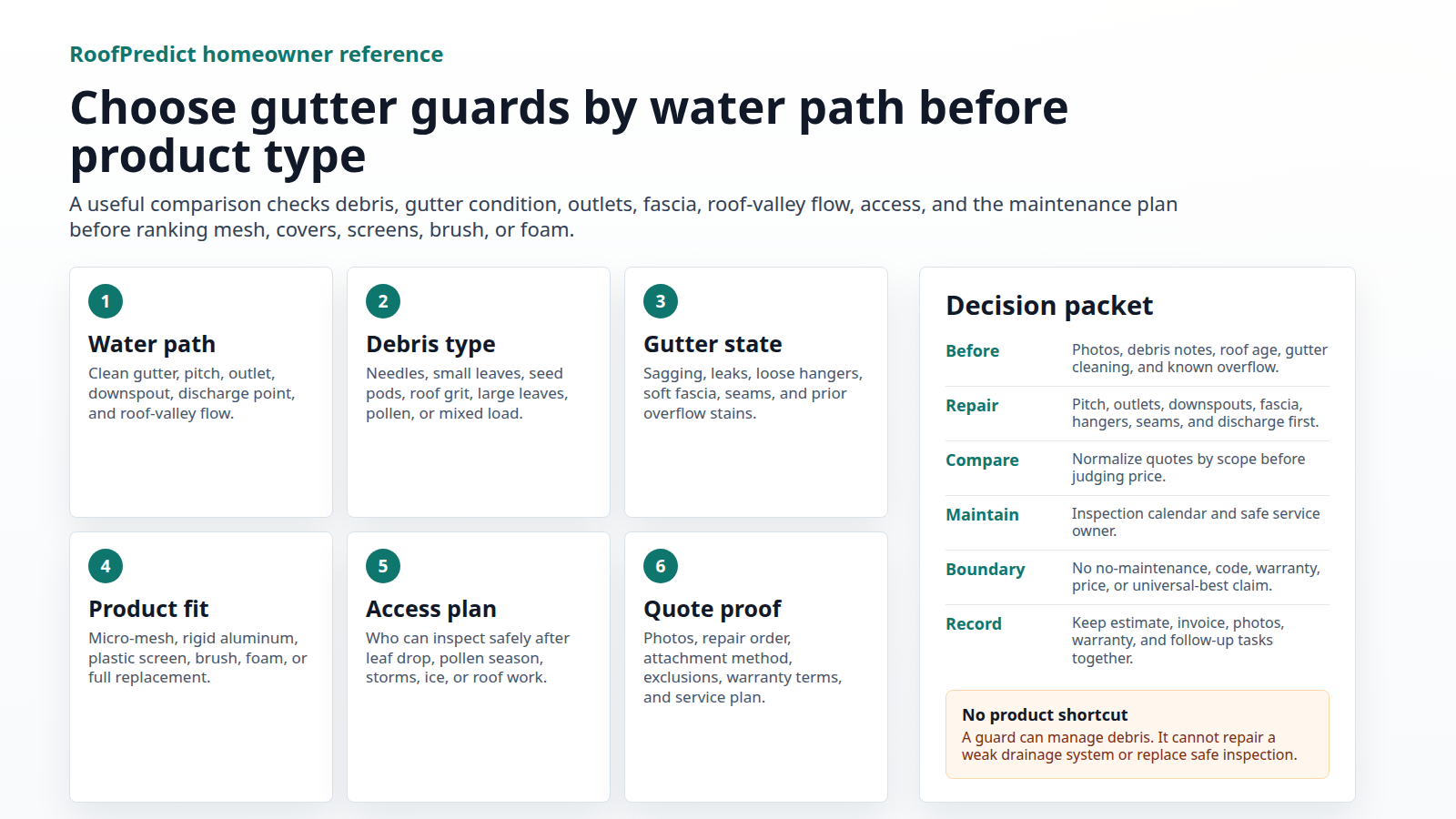
The best gutter guard is the one that fits the actual gutter run, not the one with the strongest sales claim. Start with the water path: roof area, valleys, gutter pitch, outlet size, downspouts, discharge point, fascia condition, tree debris, roof grit, safe access, and the maintenance plan someone will actually follow. Then compare guard categories.
Micro-mesh or fine stainless mesh is usually the first category to compare when pine needles, small leaves, seed pods, and shingle grit are the main problem. Perforated or rigid aluminum covers are worth comparing when larger leaves are the main load and the gutter edge can support the attachment method. Plastic mesh screens can be a lower-cost screen option for simple, easy-access runs. Brush and foam inserts are easy to understand, but they still live inside a gutter that must already drain. Hooded or one-piece systems belong in a broader gutter replacement conversation, not a simple add-on comparison.
No guard fixes a bad gutter. A guard does not correct poor slope, undersized outlets, rotten fascia, clogged downspouts, short discharge extensions, roof-valley overload, unsafe access, or a homeowner expectation that gutters will never need inspection again. The useful question is not "which product wins?" The useful question is "which product category fits this house, what must be repaired first, what still needs maintenance, and what claim should the quote prove in writing?"
The Decision Rule
Use this rule before reading a brochure: walk the water path before picking the product.
The DOE Building America gutters and downspouts guide treats gutters and downspouts as part of roof-runoff control. That is the right frame for gutter guards. A cover or insert may reduce some debris entering the trough, but rain still has to enter the gutter, flow across the run, leave through the outlet, travel down the downspout, and discharge away from the home. If that path is weak, the guard can hide the problem while water still goes where it should not.
A careful comparison starts with five questions:
- Does the gutter drain when it is clean?
- Do the downspouts handle the roof area they serve?
- Does roof-valley water overwhelm a short section during heavy rain?
- Is the fascia and gutter edge strong enough for the proposed attachment method?
- Can the homeowner, contractor, or maintenance provider inspect and clean the system safely after leaves, pollen, storms, ice, or roof work?
If any answer is unclear, the next step is not a more expensive guard. The next step is inspection, cleaning, repair, re-pitching, outlet work, downspout work, fascia repair, or a written access plan from a qualified contractor.
A Fit-First Matrix
This matrix is the main decision asset. It avoids universal rankings and ties each option to property conditions.
| Property condition | Guard categories to compare first | Main caution | What to ask before quoting |
|---|---|---|---|
| Pine needles, seed pods, roof grit, small leaves | Micro-mesh or fine stainless mesh | Fine surfaces can still collect debris on top | How will valley flow, roof pitch, mesh angle, and surface cleaning be handled? |
| Large leaves from broadleaf trees | Perforated aluminum, rigid covers, or micro-mesh | Larger openings may pass smaller debris | What opening size is used, and what happens at corners and outlets? |
| Mixed leaves and shingle granules | Micro-mesh, with a gutter and downspout precheck | Fine debris can expose existing drainage problems | Are the gutters clean, pitched, and clear before installation? |
| Low-risk, easy-access detached structure | Plastic mesh screen | Lightweight screens may not suit high debris, wind, or hard access | How is the screen held in place, trimmed, and inspected later? |
| Homeowner wants no fasteners | Brush or foam insert | Inserts can collect debris and still need service | Was the gutter cleaned first, and can the insert be removed for cleaning? |
| Sagging, leaking, undersized, or poorly pitched gutters | Repair, rehang, add outlets, or replace before any guard | A guard can make a broken drainage system look finished | What repairs happen before a guard is installed? |
| Rotten fascia, loose hangers, or failing joints | Fascia and gutter repair first | Attachment can fail or hide deterioration | What substrate is carrying the load? |
| Heavy roof-valley discharge | Water-control review before product selection | A guard may shed or overshoot water where flow is concentrated | What happens during heavy rain at that valley? |
| Wildfire-prone area with roof-edge debris | Debris-management plan plus local guidance | Product choice does not replace exterior maintenance | How will roof edges, gutters, and nearby debris be kept clean? |
| Unsafe access | Professional access plan before product selection | A guard is not a ladder-safety plan | Who can inspect it safely, and how often? |
This is why a straight "best gutter guard" list is weak. A guard succeeds or fails at the edges: valley mouths, inside corners, end caps, seams, outlets, downspout elbows, roof edges, fascia, and access points. Those details are the job.
Gutter Guard Fit Scorecard
Before comparing three quotes, score the house. A scorecard does not choose a brand. It tells the homeowner whether the property is ready for a guard quote or whether repair, cleaning, drainage work, or access planning must come first.
Score each row 0, 1, or 2:
| Field | 0 points | 1 point | 2 points |
|---|---|---|---|
| Clean drainage | Gutters are clogged, holding water, or not checked. | Some sections were cleaned, but downspouts or outlets are unclear. | Gutters, outlets, elbows, and downspouts were cleaned or flushed enough to inspect. |
| Gutter pitch | Standing water or sagging is visible. | Pitch is assumed but not documented. | Contractor notes pitch, low spots, and any repair needed before guards. |
| Outlet capacity | Outlet count, size, or elbow condition is unknown. | Outlet is visible but not tested or tied to the roof area. | Outlet, elbow, and downspout capacity are checked for each problem run. |
| Debris match | Quote does not name the debris. | Quote names leaves generally. | Quote names leaves, needles, seed pods, pollen, grit, valley debris, or mixed load. |
| Valley flow | Heavy valley discharge is ignored. | Valley is mentioned but no plan is written. | Quote states how concentrated water will enter, bypass, or be handled. |
| Fascia and hangers | Soft fascia, loose hangers, or sagging are ignored. | Defects are mentioned verbally. | Repairs, exclusions, and substrate limits are written before guard selection. |
| Attachment method | "Installed on gutters" is the only description. | Product category is named, but attachment is vague. | Quote states resting, clipping, screwing, tucking, inserting, bracketing, or replacement method. |
| Access plan | Future service assumes unsafe owner cleaning. | Service need is noted but not assigned. | Unsafe runs have a written service owner and trigger schedule. |
| Warranty boundaries | Warranty is used as a sales claim. | Warranty term is named but exclusions are unclear. | Product warranty, workmanship warranty, roof-edge questions, and exclusions are separated. |
| Records | No before photos, after photos, or run names. | Some photos exist but are not labeled. | Each run has before photos, after photos, quote notes, exclusions, and next inspection date. |
Interpret the score:
0-7: Do not choose a guard yet. Clean, inspect, repair, or define access first.
8-14: Quote may be usable, but missing fields need written answers before signing.
15-20: Strong comparison record. Now compare product category, scope, warranty, and maintenance.
This scorecard keeps the decision grounded. A high score does not guarantee the guard will work forever. A low score does not mean the house should never get guards. It means the next step is not ready for a product pitch.
What To Inspect Before Any Quote
Before comparing products, collect a simple property packet. A roofer, gutter contractor, or exterior contractor can build it during inspection; a homeowner can gather safe records and from-ground photos.
| Inspection item | What a good note says | Why it matters |
|---|---|---|
| Roof area draining into the run | "Rear upper valley and left main slope drain into 28-foot rear gutter." | The guard must handle water volume and debris. |
| Debris type | "Pine needles, oak leaves, seed pods, roof grit, and spring pollen." | Different openings and surfaces deal with different debris. |
| Gutter pitch | "Water sits near right corner after cleaning." | A guard cannot make a flat gutter drain. |
| Outlet and downspout size | "One outlet serves long rear run; elbow clogs twice each fall." | The outlet may be the choke point. |
| Fascia and hangers | "Two loose hangers and soft fascia near corner." | Attachment method and repair order matter. |
| Roof edge | "Drip edge present; contractor must state whether guard tucks, screws, clips, or rests." | Roof-edge details affect fit and warranty questions. |
| Cleaning access | "Rear run over walkout basement needs longer access equipment." | Maintenance promise must match access reality. |
| Prior problems | "Overflow at kitchen window during heavy rain; no leak inside." | The product choice should answer the actual problem. |
| Discharge point | "Downspout ends beside foundation planting bed." | Keeping debris out of the gutter does not fix poor discharge. |
| Maintenance owner | "Homeowner will not clean second-story run; contractor service needed." | A guard without an inspection plan becomes a hidden system. |
The packet changes the conversation. Instead of asking, "which brand is best?" you can ask, "what are you doing about the rear valley, the small outlet, the soft fascia, and the pine needles?"
Run-By-Run Worksheet
Do not treat the whole house as one gutter guard decision. A front porch, rear second-story run, garage run, dormer section, and long valley-fed run may need different answers. Build the comparison one run at a time.
Use this worksheet:
| Run | Debris | Water load | Existing problem | Access | First action | Guard category to compare |
|---|---|---|---|---|---|---|
| Front lower run | Large leaves | Moderate | Outlet clogs each fall | Easy | Clean, flush, outlet check | Perforated cover or micro-mesh |
| Rear upper run | Pine needles and grit | Heavy valley flow | Overflow above kitchen window | Hard | Drainage review and service plan | Fine mesh only after water-path check |
| Garage run | Few leaves | Light | No known issue | Easy | Clean and observe | Maybe no guard, simple screen, or maintenance only |
| Left side run | Mixed debris | Moderate | Sagging near corner | Moderate | Rehang and pitch check | Guard later |
The "first action" column matters most. Many homeowners want the worksheet to choose a product category. The better worksheet chooses the order of work. If the first action is repair, re-pitching, outlet enlargement, downspout extension, fascia work, or service access planning, do that before treating a guard as the solution.
This run-by-run approach also prevents overbuying. A homeowner may need a higher-quality product and service plan on a difficult second-story run, but only routine cleaning on a detached garage. One product across every run may be convenient for the installer, yet the house may not need the same answer everywhere.
Source Boundaries For This Comparison
The source set below is used carefully. Manufacturer instructions support product-specific installation and fit limits. They do not prove neutral performance rankings across every home. Public building-science and safety sources set water-management and access boundaries. They do not choose a product for the house.
- The DOE Building America gutters and downspouts guide supports treating gutters and downspouts as part of water management.
- The OSHA portable ladder QuickCard supports the safety boundary for ladder work.
- The CPSC home safe outdoor repairs checklist supports caution around outdoor repair tasks and safe tool and ladder practices.
- The NFPA wildfire home ignition zone checklist supports the idea that roof and gutter debris can be part of exterior wildfire maintenance.
- One micro-mesh installation guide supports pre-install cleaning, roof-edge fit, overlaps, gaps, end caps, and maintenance limits for that product family.
- One all-aluminum installation guide supports a rigid aluminum installation method and its product-specific details.
- One plastic mesh instruction sheet supports a simple cut, notch, arch, and tuck screen method for that product.
- One brush insert installation page supports the brush-insert category and no-fastener positioning for that product.
- One foam insert instruction sheet supports cleaning first, clearing downspouts, checking slope and hangers, avoiding gaps, and not stretching the insert for that product.
- RoofPredict is used only for recordkeeping and follow-up workflow context, not product selection, inspection, warranty, code, safety, or contractor approval.
Sources checked: June 9, 2026.
No source in this package supports price promises, payback periods, "never clean again" claims, roof warranty approval, local code advice, insurance outcomes, wind ratings, hail ratings, hurricane performance, or a claim that one guard is best for every property.
Micro-Mesh And Fine Stainless Mesh
Micro-mesh is the first category many people should compare when the debris is small: pine needles, seed pods, roof grit, small leaves, pollen clumps, and small organic material that slips through larger openings. The logic is simple. Smaller openings are meant to stop smaller material before it enters the trough.
That does not make micro-mesh an automatic winner. A fine surface can collect debris on top. Roof-valley water can arrive too fast for the run. Snow, ice, pollen, grit, and tree cover can change how the surface behaves. The roof edge may not suit the attachment method. A tight mesh over a dirty or badly pitched gutter can turn a visible clog into a hidden one.
A good micro-mesh quote explains:
- what debris the mesh is trying to manage;
- whether the gutter and downspouts will be cleaned first;
- how the product handles inside corners, outside corners, end caps, and overlaps;
- how valley discharge will be addressed;
- whether the product touches, tucks under, clips to, or screws near the roof edge;
- what maintenance still remains;
- who can inspect the surface safely.
A weak micro-mesh quote says only that the holes are small. Hole size is not the whole system.
Perforated And Rigid Aluminum Covers
Perforated or rigid aluminum covers can make sense when the debris is mostly larger leaves and when the gutter edge and fascia can support the attachment method. They may sit on the gutter lip, use brackets, use screws, snap into place, or attach in another product-specific way. The details matter because "aluminum guard" is a category, not a single installation.
The questions are practical:
- What size openings does the product use?
- What smaller debris may still enter?
- How are corners and ends handled?
- Does the product depend on the front gutter lip?
- Does it need screws into the gutter, fascia, or other parts?
- Can it be removed for cleaning or repair?
- What happens where roof-valley flow hits the run?
- What does the installer do if the existing gutter is bent, loose, or out of pitch?
Rigid covers can be useful when the gutter structure is sound. They can also be the wrong distraction when the run needs re-pitching, outlet work, downspout work, or fascia repair first.
Plastic Mesh Screens
Plastic mesh screens are simple compared with framed metal systems. They are easier to understand, easier to trim, and often positioned as a lighter screen option. They can make sense on low-risk, easy-access runs where the homeowner or maintenance provider can inspect the gutter regularly.
The tradeoff is that simplicity is not the same as fit. A light screen still has to deal with wind, tree debris, roof grit, sunlight exposure, corners, outlet openings, and cleaning. If the run is second story, hard to reach, under heavy trees, or already failing, a simple screen may be the wrong place to save money.
The quote should say how the screen is held, how it is cut at corners, how it handles outlets, and how it will be removed or cleaned later. If the only answer is "it keeps leaves out," the quote is thin.
Brush Inserts
Brush inserts sit inside the gutter. They are easy to explain: a long brush-like insert occupies the trough so larger debris rests on or near the bristles while water moves through the gutter. They may appeal to homeowners who do not want roof-edge attachment or fasteners.
The caution is also easy: the insert is inside the water path. If the gutter already holds water, has sludge, has clogged downspouts, has poor slope, or needs hanger work, a brush insert is not a drainage repair. It also still needs inspection. Debris can sit on it, lodge into it, or collect around outlets and corners.
Use brush inserts only after the gutter is clean and draining. Ask how the insert is sized, cut, seated, removed, cleaned, and inspected after leaf season.
Foam Inserts
Foam inserts also sit inside the gutter. They can be attractive because they are visually simple and often marketed as easy to install. The source-limited installation instructions used here point to the right precheck: clean the gutter, clear the downspouts, check slope and hangers, avoid gaps, and do not stretch the insert.
That precheck is the real lesson. Foam can only work inside a gutter that already has a sound water path. If the foam is used to hide sludge, low spots, loose hangers, crushed outlets, or poor discharge, the homeowner may not see the problem until overflow, staining, fascia damage, or foundation drainage trouble shows up.
A foam-insert quote should answer these questions:
- Was the gutter cleaned before the insert went in?
- Were downspouts flushed or checked?
- Were low spots or loose hangers repaired?
- How will the insert be removed if debris or roof grit builds up?
- What is the inspection interval?
- What happens at outlets, seams, corners, and downspout openings?
Hooded Or One-Piece Systems
Hooded systems and one-piece gutter systems belong in a separate conversation because they often change more than a small add-on screen. They may involve replacement gutters, a different cover shape, or a more involved installation. That can be a valid route on some homes, but it should not be mixed casually with a simple insert or screen quote.
Ask the contractor to separate:
- whether the existing gutters are being reused or replaced;
- whether fascia repair is included;
- what happens to downspouts and outlets;
- how the hood or cover handles roof-valley flow;
- how maintenance and service access work;
- whether the proposal changes drip edge, roof edge, or other adjacent details;
- what is covered by product warranty and what is covered by workmanship warranty.
If the quote is a full system replacement, compare it as a full system replacement. Do not compare only the guard line item.
The Five Most Common Bad Comparisons
Many gutter guard decisions go wrong before the homeowner even compares prices. These are the mistakes to catch.
| Bad comparison | Why it is weak | Better question |
|---|---|---|
| Comparing brands before gutter condition | A guard cannot fix a failing run | What repairs are needed before any guard goes on? |
| Comparing hole size only | Water path, corners, valleys, and access still matter | How does this product fit this exact run? |
| Treating the highest price as best | Scope, replacement work, access, and warranty terms may differ | What is included and excluded? |
| Treating the lowest price as best | Cleaning, repairs, outlets, and access may be missing | What problem will remain after installation? |
| Believing no-maintenance claims | Every exterior system needs inspection | Who inspects it, when, and how? |
The best quote is usually not the longest or shortest. It is the quote that names the property condition, the product category, the repair order, the maintenance expectation, and the limits.
Quote Review Packet
Before signing, ask for a short written packet. It does not need to be fancy. It needs to be specific.
| Packet item | What it should show |
|---|---|
| Debris diagnosis | Leaves, needles, seed pods, grit, pollen, roof-valley debris, or mixed load. |
| Gutter condition | Cleaned, pitched, leaking, sagging, loose hangers, soft fascia, clogged outlet, or replacement needed. |
| Product category | Micro-mesh, perforated aluminum, plastic mesh, brush insert, foam insert, hooded system, or replacement system. |
| Attachment method | Resting, clipping, screwing, tucking, inserting, bracketing, or full-system replacement. |
| Pre-install work | Cleaning, flushing, re-pitching, hanger work, outlet enlargement, downspout extension, fascia repair. |
| Exclusions | Rotten fascia, hidden damage, roof-edge warranty questions, existing leaks, underground drains, code or HOA questions. |
| Maintenance plan | When to inspect, who inspects, what can be cleaned safely, what requires a contractor. |
| Photos | Wide run, corner, outlet, downspout, valley, fascia, roof edge, and problem area. |
| Warranty terms | Product warranty, workmanship warranty, exclusions, transfer terms, and claim process. |
| Follow-up trigger | Overflow, staining, standing water, debris mat, loose section, leak, or post-storm inspection. |
This packet protects both sides. The homeowner gets a clear reason for the recommendation. The contractor gets a record of what was inspected, what was quoted, and what was excluded.
What To Photograph
Safe photos make the quote better. They also make the maintenance record better later.
Take these from the ground, a window, a balcony, or another safe location. If a roof-level or ladder-level photo is needed, let a qualified person handle it.
| Photo | Why it helps |
|---|---|
| Whole elevation | Shows which side of the house and how the roof drains. |
| Full gutter run | Shows length, pitch clues, corners, and downspout count. |
| Roof valley above the run | Shows concentrated water and debris areas. |
| Downspout and discharge point | Shows whether water leaves the home properly. |
| Outlet area | Shows whether debris collects at the choke point. |
| Fascia and hanger area | Shows sagging, loose sections, staining, or rot clues. |
| Debris sample in place | Shows leaves, needles, grit, seeds, pollen, or mixed load. |
| Existing overflow stain | Shows where water has escaped the gutter. |
| Contractor close-ups | Useful if labeled by location and saved as originals. |
| After-install photos | Creates a baseline for later service. |
Name the files plainly:
rear-gutter-wide-before-cleaning-2026-05-29.jpgrear-valley-above-kitchen-window-2026-05-29.jpgleft-downspout-discharge-near-foundation-2026-05-29.jpgfront-gutter-after-guard-install-2026-06-03.jpg
The file name is not a formality. Six months later, clear labels can settle which run was repaired, what was excluded, and whether the same area is acting up again.
First-Rain Acceptance Test
The first meaningful test is not the installation day. It is the first heavy rain, first leaf drop, first seed or pollen season, and first storm after installation. Write the acceptance test before the job is complete so everyone knows what will be checked.
Use this acceptance card:
Install date:
Runs treated:
Cleaning completed:
Downspouts flushed:
Repairs completed before guard:
Known exclusions:
First-rain observation date:
Observed from safe ground location:
Overflow seen: yes / no / unknown
Water overshoot at valley: yes / no / unknown
Leak at seam or end cap: yes / no / unknown
Downspout discharge clear: yes / no / unknown
Debris sitting on guard surface: yes / no / unknown
Photos saved:
Contractor follow-up needed:
Next inspection date:
Do not use the first-rain test to climb, reach, or touch the system. The homeowner can observe safely from the ground, from windows, or from another safe location. If the run is high, steep, slick, or hard to access, the inspection belongs to a qualified service provider.
This test helps separate product fit from drainage problems. If water overshoots only at one valley during heavy rain, the issue may be concentrated flow. If water backs up at one outlet, the choke point may be the outlet, elbow, or downspout. If water drips at a seam, the issue may be joint sealing or gutter condition. If debris sits on top of the guard, the maintenance plan needs to say who clears it.
Save the card with the quote and invoice. A clear first-rain record is useful if the installer needs to return, if a warranty question comes up, or if a future buyer asks what was done.
Callback Packet If Overflow Returns
If overflow, debris matting, staining, or a loose section shows up after installation, do not start with a complaint that says the guard failed. Start with a callback packet. The packet should make it easy for the installer to separate product fit, drainage, debris, maintenance, and excluded work.
Use this packet:
| Packet field | What to collect | Why it helps |
|---|---|---|
| Run name | "Rear upper run above kitchen window," not "the back gutter." | Keeps everyone focused on the same section. |
| Original problem | Overflow, clogging, pine needles, downspout backup, fascia staining, or access issue. | Shows what the job was supposed to address. |
| Quote scope | Product category, pre-install cleaning, repairs, exclusions, and maintenance plan. | Separates promised work from assumptions. |
| Install date | Date of installation and weather since installation. | Helps distinguish immediate fit issue from seasonal debris buildup. |
| First-rain notes | Safe observation date, rain intensity if known, overflow location, and photos. | Connects the issue to a real event. |
| Debris evidence | Photos of debris on top, at corners, near outlets, or at downspout discharge. | Helps locate the choke point. |
| Downspout discharge | Photos or notes showing whether water exits away from the house. | Overflow can be tied to discharge or elbow problems. |
| Access limit | Whether the area can be safely inspected by the homeowner. | Prevents unsafe owner cleanup from becoming the default answer. |
| Requested next step | Reinspection, outlet check, valley review, cleaning, repair, adjustment, or written explanation. | Gives the contractor a specific response path. |
Short message:
Hi, overflow returned at the rear upper run above the kitchen window during the first heavy rain after installation. I attached the original quote, install date, safe ground photos, first-rain notes, and downspout discharge photo. Can you review whether this is a product fit issue, valley-flow issue, outlet/downspout issue, maintenance issue, or excluded condition, and tell us the next step in writing?
Do not climb to prove the problem. The callback packet should make the issue clearer without putting the homeowner on a ladder. If the contractor needs roof-edge, second-story, or ladder-level inspection, that should be handled by a qualified person with the right access plan.
The best callback result is not always a free repair. Sometimes the answer is a warranty adjustment. Sometimes it is added outlet work, downspout change, valley work, cleaning, fascia repair, or a documented exclusion. The point is to get the issue into a written lane instead of arguing from memory.
Safety Is Part Of The Product Decision
Gutter guards are often sold as a way to reduce cleaning. That can be a fair goal, especially for second-story gutters, steep lots, heavy tree cover, or homeowners who should not be on ladders. But the safety argument only works if the maintenance plan is honest.
The OSHA portable ladder QuickCard and the CPSC outdoor repair checklist support a simple boundary: ladder work is not casual. A homeowner should not buy a guard that still requires unsafe owner cleaning from a ladder, then pretend the safety problem is gone.
Ask:
- Can this system be inspected from the ground?
- Can debris on top be removed safely?
- Does the second-story run need a service plan?
- Will the installer return after heavy leaf drop or the first storm?
- Who handles clogs at elbows, underground drains, and hard-to-reach outlets?
- What should the homeowner photograph instead of climbing?
If the answer assumes the homeowner will climb later, the system has not solved the access problem.
Wildfire, Trees, And Roof-Edge Debris
In areas with wildfire exposure, gutter debris is not only a clog issue. It can also be part of the home ignition zone maintenance conversation. The NFPA wildfire home ignition zone checklist includes attention to debris around roofs and gutters.
That does not mean a gutter guard makes a home wildfire-safe. It means debris at roof edges should stay visible in the maintenance plan. A guard may reduce some material entering the trough, but leaves, needles, and pollen can still collect on top of a cover, at valleys, behind dormers, near skylights, or along roof-wall intersections.
If wildfire exposure is part of the property context, ask the contractor to write down:
- how roof-edge debris will be monitored;
- whether the guard surface can trap fine material;
- how valleys and corners are cleaned;
- whether nearby trees need maintenance;
- whether local fire guidance, insurance requirements, or community rules apply.
This page does not give local wildfire, insurance, or code advice. It keeps the gutter guard decision tied to a clear maintenance record.
How Contractors Should Present The Recommendation
A contractor can make the recommendation more useful by changing the quote language. Instead of "best gutter guard," write a fit statement:
"Rear upper run has pine needles, roof grit, one heavy valley, and difficult second-story access. Existing gutters need cleaning and one loose hanger repaired before installation. Proposed category: fine mesh. Remaining maintenance: inspect surface after fall leaf drop and after major storms; service access needed for rear run."
That statement is better than a brand pitch because it can be checked. It names the debris, the run, the defect, the product category, the maintenance plan, and the access limit.
Use this quote structure:
| Section | What to write |
|---|---|
| Problem | "Overflow at rear kitchen window during heavy rain; pine needles and roof grit present." |
| Condition | "Gutter cleaned; one low spot remains; fascia solid except left corner." |
| Product category | "Fine mesh guard selected because fine debris is the main clog source." |
| Repair before guard | "Rehang left corner and flush downspouts before installation." |
| Exclusions | "Underground drain, fascia replacement beyond visible corner, roof warranty review, and future tree debris removal not included." |
| Maintenance | "Inspect after fall leaf drop and first heavy rain; contractor service required for second-story rear run." |
| Records | "Before and after photos stored with estimate and invoice." |
That is the kind of quote a homeowner can compare.
For Roofers: Turn Gutter Guard Quotes Into Service-Area Intelligence
For a roofing company, gutter guard comparison should not live only in a one-off quote folder. It can become a repeatable intake, sales, production, callback, and local-market workflow. The point is not to push one guard category. The point is to prove that the company understands roof runoff, debris, access, maintenance, and roof-edge records better than a product-only seller.
Use the same run-by-run language across the office:
| Team lane | What to capture | Why it matters |
|---|---|---|
| CSR or appointment setter | Run name, overflow location, debris type, access concern, prior cleaning, and whether roof work is also being discussed. | The first call should route repair-first and unsafe-access jobs differently from simple low-run screen requests. |
| Estimator | Water path, valley flow, outlet/downspout condition, fascia/hanger condition, roof-edge attachment question, and maintenance owner. | The recommendation becomes a fit statement instead of a product pitch. |
| Sales manager | Whether the quote separates cleaning, repair, guard installation, downspout discharge, exclusions, and future service. | Weak scope notes create callbacks and reputation risk. |
| Production manager | Which repairs must happen before guard work, which runs stay untreated, and which first-rain checks are promised. | Crews should not cover a gutter problem that the sales note did not resolve. |
| Service or warranty desk | First-rain observations, debris-on-top photos, loose sections, overflow location, and original exclusions. | Callback triage needs the original run map, not a memory of the sale. |
| Marketing or directory owner | Written estimate standards, photo records, serviceability notes, and gutter/roof-edge proof fields. | Directory/profile copy can show process quality without claiming guaranteed performance. |
This is also where city and state content can become legitimately different. A gutter guard page for a pine-heavy, wildfire-exposed foothill market should not read like a page for a humid coastal market with heavy roof runoff, or a freeze-thaw market where ice and service access matter. A page for an older inner-ring suburb with undersized downspouts and mature trees should not copy the same examples as a new subdivision with larger roof planes, HOA rules, and limited tree canopy.
Before RoofPredict supports a state, metro, city, county, or directory page around gutter guards, the note should answer five questions:
- What local debris or roof-edge condition changes the comparison?
- What weather pattern changes water load, service timing, or first-rain acceptance?
- What housing-stock pattern changes gutter age, fascia condition, access, or roof geometry?
- What sourced local permitting, wildfire, HOA, storm, or consumer-protection context belongs in the page, if any?
- What should a roofer do differently in intake, quote wording, production handoff, maintenance reminders, or directory proof because of this market?
Good local angles can include pine needles near wooded ridgelines, broadleaf debris in older neighborhoods, hurricane-season discharge checks, freeze-thaw service access, wildfire roof-edge debris plans, lake-effect leaf and snow timing, clay or expansive-soil foundation-water concerns, steep walkout rear elevations, townhome/HOA maintenance responsibility, and service-area routing after storms. Bad local angles are population facts, generic "many homes have gutters" copy, or a city name inserted into the same best-product table.
RoofPredict metadata for a gutter guard or drainage page should stay practical:
audience: roofing_company_owner, estimator, sales_manager, service_manager, property_manager, homeowner
topic: gutter_guard_fit, drainage_records, quote_scope, roof_edge_records, serviceability, local_market_brief
state:
city_or_metro:
debris_signal:
weather_signal:
housing_stock_signal:
directory_cta_fit: contractor_profile_proof, written_scope_quality, service_records
newsletter_cta_fit: roof_edge_maintenance, first_rain_follow_up, storm_season_drainage
indexability_note: index only if the local facts change the roofer workflow
The source boundary still matters. Building America supports runoff and downspout context. OSHA and CPSC support safety boundaries. NFPA supports roof and gutter debris in wildfire maintenance context. Product instructions support product-specific fit and maintenance limits. None of those sources proves that a contractor's preferred guard is best for every house in a city, or that a directory profile should rank one installer above another.
Where RoofPredict Fits
RoofPredict should not tell a homeowner which guard to buy. It should not certify an installer, approve a roof-edge method, decide warranty coverage, judge code compliance, or say a product will solve a drainage problem. The value is recordkeeping and follow-up.
For this topic, the useful RoofPredict workflow is:
- keep roof age, gutter notes, storm history, photos, routes, estimates, and follow-up tasks together;
- separate the gutter issue from roof-surface, roof-age, storm, and leak records;
- store before and after photos for each run;
- track which contractor saw which condition;
- keep quote versions and exclusions visible;
- remind the owner when the first post-install inspection is due;
- preserve the source of each claim so a future roofer or buyer can understand the file.
That record can help a roofer, gutter contractor, property manager, or homeowner have a cleaner conversation. It does not replace inspection.
Red Flags In Gutter Guard Claims
These claims should slow the decision down:
| Claim | Why to question it | Better ask |
|---|---|---|
| "Never clean gutters again." | No exterior system is free from inspection. | What maintenance remains and who does it? |
| "Works on every roof." | Roof edge, valleys, pitch, debris, and access vary. | What makes it fit this run? |
| "No need to clean before install." | Existing sludge, low spots, and clogs can stay hidden. | Will gutters and downspouts be cleaned and checked first? |
| "This fixes overflow." | Overflow may come from outlet size, pitch, valley flow, or discharge. | What caused the overflow? |
| "Warranty covers everything." | Product and workmanship warranties have terms and exclusions. | What is covered, by whom, and for how long? |
| "You can handle cleaning later." | The run may be unsafe for owner access. | Who services it if debris builds up? |
| "Lowest price, same result." | Scope may omit repairs, access, outlets, downspouts, or service. | What work is excluded? |
| "Highest price means best." | Full replacement may be included, or the scope may still be vague. | What problem does the extra cost solve? |
Good contractors can answer these questions without defensiveness. Weak quotes get vague.
When To Choose Repair Before Guards
Sometimes the answer is not a gutter guard. It is repair first.
Choose repair or drainage correction before guard selection when:
- gutters hold standing water after cleaning;
- downspouts are clogged or undersized;
- outlets are crushed, blocked, or poorly placed;
- fascia is soft, stained, or damaged;
- hangers are loose or spaced poorly;
- seams leak;
- roof-valley water overshoots the gutter;
- downspouts discharge beside the foundation;
- underground drains are clogged;
- ice, snow, or leaf problems are tied to a bigger roof-edge issue;
- the homeowner cannot maintain the run safely and no service plan exists.
A guard can be a useful second step. It should not be the cover placed over an unresolved first step.
Downspout Discharge Audit Before Buying
A gutter guard comparison should not stop at the top of the gutter. The run can stay cleaner and still fail if the outlet, elbow, downspout, underground drain, splash block, extension, or discharge area cannot move water away from the house. Before buying guards, follow the water from roof edge to final discharge.
Use a discharge audit for each run:
| Discharge point | What to record from safe areas | Why it matters before guards |
|---|---|---|
| Outlet | Whether water and debris can enter the downspout opening without backing up. | A guard will not fix a small, crushed, or blocked outlet. |
| Elbow | Whether elbows are accessible, dented, loose, or known to clog. | Fine debris can collect at bends even when the gutter looks cleaner. |
| Downspout | Whether the downspout is attached, sized, and connected to the right run. | Overflow may come from a bad vertical path, not the guard surface. |
| Extension or splash block | Where the water lands after leaving the downspout. | Clean gutters still cause trouble if discharge lands against the foundation. |
| Underground drain | Whether the pipe has a visible cleanout, daylight point, or known clog history. | A buried drain can make a good guard look bad when water backs up. |
| Grading and hardscape | Whether water runs toward the house, across a walk, into a low spot, or into landscaping. | The problem may be site drainage, not debris in the gutter. |
| First-rain observation | What happens during a normal rain after cleaning but before guards. | A pre-guard observation helps separate old drainage problems from new guard problems. |
Add one line to the run worksheet:
Discharge audit:
Run:
Outlet condition:
Elbow/downspout condition:
Extension or underground drain:
Where water ends up:
Known backup history:
Repair needed before guard: yes / no / unknown
This is not a grading, foundation, or drainage design. It is a buyer-protection note. If the downspout disappears into an underground drain with no visible outlet, write that down. If water exits beside the foundation, write that down. If one elbow has clogged every fall for three years, write that down. The guard quote should not pretend those details are outside the decision.
Ask the contractor to separate three answers:
| Question | Better written answer |
|---|---|
| Will the gutter be cleaned before guards? | Yes/no, with outlet and downspout check noted separately. |
| Will downspouts be flushed? | Yes/no, and whether underground drains are included or excluded. |
| Will discharge extensions be adjusted? | Included, excluded, or quoted separately. |
| What if the underground drain backs up later? | State whether the installer services it or excludes it. |
| What record will prove the discharge path was checked? | Photos, note, invoice line, or service checklist. |
The discharge audit also improves the first-rain acceptance test. If overflow appears after guards are installed, the homeowner can compare the new observation against the old discharge note instead of guessing whether the product failed. The answer may be debris on top of the guard, a valley surge, a clogged elbow, a buried-drain backup, poor slope, or a discharge point that was never corrected.
RoofPredict can store the run map, outlet note, downspout photo, discharge point, first-rain observation, and callback record together. It should not decide the drainage design or product choice. It should make the water path easier to review when the next person asks why one run still overflows.
Scenario Guide
The scenarios below show how the same product category can be a good fit on one run and a poor fit on another.
Pine trees over a second-story rear gutter
This is the classic fine-debris case. Needles, small cones, pollen clumps, and grit can slip through larger openings and settle near outlets. Micro-mesh belongs in the first comparison set, but the rear second-story access changes the decision. The quote should not assume the homeowner will brush off the mesh from a ladder twice a year.
The better recommendation names both parts:
"Fine debris is the main clog source, so fine mesh is the first category. Rear access is difficult, so the maintenance plan needs contractor service after fall needle drop and after the first heavy spring pollen period."
If the quote mentions only the mesh and not the access plan, it is incomplete.
Broadleaf trees over a single-story front gutter
Large leaves can make perforated aluminum, rigid covers, or micro-mesh worth comparing. If the gutter is single story and easy to inspect safely from the ground or from a professional ladder setup, the maintenance plan may be simpler than the pine-needle case. The key is still the outlet. Large leaves often collect where the outlet and downspout meet. If the outlet is small or the downspout elbow clogs, the guard surface is not the whole answer.
Ask the installer to show the outlet photo before and after cleaning. If the quote has a product photo but no outlet note, it is missing the choke point.
Roof valley dumping into a short gutter section
This is where many product comparisons fail. The debris may not be the main issue. The concentrated water may be. During heavy rain, a roof valley can send water toward one short section faster than the gutter can accept it. A guard may make that better, worse, or unchanged depending on slope, surface, opening, valley direction, gutter size, and outlet placement.
The quote should say what happens during heavy rain. It may recommend a diverter, larger gutter, added outlet, downspout change, valley detail review, or no guard until drainage is corrected. If the quote treats this as a normal leaf-clog job, slow down.
Older gutters with loose hangers
Loose hangers are not a product preference. They are a repair item. Any guard that relies on the front lip, gutter body, fascia, or brackets depends on the existing system carrying load and holding alignment. If the run sags now, a cover can make the sag less visible while water still sits in the trough.
The better quote separates repair from guard:
"Clean and flush. Rehang 32-foot run. Replace two hangers. Confirm pitch to left downspout. Then install selected guard category."
That sequence is more important than the guard brand.
Newer gutters with a homeowner who cannot climb
This can be a strong case for a guard if the gutters are sound and the main issue is reducing frequent debris clearing. But the quote must replace homeowner ladder work with a service plan, not pretend future inspection disappears.
The maintenance section should answer: who checks it, how often, how debris on top is handled, how the contractor documents service, and what the homeowner should photograph from the ground if overflow returns.
Detached garage or shed with low gutters
A lighter screen or insert may be reasonable on a low-risk, easy-access structure if the homeowner understands the maintenance limits. This is where the lowest-cost option may fit. The stakes are different from a second-story main-house run over a finished basement.
The decision should still include cleaning, outlet review, and discharge. Simple does not mean skip the precheck.
Home for sale
If the home is being listed, the record matters almost as much as the product. A buyer, inspector, agent, or appraiser may ask what was installed, why it was installed, and whether any water issue remains. The seller should keep the estimate, invoice, product information, warranty terms, before photos, after photos, and any service notes.
Do not hide prior overflow, fascia damage, or leak history behind a fresh guard installation. A clean record is stronger than a vague claim that the gutters were "upgraded."
When A Run Should Stay Unguarded For Now
One of the most useful outcomes of a gutter guard comparison is deciding not to install a guard on a specific run yet. That is not a failed sale. It can be the correct diagnosis when the run is not ready.
Leave a run unguarded, or delay guard selection, when the first problem is one of these:
| Condition | Why a guard can make the file worse | Better first step |
|---|---|---|
| Standing water in a clean gutter | The water path is already weak, and a cover can hide the low spot. | Re-pitch, rehang, repair, or replace the run before product selection. |
| Crushed or undersized outlet | The choke point is where water leaves the gutter, not where debris enters. | Outlet and downspout review. |
| Downspout discharges beside foundation | Keeping leaves out does not fix poor discharge location. | Extend, redirect, or review drainage discharge. |
| Soft fascia or loose hangers | The attachment substrate may not support the product. | Fascia and hanger repair first. |
| Heavy valley overshoot | Water may be bypassing the gutter because of concentrated roof flow. | Valley flow and gutter sizing review. |
| Easy-access garage with low debris | The maintenance problem may fail to warrant the product cost. | Routine cleaning, outlet check, and observation. |
| Hard-access run with no service plan | The guard may reduce cleaning but still require unsafe future inspection. | Written service owner and interval before installation. |
| Product would tuck or fasten near sensitive roof-edge conditions | Warranty, roof-edge, or installation questions may be unresolved. | Product instruction and contractor scope review. |
This section matters because many homes do not need the same answer on every edge. A rear second-story pine-needle run may deserve a careful fine-mesh quote and service plan. A low detached garage under light debris may need only cleaning. A valley-fed corner may need drainage correction before any guard. A sagging old gutter may need replacement, not a cover.
Use this no-install note:
Run:
Reason guard is delayed:
First repair or inspection needed:
Who owns next step:
Date to recheck:
Photos saved:
What should not be claimed yet:
The final line protects the record. If the run has not been repaired, the homeowner should not describe the gutter system as upgraded. If the valley issue is unresolved, the homeowner should not say the overflow is solved. If the product attachment method has not been reviewed, the homeowner should not assume warranty compatibility.
Seasonal Debris Diary Before Buying For The Whole House
A gutter guard installed in June may look good until October leaves, spring pollen, pine needle drop, roof grit, seed pods, or the first hard rain. If the homeowner is unsure whether to cover every run, keep a seasonal debris diary first. This is especially useful for houses with mixed trees, steep roof areas, valley flow, or different access conditions on each side.
Use this diary:
| Date or season | Run | Weather or tree condition | What was observed safely | What it suggests |
|---|---|---|---|---|
| Spring pollen | Rear upper run | Yellow pollen film and seed pods. | Debris sitting near valley mouth. | Surface-cleaning plan matters if mesh is used. |
| Early summer storm | Front lower run | Heavy rain. | No overflow; downspout discharged well. | Guard may be optional if debris is low. |
| Fall leaf drop | Left side run | Broadleaf accumulation. | Leaves collected at inside corner and outlet. | Corner and outlet design matter more than straight run. |
| Winter freeze/thaw | North run | Ice at edge. | No safe access; staining visible below end cap. | Needs contractor review, not owner cleaning. |
| After roof repair | Garage run | Shingle work nearby. | Grit near outlet after repair. | Flush and check outlet before deciding on guard. |
The diary should not become a science project. Three or four dated notes can change the quote conversation. Instead of asking "what is the best guard?" the homeowner can say: "The rear upper run gets pine needles and pollen at the valley, the left run clogs at the outlet during leaf drop, and the garage run has not overflowed. Please quote by run, not as one whole-house product."
This also helps contractors. A good contractor can use the diary to explain why one run needs fine mesh, another needs outlet work, another needs no guard yet, and another needs a service plan. A weak quote ignores the differences and sells one answer everywhere.
If the diary shows no recurring problem on a run, do not force a product decision. Write "observe and clean" as the current plan. That note is useful because it shows the homeowner made a deliberate maintenance choice instead of forgetting the run. It also gives the next reviewer a baseline. If overflow appears later, the record can show whether the problem started after tree growth, roof work, a storm, a gutter repair, downspout damage, or a missed cleaning interval.
If the diary shows the same problem three times in the same place, treat that as a run-specific design question. Repeated overflow at one corner is different from light debris along the whole run. Repeated debris mats at a valley are different from a clogged downspout elbow. Repeated staining below an end cap is different from leaves sitting on the guard surface. The diary helps the quote ask the right question instead of buying a whole-house answer for a one-run pattern.
Whole-House Versus Run-Specific Installation
A whole-house gutter guard installation is convenient. It can make sense when the gutter system is sound, debris is consistent, access needs are similar, and the quote documents every run. But whole-house language can also hide uneven needs.
Compare the two approaches:
| Approach | Good fit when | Risk to watch |
|---|---|---|
| Whole-house install | Gutters are in similar condition, debris is similar, all runs are cleaned and checked, and service plan covers every elevation. | Quote may skip run-specific problems and treat repair-first areas as ready. |
| Run-specific install | Debris, access, water load, gutter condition, or budget differs by elevation. | Homeowner needs a clear record of which runs were treated and which were not. |
| Repair-first install | Some runs need pitch, fascia, hanger, outlet, downspout, or discharge work before guards. | Product quote can distract from needed repairs. |
| Test-run install | Homeowner wants to observe one difficult run before covering the whole house. | Installer should state whether later matching, pricing, or warranty terms change. |
| No-install maintenance plan | Low debris or easy access makes routine cleaning more sensible than a guard. | Homeowner still needs a calendar and safe access plan. |
If the homeowner installs guards on only some runs, label the untreated runs clearly:
Run treated:
Run not treated:
Reason not treated:
Maintenance plan:
Next review date:
What future buyer or service provider should know:
That note prevents a future misunderstanding. "Gutter guards installed" can sound like the whole house was covered. The record should say exactly which runs were covered, which were repaired, which were left open, and why.
Serviceability Test Before Buying
A gutter guard that works on day one can still be a bad fit if no one can service it later. Before choosing a product category, ask how the run will be inspected, cleaned, opened, removed, reinstalled, and documented after leaves, pollen, pine needles, roof grit, ice, or roof work changes the condition.
Use a serviceability test by run:
| Service question | Good answer | Weak answer |
|---|---|---|
| Who can safely inspect this run later? | Installer, gutter company, roofer, or maintenance provider is named for second-story or steep areas. | "You can just look at it once in a while" for unsafe access. |
| How will debris on top be removed? | Surface cleaning method, access limits, and season are written. | "It will shed everything" with no cleaning plan. |
| How are outlets and elbows checked? | Downspout flush, outlet access, and elbow check are part of service. | Only the top cover is discussed. |
| Can a section be opened or removed? | Removal/reinstall process, labor trigger, and warranty boundary are stated. | No one explains how to access the gutter after installation. |
| What happens after roof work? | Guard removal, protection, reinstallation, and photo records are addressed. | The quote ignores future roof repair or replacement. |
| What proves service happened? | Photos, invoice note, cleaned run list, and next service date are saved. | Verbal "all good" with no record. |
This test matters most on hard runs: second-story rear gutters, steep roof edges, runs under pine trees, valleys that dump heavy water, gutters above decks or landscaping, and long runs with inside corners. Those are the areas where a homeowner is least likely to climb safely and most likely to need a clear service owner.
Ask the contractor one plain question:
If this run overflows or collects debris after installation, how will someone safely inspect the top surface, outlet, inside corner, downspout elbow, and gutter interior without turning it into a homeowner ladder job?
A strong answer may not be cheap. It may say the run needs annual service, a specific access method, a different product category, a repair before guard installation, or no guard until the gutter is rebuilt. That is useful. The goal is not to buy the lowest-maintenance promise. The goal is to buy a system that can be maintained honestly.
Also ask what happens when the roof is repaired or replaced. Some guard systems may need to be removed, protected, reset, or inspected after roof work. Some attachment methods may complicate roof-edge work. The answer should be written before purchase because the future roofer may not be the same company that installed the guard.
Add a serviceability note to the quote packet:
Run:
Access owner:
Surface cleaning method:
Outlet/downspout check method:
Removal or opening process:
Roof-work handling:
Warranty or service boundary:
First service date:
Evidence to save:
RoofPredict's role is simple here: keep the serviceability note, quote, product record, photos, and next service reminder tied to the property. It should not decide which product wins. It should preserve the conditions that made the product a reasonable choice and the maintenance path that keeps the record useful later.
Maintenance Calendar
Gutter guard maintenance should be written into the job. Use a calendar tied to the property, not a generic promise.
| Timing | What to check | Who should handle it |
|---|---|---|
| Before installation | Clean gutters, flush downspouts, inspect slope, outlets, hangers, fascia, seams, and discharge. | Contractor or qualified maintenance provider. |
| Right after installation | Confirm product placement, corners, end caps, outlets, downspouts, roof-edge fit, and before/after photos. | Installer and homeowner record review. |
| First heavy rain | Watch from safe ground level for overflow, overshoot, leaking seams, or new stains. | Homeowner can observe safely; contractor handles access. |
| After first leaf drop | Look for debris mats on top, blocked corners, outlet trouble, and downspout flow. | Service provider for unsafe runs. |
| After pollen or seed season | Check fine material buildup, especially on mesh or at valleys. | Service provider if access is not safe. |
| After major wind or hail | Photograph visible displacement, loose sections, or overflow from the ground. | Qualified inspection if roof or ladder access is needed. |
| Before listing or refinancing | Gather install record, warranty, photos, and service notes. | Homeowner or property manager. |
| Annual review | Confirm the system still drains and the maintenance plan is still realistic. | Contractor for hard-to-reach runs. |
This calendar keeps a guard from becoming a forgotten exterior part. The goal is less emergency cleaning and fewer surprises, not no future attention.
How To Compare Three Quotes
Homeowners often get three quotes and compare only the total. That is risky because the quotes may not be selling the same job. Normalize them before deciding.
Create a small table:
| Field | Quote A | Quote B | Quote C |
|---|---|---|---|
| Product category | Micro-mesh | Perforated aluminum | Foam insert |
| Gutter cleaning included | Yes / no / unclear | Yes / no / unclear | Yes / no / unclear |
| Downspouts flushed | Yes / no / unclear | Yes / no / unclear | Yes / no / unclear |
| Hanger or pitch repair | Included / excluded / unclear | Included / excluded / unclear | Included / excluded / unclear |
| Fascia repair | Included / excluded / unclear | Included / excluded / unclear | Included / excluded / unclear |
| Valley treatment | Included / excluded / unclear | Included / excluded / unclear | Included / excluded / unclear |
| Attachment method | Written / vague | Written / vague | Written / vague |
| Maintenance plan | Written / vague | Written / vague | Written / vague |
| Warranty terms | Product and workmanship separated / vague | Product and workmanship separated / vague | Product and workmanship separated / vague |
| Access plan | Written / vague | Written / vague | Written / vague |
After the table is filled, the cheapest quote may no longer look cheapest. It may omit cleaning or repairs. The highest quote may be easier to understand because it includes replacement gutters. Or it may still be vague. The table forces each quote to answer the same questions.
Use this decision sequence:
- Reject quotes that do not inspect the water path.
- Reject quotes that promise no maintenance.
- Reject quotes that cannot state the attachment method.
- Separate repair, replacement, and guard work into different lines.
- Compare the remaining quotes by fit, scope, access, warranty terms, and service plan.
That sequence is slower than picking the middle number. It is also a cleaner way to avoid paying for the wrong fix.
Pre-Signature Scope Audit
Before accepting a gutter guard quote, run one last scope audit. This is the step that turns a sales visit into a usable home record. The audit should be short enough for a homeowner to complete, but strict enough that vague promises do not slip through.
Use the audit after the contractor has inspected the home and before the homeowner signs. If a field is missing, ask for the quote to be revised in writing. Do not rely on a verbal explanation for a detail that will matter after the first heavy rain, first leaf drop, first callback, or future sale.
| Audit field | Acceptable written answer | Missing answer usually means |
|---|---|---|
| Run map | The quote names each run, side of house, treated section, untreated section, and problem area. | "Whole house" may hide different conditions on each elevation. |
| Cleaning status | Gutters, outlets, elbows, and downspouts are cleaned, flushed, or clearly excluded before installation. | Existing sludge or outlet blockage may be covered. |
| Repair order | Pitch correction, hanger work, fascia repair, outlet changes, and downspout extensions are listed before guard installation when needed. | The product may be installed over the actual defect. |
| Debris match | The quote names the debris: pine needles, broad leaves, seed pods, pollen, roof grit, valley debris, or mixed load. | The product category may be chosen from a script instead of the house. |
| Valley and outlet handling | Heavy valley flow, inside corners, end caps, outlets, elbows, and downspout discharge are addressed by run. | Overflow may return at the same choke point. |
| Attachment method | The quote states whether the product rests, clips, screws, tucks, inserts, brackets, or replaces the gutter system. | Roof-edge, fascia, service, and warranty boundaries stay unclear. |
| Access owner | Unsafe second-story or steep-slope areas have a service owner and inspection trigger. | Future cleaning may quietly fall back on unsafe homeowner access. |
| Warranty split | Product warranty, workmanship warranty, exclusions, transfer terms, and claim contact are separated. | A long warranty phrase may cover less than the homeowner assumes. |
| Maintenance trigger | First-rain, leaf-drop, pollen, storm, and annual inspection triggers are listed. | The system may be sold as maintenance-free without a real service plan. |
| Record packet | Before photos, after photos, invoice, product information, exclusions, and next service date are named. | The homeowner may have no usable evidence if overflow returns. |
The audit should produce one of three decisions.
| Decision | What it means | Next action |
|---|---|---|
| Ready to sign | The quote names the run, condition, product category, repairs, access plan, warranty split, and records. | Save the quote and schedule the work. |
| Revise quote | The contractor inspected the property, but one or more written fields are missing. | Ask for a revised scope before approving. |
| Stop and repair first | The gutter system has standing water, bad pitch, bad fascia, clogged downspouts, poor discharge, or valley overshoot that the quote does not solve. | Repair, clean, resize, rehang, redirect, or inspect before guard selection. |
This is where many decisions improve. A homeowner may discover that Quote A is cheaper because it excludes downspout flushing. Quote B may look expensive because it includes fascia repair and outlet work that the other quotes ignored. Quote C may use a good product category but leave no access plan for a second-story run under pine trees. The audit does not choose the contractor. It makes the comparison honest.
Use this short approval note inside the RoofPredict file:
Quote decision:
Runs approved:
Runs excluded:
Reason product category fits:
Repairs required before install:
Cleaning and downspout status:
Attachment method:
Access owner:
Warranty documents received:
First-rain check date:
Leaf-season check date:
Open exclusions:
The open-exclusions line matters. It prevents a future reader from treating the guard installation as a complete drainage repair. If underground drains were excluded, write that down. If fascia replacement was excluded, write that down. If valley overshoot was observed but not corrected, write that down. If the product instructions raise roof-edge questions, keep the contractor's answer with the quote.
For a homeowner, this audit reduces regret. For a contractor, it reduces callbacks caused by mismatched expectations. For a future roofer, buyer, property manager, or inspector, it explains what was actually done. A gutter guard decision is much easier to trust when the record says, "rear upper run, pine needles, fine mesh category, downspouts flushed, one hanger repaired, second-story service needed after leaf drop," instead of "gutter guards installed."
How To Write A Source-Limited Recommendation
The safest public language is specific and bounded. Avoid claims that sound bigger than the evidence.
Use wording like this:
| Overstated wording | Better wording |
|---|---|
| "This is the best gutter guard." | "This category fits this run because the main debris is pine needles and the gutters are being cleaned and checked first." |
| "You will never clean gutters again." | "This may reduce debris entering the gutter, but the surface, outlets, and downspouts still need inspection." |
| "This fixes your overflow problem." | "This addresses the leaf load; the quote also includes outlet and pitch review because overflow can have more than one cause." |
| "This is warranty safe." | "The installer should show how the product attaches and what the product and roof-edge instructions say." |
| "This is code approved." | "Local code, HOA, wildfire, and warranty questions need local or product-specific review." |
| "Easy DIY install." | "Installation and cleaning require safe access and should not put the homeowner on unsafe ladders or roof areas." |
This language is not timid. It is stronger because it can be supported.
What A Homeowner Should Send To A Contractor
Before the appointment, send a short note:
"We are comparing gutter guard options for the rear and front runs. The rear gutter overflows near the kitchen window during heavy rain. We have pine needles and roof grit. The rear run is second story and not safe for owner cleaning. Please inspect the gutter pitch, outlets, downspouts, fascia, roof-valley flow, and access before recommending a product. We want the quote to separate repairs, guard installation, exclusions, warranty terms, and maintenance."
Attach:
- wide photos of the front, rear, left, and right elevations;
- photos of the worst debris area;
- photos of overflow stains or splash marks;
- downspout and discharge photos;
- any prior gutter cleaning invoices;
- any roof or fascia repair notes;
- the roof age if known;
- any storm or tree-work timing that may matter.
That message gives the contractor a clear job. It also filters weak sales calls. A contractor who only wants to quote from a product script may not be the right fit for a property-specific decision.
What A Contractor Should Leave Behind
After the appointment, the homeowner should have enough information to explain the decision to someone else. That could be a spouse, property manager, buyer, insurer, roofer, HOA, or future contractor.
The leave-behind should include:
- product category and product name;
- before photos;
- repair notes;
- attachment method;
- gutter cleaning and downspout-flush confirmation;
- serviceability instructions for covered runs;
- exclusions;
- product warranty terms;
- workmanship warranty terms;
- maintenance plan;
- service contact;
- after photos once installed.
If that record exists, the installation is easier to manage later. If overflow returns, everyone can see what was supposed to be solved and what was excluded.
Reader Boundary
This is a homeowner and contractor decision aid, not a product ranking. It intentionally avoids exact pricing, product guarantees, brand ranking, code advice, roof warranty advice, insurance advice, safety instructions for roof work, and claims that one guard category is best everywhere.
The safe use is narrower: inspect the water path, identify the debris, repair the gutter system first when needed, compare the category against the actual run, get the attachment method and maintenance plan in writing, and keep the record. If the quote cannot answer those points, the homeowner needs a clearer quote before choosing a product.
RoofPredict Service Record Template
RoofPredict's useful role is to keep the gutter decision connected to the wider roof file. A gutter guard can affect roof-edge records, drainage notes, storm follow-up, sale preparation, and maintenance reminders. Put the information in a reusable record rather than leaving it inside a contractor email thread.
Use this record template:
Property:
Run name:
Problem observed:
Debris type:
Water-path notes:
Pre-install repairs:
Product category:
Product name:
Attachment method:
Installer:
Install date:
Before photos:
After photos:
Warranty documents:
Workmanship warranty:
Exclusions:
First-rain check:
Leaf-season check:
Next service date:
Open questions:
The template is useful because gutter guard problems often show up months later. The person looking at the issue later may not be the person who approved the work. A clean service record can answer the basic questions: which run, which product, why it was chosen, what was repaired first, what was excluded, what photos exist, and what service is due next.
It also keeps the decision out of brand folklore. Instead of "we bought the best guard," the record says "rear upper run, pine needles, hard access, fine mesh, downspout flushed, hanger repaired, first-rain check scheduled." That is a stronger home record.
FAQ
Are gutter guards worth it?
They can be worth comparing when the main problem is recurring debris and the gutter already drains correctly. They are not a fix for bad slope, clogged downspouts, rotten fascia, undersized outlets, poor discharge, unsafe access, or roof-valley water that overwhelms the run. Compare the guard only after the water path is inspected.
Which gutter guard is best for pine needles?
Micro-mesh or fine stainless mesh is usually the first category to compare for pine needles and small debris, but it is not automatically best for every house. The roof edge, valley flow, mesh angle, cleaning access, and maintenance plan still matter. Ask the installer how the surface will be inspected after needles and pollen build up.
Do gutter guards mean I never have to clean gutters again?
No. A guard can reduce some debris entering the gutter, but it does not remove the need for inspection. Leaves, needles, pollen, grit, ice, and valley debris can collect on top of a cover, at corners, near outlets, or inside downspout elbows. A good quote states what maintenance remains.
Should gutters be cleaned before guards are installed?
Yes. The gutter, outlets, and downspouts should be clean enough to inspect before a guard goes on. If sludge, standing water, loose hangers, low spots, or clogged outlets are covered up, the guard can hide the real problem.
Should every gutter run get the same guard?
Not automatically. A second-story pine-needle run, an easy-access garage, a valley-fed corner, and a sagging old gutter may need different answers. Compare by run: debris, water load, gutter condition, access, outlet capacity, attachment method, and maintenance owner. Some runs may need repair first or no guard yet.
Can gutter guards cause roof warranty problems?
They can raise roof-edge questions if a product tucks under, lifts, fastens near, or changes materials at the roof edge. Do not rely on a generic answer. Ask the installer to identify the attachment method and point to the product instructions and any warranty boundary that applies.
Are foam or brush gutter inserts bad?
Not automatically. Foam and brush inserts can make sense on some clean, simple, inspectable runs. The caution is that they sit inside the gutter, so they should not be used to hide poor slope, clogged downspouts, sludge, loose hangers, or hard-to-service outlets. Ask how they will be removed and cleaned later.
What photos should I take before getting a gutter guard quote?
Take safe photos of the whole elevation, full gutter run, roof valley above the run, downspout, discharge point, outlet area, fascia, debris type, overflow stains, and any contractor close-ups. Label the date, side of the house, and problem. Do not climb for a better angle.
Should I choose the cheapest gutter guard quote?
Not until you compare scope. A cheaper quote may omit cleaning, repairs, outlet work, fascia work, downspout extensions, second-story access, or follow-up service. A higher quote may include replacement work you do not need. Compare the condition notes, repair order, product category, attachment method, exclusions, and maintenance plan.
What if water still overflows after gutter guards are installed?
Document the overflow with safe photos and the date, then compare it against the original quote. The cause may be valley flow, outlet capacity, gutter pitch, debris on top of the guard, a clogged elbow, poor discharge, or another issue. Ask the installer what was included, what was excluded, and what changed since installation.
What records should I save after gutter guards are installed?
Save the quote, product category, product name, attachment method, before photos, after photos, cleaning and repair notes, downspout flush notes, exclusions, warranty documents, first-rain observation, callback notes, service dates, and untreated-run list. Those records help future maintenance, sale, warranty, and overflow questions.
What should I confirm before signing a gutter guard quote?
Confirm the run map, cleaning status, downspout flush, repair order, debris match, valley and outlet handling, attachment method, access owner, warranty split, maintenance triggers, exclusions, and record packet. If the quote cannot put those fields in writing, ask for a revised scope before approving the work.
What should I ask about servicing gutter guards later?
Ask who can safely inspect the run, how debris on top will be removed, how outlets and downspouts will be checked, whether sections can be opened or removed, what happens after roof work, and what records prove service happened. A gutter guard that cannot be serviced safely may not fit that run.
Should I check downspout discharge before buying gutter guards?
Yes. Check where each run sends water after it leaves the gutter: outlet, elbows, downspout, extension, splash block, underground drain, grading, and final discharge point. A guard can reduce debris and still leave overflow or water-at-foundation problems if the discharge path is blocked, undersized, or excluded from the quote.
Can RoofPredict choose a gutter guard for me?
No. RoofPredict can help organize roof age, gutter notes, photos, estimates, storm history, reports, follow-up tasks, and maintenance records. It does not inspect gutters, choose products, approve installation methods, decide warranties, or certify contractors.
The Roofline by RoofPredict
Stay Ahead of Roofing Market Changes
Join The Roofline by RoofPredict for weekly roofing intelligence: material price signals, storm demand, insurance and regulatory updates, sales tactics, and local contractor opportunities.
Sources
- Gutters and Downspouts — basc.pnnl.gov
- Portable Ladder Safety QuickCard — osha.gov
- Home Safe Outdoor Repairs Checklist — cpsc.gov
- Wildfire Home Ignition Zone Checklist — content.nfpa.org
- Micro-Mesh Gutter Guard Installation Guide — gutterguard.com
- Total All Aluminum Install Guide — totalgutterguard.com
- Plastic Mesh Gutter Guard Instruction Sheet — frostking.com
- Brush Insert Installation Guidance — gutterbrush.com
- Foam Insert Installation Instructions — images.thdstatic.com
- RoofPredict — roofpredict.com