
How to Verify Manufacturer Recall or Defect Shingles
On this page
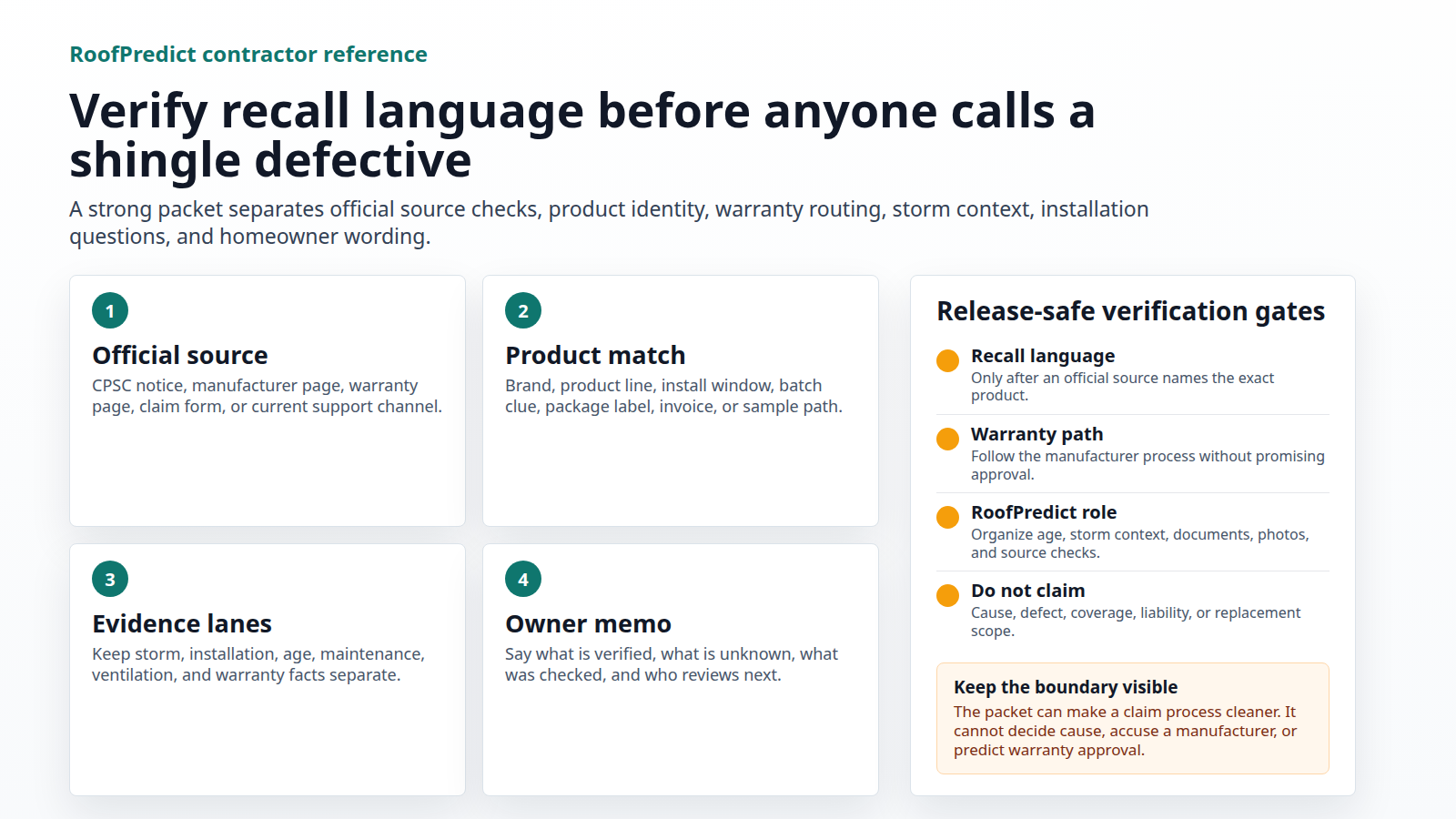
Do not tell a homeowner that their shingles are recalled until you have an official source that says that exact product is recalled. Start with the CPSC recalls database, then check the manufacturer's current recall, warranty, and claim pages. If there is no official recall notice, treat the roof as a documentation problem: identify the shingle, confirm the installation window, separate storm damage from installation and age factors, collect photos and records, and submit the right warranty or claim packet if the evidence supports it.
That distinction matters. A recall is not the same thing as a warranty claim. A warranty claim is not the same thing as an insurance claim. A manufacturing defect is not the same thing as hail damage, wind damage, poor ventilation, improper nailing, or normal aging. The contractor's job is to keep those buckets separate until the evidence says otherwise.
Fast answer for the field
If a homeowner asks whether the shingles are recalled, the safest field answer is: "Not confirmed yet. We need the exact product and an official source before we use the word recall."
Use this first sort before writing the memo, speaking with the homeowner, or opening a manufacturer claim.
| Homeowner question | Evidence that can support it | Safer next step |
|---|---|---|
| "Are these recalled?" | An official CPSC or manufacturer recall notice that names the product. | Save the notice URL, recall number, product description, remedy, and contact path. |
| "Is this a warranty claim?" | The right manufacturer warranty version plus product, install, ownership, transfer, and photo evidence. | Build the manufacturer packet before predicting an outcome. |
| "Is this hail or wind?" | Roof-plane pattern, soft-metal context, accessory condition, storm timing, and photos. | Keep storm evidence separate from manufacturer-defect language. |
| "Was it installed wrong?" | Fastening, slope, deck, flashing, ventilation, accessory, or application observations. | Document the condition without turning it into a warranty conclusion. |
| "Is the roof just old?" | Install window, exposure, maintenance, algae, granule wear, leaks, and comparison planes. | Say what is known, what is inferred, and what still needs verification. |
| "What if we do not know the product?" | Invoice, wrapper, permit, warranty registration, supplier record, leftover bundle, or manufacturer sample review. | Mark the product identity as unknown or inferred until supported. |
That table is the whole discipline. The stronger answer is not a louder brand accusation. It is a repeatable way for contractors and homeowners to separate proof from suspicion.
Start with the right bucket
When a homeowner says, "I heard these shingles were recalled," slow the conversation down. The first useful question is not "Which brand?" It is "What are we trying to verify?"
There are six common buckets:
- An official product recall or safety warning.
- A manufacturer warranty claim.
- A suspected manufacturing defect.
- Storm damage, such as hail, wind, flying debris, or seal damage.
- Installation or roof-system conditions, such as fastening, deck movement, flashing, ventilation, slope, or incompatible materials.
- Age, exposure, wear, algae, color variation, or other conditions that may not be a defect.
Those buckets can overlap in a homeowner's mind, but they cannot be treated as the same thing in your notes. A roof can have product issues and storm damage. It can have a workmanship problem and an old warranty. It can have symptoms that look dramatic but still need lab review or manufacturer inspection. If you blend every possible cause into "defective shingles," you create a weaker packet and a riskier homeowner conversation.
Generic "recall lists" age badly. They often mix recalls, lawsuits, warranty disputes, solar shingles, accessories, tools, and unrelated roof products. A contractor needs a repeatable verification workflow instead.
What counts as a real recall
A real recall has an official notice. In the United States, the safest starting point is the U.S. Consumer Product Safety Commission recalls page. Search by product name, manufacturer, model, and plain-language terms such as "roof," "shingle," "solar shingle," or the exact product line printed on the wrapper or warranty paperwork.
The format of a real notice is specific. For example, the CPSC notice for GAF Energy Timberline Solar Energy Shingles identifies the product, hazard, remedy, recall date, unit count, consumer contact, manufacturer, and recall number. That does not mean ordinary asphalt shingles are included. It means the named product in the notice is included.
When you find a possible notice, break it apart before you talk to the homeowner:
| Notice field | What to copy into the packet | Why it matters |
|---|---|---|
| Recall number | The official recall number exactly as written. | Keeps the source traceable. |
| Product name | The full product name, model, line, or component listed in the notice. | Prevents a solar shingle, tile, accessory, or tool recall from being generalized to asphalt shingles. |
| Recall date | The date on the official notice. | Separates current notices from old search-result snippets. |
| Hazard or issue | The hazard or issue stated by the official source. | Stops the contractor from inventing a different defect theory. |
| Remedy | The official repair, replacement, refund, contact, or instruction language. | Keeps the next step tied to the notice instead of a sales claim. |
| Affected units or dates | Any unit count, sale dates, install dates, model ranges, or geographic limits. | Helps compare the official source against the roof in front of you. |
| Consumer contact | The official phone, website, or manufacturer contact path. | Gives the homeowner a source-controlled next step. |
| Product match note | Whether the roof product is verified, inferred, or unknown. | Keeps product identity separate from recall existence. |
That is the standard. If you cannot point to an official notice that names the product, do not call it a recall. Use language such as:
- "We are checking whether there is an official recall or warranty notice for this product."
- "I do not have an official recall source yet."
- "The next step is product identification and manufacturer warranty review."
That wording protects the homeowner and the contractor. It keeps the page grounded in verifiable sources and teaches a clean method instead of creating a new unsourced rumor.
Run the source check like a log
The best way to avoid a bad recall article is to make the source check auditable. Do not write "no recall exists" just because a fast search did not show one. Write what was checked, when it was checked, what exact product name was searched, and what the source did or did not say.
For a contractor packet, the log can be simple:
| Source checked | Search term or page | Result to record | Boundary to write down |
|---|---|---|---|
| CPSC recalls | Brand, product line, model, and terms like roof, shingle, solar shingle. | Official recall found or no matching official notice found during this review. | The general recalls page is not a warranty source. |
| Manufacturer recall or safety page | Exact product line and accessory names. | Matching notice, no matching notice, or no public recall page found. | Do not turn a missing notice into proof that no issue exists. |
| Manufacturer warranty page | Product, install date, owner status, transfer status. | Claim path and required documents. | A warranty path is not a recall. |
| Manufacturer claim center | Required photos, samples, proofs, timing, and contact method. | Packet requirements. | Requirements do not predict approval. |
| Technical bulletin | Symptom or condition, such as hail, seal, ventilation, or installation context. | Condition language that helps classify evidence. | A bulletin is not proof that the specific roof has that condition. |
| RoofPredict packet | Roof age clues, storm context, photos, product notes, source links. | Organized field memo and missing evidence. | RoofPredict organizes evidence; it does not decide the warranty outcome. |
The log should include "date reviewed" because warranty pages, claim portals, and recall pages can change. Before publication, official recall, warranty, and claim pages need to be rechecked.
What "no matching recall" actually means
"No matching recall found" is a useful result, but it is often written badly. It should not be turned into "there is no problem," "the shingles are fine," or "the manufacturer has no responsibility." It means something narrower: the official recall sources checked during this review did not show a notice that matches the roof product as currently identified.
Write the result with three parts:
- The source searched.
- The exact product, brand, model, or roof term searched.
- The date of the search and the product identity level.
That gives the homeowner a clear record without overstating the finding. A good note might say:
CPSC recall search completed on [date] for [brand], [product line if known], "roof shingle," and "solar shingle." No matching official recall notice found in this review. Product identity is inferred from homeowner invoice and not yet verified by manufacturer or supplier record.
The sentence is careful for a reason. If the product identity later changes, the search result may need to change. If the manufacturer publishes a later notice, the source log needs a new row. If the issue is a warranty question rather than a safety recall, the answer may live on the claim path instead of the recall path.
Use this interpretation table when the first search does not produce a clean answer:
| Finding | What it supports | What it does not support | Next move |
|---|---|---|---|
| No matching CPSC notice found | No official CPSC recall match in this review | Proof that no warranty, defect, storm, or installation issue exists | Move to product identity and warranty-source review |
| Manufacturer has a warranty page but no recall page | A warranty or claim process may exist | Proof that the product is recalled | Capture claim requirements and build a neutral packet |
| Product line is discontinued | The current sales page may not help | Proof that the product was defective | Ask for warranty version, archive, supplier, or manufacturer support |
| Homeowner found a lawsuit, forum, or copied list | Explains the homeowner's concern | Official recall proof | Save as context only and verify through official sources |
| Contractor believes the pattern looks unusual | A qualified inspection may be needed | Product defect conclusion by itself | Document observations, comparison areas, and possible causes |
| Manufacturer says "no matching recall" | The recall lane may be closed for that product review | Insurance, legal, workmanship, or full condition answer | Save the response and route to the right remaining bucket |
This is the difference between a useful search page and a rumor page. The public answer should help a reader understand the verification status, not push the strongest possible accusation.
Recall, warranty, defect, storm, or installation
After the recall check, move into warranty and cause triage.
Manufacturer warranties are written around specific products, periods, remedies, transfer rules, required components, and exclusions. The Owens Corning roofing warranty page separates standard limited warranties, extended warranty options, registration, transfer, and claim paths. That is a warranty framework, not a blanket promise that every visible issue will be covered.
IKO gives a useful warning against oversimplifying useful life. In its current limited warranty for asphalt shingles, IKO says warranty periods are not guarantees of useful lifetime and that roof design, ventilation, weather events, climate, and exposure can affect water-shedding performance. IKO's warranty center also says the IKO Asphalt Shingle Limited Warranty warrants against manufacturing defects resulting in leaks and does not warrant against incorrect application.
TAMKO makes the same bucket separation clear in its Warranty Center. TAMKO says its limited warranties cover manufacturing defects that have caused roof leaks. It also says weather or environmental damage, improper installation, and poor workmanship are not covered by TAMKO limited warranties. Again, that is not an insurance statement. It is a manufacturer warranty distinction.
Hail is its own bucket. The IBHS hail-damage brochure explains that collateral signs on soft metals and outdoor surfaces can help frame the question, while shingle marks can have look-alikes and still need qualified review. That kind of storm evidence should not be relabeled as a manufacturer defect unless the manufacturer process and the facts support that conclusion.
If storm context is the main issue, route the homeowner to a storm packet instead of stretching this page into a claim-prep article. The related RoofPredict guide How to Document Storm Damage Before Calling a Roofer covers safe photo order, room labels, receipts, insurer questions, and pre-roofer documentation.
Identify the shingle before you research the claim
Most weak warranty conversations begin with a vague product name. "CertainTeed," "GAF," "Owens Corning," "IKO," or "TAMKO" is not enough. You need the line, approximate install date, product color if available, accessory system if relevant, installer, property owner at installation, transfer status, and any wrapper, invoice, estimate, permit, or warranty registration record.
The minimum product identity packet should include:
- Manufacturer.
- Shingle line and color if known.
- Accessory products if they affect warranty class.
- Installation date or best available install window.
- Installer name and invoice.
- Original owner and current owner.
- Warranty registration or transfer evidence if applicable.
- Photos of packaging, leftover bundles, invoices, contracts, or attic records.
- Roof planes affected and roof planes not affected.
- Slope, ventilation observations, and visible roof-system context.
If the product identity is incomplete, do not hide that. Use a three-level label in the memo:
| Identity level | What it means | How to write it |
|---|---|---|
| Verified | Paperwork, wrapper, registration, supplier record, or manufacturer review supports the product. | "Product identity verified from invoice and wrapper photo." |
| Inferred | The line or color appears likely, but the record is not conclusive. | "Product identity inferred from visible profile and owner record; manufacturer confirmation not yet obtained." |
| Unknown | The packet does not support a product name yet. | "Product identity unknown; recall and warranty language should stay conditional." |
That small label can prevent a large mistake. A page that helps a contractor say "unknown" cleanly is more useful than a page that pushes every roof toward a brand conclusion.
The reason is simple: the warranty version in effect at installation can matter. IKO's warranty center says current warranty documents are available online and previous versions should be requested from IKO Warranty Services. TAMKO says the applicable limited warranty is the one in effect when those TAMKO products were purchased. CertainTeed's roof warranty guidance points readers back to the full warranty details, conditions, limitations, and exclusions.
For brand-specific searches like "Owens Corning shingle recall list," send the reader to the official brand destination before discussing third-party results. Owens Corning has an official roofing and shingle warranty claims page. Use that kind of official source as the next step, not a forum thread or a copied list.
Missing Product Records Recovery Plan
Many recall and warranty conversations stall because nobody can name the exact shingle. That does not mean the roof has no issue. It means the packet is still in product-recovery mode. Treat missing product identity as a documented workflow state, not a reason to guess prematurely.
Start with the least destructive records first:
| Recovery Source | What To Ask For | Why It Helps | Limit |
|---|---|---|---|
| Original roof contract or invoice | Manufacturer, product line, color, accessory package, install date, installer, warranty option | Strong starting point for product identity and warranty version | Invoice wording can be abbreviated or wrong |
| Warranty registration | Product line, owner, install date, contractor, transfer status | May connect the roof to a manufacturer record | Registration does not prove current condition |
| Supplier or distributor record | Material order, bundle count, color, lot or batch field if available | Can verify product when homeowner paperwork is thin | Supplier access may require contractor help |
| Permit or inspection record | Work date, scope, contractor, address | Helps narrow install window and contractor path | Permits often omit product line |
| Builder, seller, or closing file | Prior roof disclosure, inspection report, repair invoice | Useful when the current owner did not buy the roof | May be based on seller knowledge, not source proof |
| Leftover bundle, wrapper, or attic/garage storage | Product wrapper, color label, SKU, manufacturing clues | Strong evidence if safely available | Loose materials may not match the installed roof |
| Contractor photo set | Close, medium, and wide photos; comparison slopes; accessory and ridge photos | Helps manufacturer or supplier review visible clues | Photos alone rarely prove exact product |
| Manufacturer or distributor support | Product-identification help, claim intake, sample instructions | May be needed when records conflict | Support response is process-specific and may not be a warranty decision |
Use a recovery status table so the file does not drift:
| Product Recovery Status | Use When | Memo Language |
|---|---|---|
| Verified from record | Invoice, wrapper, registration, supplier, or manufacturer response supports the product identity. | "Product identity verified from [record] dated [date]." |
| Inferred from mixed records | More than one record points in the same direction, but no source fully verifies the product. | "Product identity inferred from [records]; official confirmation still needed." |
| Conflicting records | Records name different products, dates, colors, contractors, or roof areas. | "Product identity conflict exists; recall and warranty search must remain conditional." |
| Unknown after search | Reasonable records were checked and none verified the product. | "Product identity remains unknown after record search; do not use recall or product-defect language." |
Conflicts are common. A homeowner may have a seller disclosure that says one year, a permit with another year, and an invoice that covers only a detached garage. A roofer may find a wrapper in the attic that belongs to a repair bundle, not the original roof. A warranty registration may name a product family but not the exact color or accessory system. Do not force those records into one clean answer too early. Write the conflict down.
Use this note when the product is still unverified:
Product recovery note:
Records checked:
Records missing:
Conflicting records:
Current identity status:
Official source search status:
Warranty path status:
Who owns the next record request:
Deadline:
The recall search should follow the identity status. If the product is verified, search official recall and warranty sources for that product. If the product is inferred, search with a clear note that the identity is not final. If the product is unknown, search broad official sources only as background and keep the memo out of recall language until a stronger record appears.
This is a strong RoofPredict use case. The software can store each record request, owner, deadline, source document, identity status, and conflict note. It should not decide which product is installed from a photo alone, and it should not convert an inferred product into a verified recall match. The value is keeping the recovery trail visible until the right source confirms the product or the packet stays honestly unknown, with every later reviewer able to see what was checked and why the wording stayed cautious.
Use a brand verification workspace
Brand searches bring traffic, but they also bring risk. Treat each brand row as a verification workspace, not as an accusation.
| Brand or source | Official starting point | What to capture | What not to imply |
|---|---|---|---|
| CPSC | Recalls database | Product name, recall number, date, remedy, contact, and units if a notice matches. | Do not imply a recall unless the notice names the product. |
| GAF | CPSC recall search and the manufacturer's current warranty or claims destination. | Exact product name, notice URL if one exists, warranty path, claim path, product description, and date reviewed. | Do not use one GAF solar-shingle recall notice as evidence about ordinary asphalt shingles or unrelated products. |
| IKO | Warranty information and current warranty guide | Proof of purchase, claim packet, photos, possible shingle samples, correct warranty version. | Do not use the current PDF for an older roof without checking the install period. |
| TAMKO | Warranty Center | Property, owner, product, install or purchase date, photos, possible installed shingle samples. | Do not treat weather damage, installation issues, or normal aging as TAMKO warranty coverage. |
| Owens Corning | Warranty claims and warranty page | Claim path, current warranty documents, transfer rules, proof of purchase, proof of ownership, installed samples if required. | Do not state a recall or defect without an official recall or product-specific source. |
| CertainTeed | Official roof warranty guidance and warranty resources | Warranty level, product line, install evidence, credentialing context, and the full warranty document when available. | Do not use credentialing or overview copy as defect proof. |
This table is also the better search result. People searching a brand recall query are often trying to find a path, not a rumor. Give them the path.
For a real contractor worksheet, add one row per product question:
| Field | Entry |
|---|---|
| Exact product name | Verified name from wrapper, invoice, warranty registration, or manufacturer review. |
| Install window | Exact date, date range, or unknown. |
| Product identity confidence | Verified, inferred, or unknown. |
| Official recall source checked | CPSC URL, manufacturer notice URL, or "no matching official notice found in this review." |
| Source check date | Date the contractor checked the official source. |
| Warranty source checked | Current manufacturer warranty page and, when needed, the warranty version tied to installation. |
| Claim path | Manufacturer claim portal, phone, form, or distributor/manufacturer instruction. |
| Sample/photo requirements | Current brand-specific requirements, not copied from another brand. |
| Status | Recall matched, warranty review possible, storm evidence separate, installation review needed, age/exposure likely, mixed, or unknown. |
That worksheet is intentionally plain. It gives a contractor enough structure to avoid brand accusations and gives the homeowner a record they can understand later.
Keep a living source record
Recall, warranty, and claim pages are operational sources. They can change when a manufacturer updates a form, moves a claim portal, publishes a bulletin, changes a document library, retires an old PDF, or adds a new consumer notice. A serious contractor packet should keep a small source record instead of treating a one-time search as permanent.
For each official source, keep:
- URL reviewed.
- Page title or document title.
- Date reviewed.
- Product name searched.
- Whether the page names the product, gives a warranty path, gives a claim path, gives a sample instruction, or gives no matching result.
- Contact path if the source gives one.
- Screenshot or PDF copy when the reviewer needs an internal record, while still linking to the live official source in the public memo.
- Reason the source matters to this roof.
The source record should also say what changed when the page is refreshed. "Checked again" is too vague. Use a short change note:
| Refresh result | How to write it |
|---|---|
| No visible change | "Same URL and claim path visible on [date]; no matching official recall notice found for [product searched]." |
| Claim path changed | "Manufacturer claim path changed from [old path] to [new path] on [date]; packet routing updated." |
| Source disappeared | "Prior source URL no longer accessible on [date]; searched manufacturer warranty resources and saved replacement path." |
| New notice appeared | "New official notice found on [date]; product name, date range, remedy, and contact path moved to recall comparison row." |
| Product identity changed | "Product identity changed from inferred to verified after [record/source]; official recall and warranty searches repeated." |
For public content, this matters because old recall pages can create bad search results long after the field facts have changed. For office operations, it matters because a warranty packet may sit open for weeks while records, photos, samples, and manufacturer responses come in. The source record keeps the team from giving the homeowner a stale answer.
Build a claim packet before you use defect language
The best contractor packet does not start with a conclusion. It starts with evidence.
TAMKO's Warranty Center asks claimants to gather the roofer or builder invoice, property address, owner information, product name, install or purchase date, issue description, photos, and potentially shingle samples. IKO's warranty information page asks for clear photographs and explains that samples may be needed after proof of purchase is reviewed. Owens Corning maintains official warranty and claim destinations that point readers toward current warranty documents, registration, transfer, and claim handling.
Turn that into a field packet:
- Overview photos of the full front, back, and each affected plane.
- Closeups of the symptom with scale.
- Photos that show whether the pattern is random, directional, plane-specific, valley-specific, or concentrated at penetrations.
- Photos of non-affected areas for comparison.
- Photos of metal, vents, skylights, gutters, siding, and soft metals if storm damage is suspected.
- Attic or eave photos when ventilation is relevant and safely visible.
- Invoice, contract, permit, manufacturer registration, transfer documents, and proof of ownership if available.
- A short timeline: install date, first observed issue, storms near the property, repairs, and current leak status.
- Notes that separate observed facts from opinions.
The last point is the most important. "Observed granule loss on south-facing rear slope" is a field fact. "This is a bad batch" is a conclusion. "Hail impacts visible on soft metals and random roof-plane marks" is more useful than "defective shingles." Contractors need facts that a manufacturer, homeowner, adjuster, or reviewer can evaluate.
Preserve evidence before removal or replacement
The highest-risk moment is often after the contractor and homeowner decide the roof needs work. If shingles are torn off before product identity, photos, samples, and manufacturer instructions are handled, the warranty or recall question can become harder to review.
Before disturbing the affected area, preserve:
- wide photos of every affected and unaffected roof plane;
- closeups with location labels and scale;
- photos of wrappers, leftover bundles, invoices, permits, warranty registrations, and prior inspection reports;
- manufacturer instructions about whether samples are needed, how large they should be, and where they should come from;
- notes showing whether emergency repairs, tarping, or mitigation changed the condition;
- the date and reason any material was removed;
- the chain of custody for any sample retained by the contractor, homeowner, distributor, manufacturer, or lab.
Do not tell the homeowner that removal is forbidden in every situation. Safety and active water entry can change priorities. The safer rule is narrower: before planned removal or replacement, check the manufacturer process, document the roof, and preserve the evidence that the official process says it may need.
When The Manufacturer Asks For Samples
Some manufacturer warranty or claim processes may ask for installed shingle samples after the first record review. Do not treat that as a casual office task. A sample can help a manufacturer review the material, but it can also weaken the packet if it is pulled from the wrong place, removed before enough photos exist, mixed with storm debris, or handed around without labels.
The contractor should slow the sample step down and answer five questions first:
| Question | Why It Matters | Safer Record |
|---|---|---|
| Who requested the sample? | A manufacturer, distributor, warranty department, contractor office, insurer, or homeowner may mean different things by "sample." | Save the request, date, contact name, claim number, and exact wording. |
| What size and location were requested? | A random loose shingle may not answer the product or defect question. | Record the requested sample size, roof plane, course, symptom area, and comparison area. |
| Who is qualified to remove it? | Homeowners should not climb, pry shingles, cut roof material, or disturb a water-shedding system. | Assign qualified roof access and note who removed the sample. |
| What photos exist before removal? | Once a sample is gone, pattern and location context can be lost. | Save wide, medium, close, and labeled location photos before removal. |
| Where does the sample go next? | A useful sample can become weak evidence if nobody knows who handled it. | Label the bag or box, record chain of custody, and save shipping or handoff details. |
The sample label should be boring and exact:
Property: [address or internal job ID]
Roof plane: rear south slope
Location: third course above lower-right valley, two feet left of plumbing vent
Reason: manufacturer sample request dated [date]
Removed by: [qualified contractor name]
Removed on: [date and time]
Photos before removal: IMG_1412 through IMG_1424
Packet version: warranty-review-v2
If a comparison sample is requested, keep it separate from the affected sample. Label it as a comparison area, not as proof that the other area is undamaged. If multiple samples are requested, give each one its own ID. Do not put loose pieces from different slopes into one bag and expect the reviewer to reconstruct the roof.
This is also where RoofPredict can help the office process without pretending to be the reviewer. The system can track sample requested, sample assigned, pre-removal photos complete, sample removed, handoff complete, shipment saved, reviewer response received, and next owner. It should not say the sample proves a defect. The point is to preserve the path so the manufacturer, homeowner, and contractor can see what happened.
Photograph for the question you are trying to answer
Weak packets often have many photos, but not the right photos. The photo set should match the question.
| Evidence question | Photos that help | Why it matters |
|---|---|---|
| What product is on the roof? | Wrapper, leftover bundles, invoice, ridge cap, starter, accessory labels, visible shingle profile, and color context. | Product identity comes before recall or warranty language. |
| Where is the symptom? | Full front and back, each affected plane, each unaffected comparison plane, valleys, ridges, eaves, penetrations, and transitions. | Pattern matters more than a single dramatic closeup. |
| Is this storm related? | Soft metals, vents, gutters, downspouts, siding, window screens, random roof-plane marks, and date-stamped storm context. | Storm context should be recorded without becoming defect proof. |
| Is installation relevant? | Fastener placement where visible or sampled, overhangs, starter, flashing, ventilation, deck movement, low-slope tie-ins, and attic/eave views when safe. | Installation and roof-system conditions can change the warranty conversation. |
| Is the packet manufacturer-ready? | Required sample locations, proof documents, ownership or transfer records, and the exact affected roof area. | Manufacturer claim pages often ask for specific documents and samples. |
IKO, TAMKO, and Owens Corning all describe some combination of proof, photos, warranty documents, and possible installed shingle samples in their warranty or claim materials. The exact requirement depends on the brand and claim process, so check the current manufacturer page instead of copying one brand's rule to every roof.
If the visible evidence is mostly gutters, downspouts, or other roof-edge collateral damage, keep this page focused on verification and use the related RoofPredict homeowner guide for the replacement decision: Should You Replace Gutters When You Replace Your Roof?.
How to talk to homeowners without overpromising
The homeowner wants certainty. The contractor often wants to be helpful. That combination creates bad wording.
Avoid:
- "Your shingles are recalled."
- "The manufacturer will replace this."
- "This is definitely a defect."
- "Storm history proves the issue."
- "The warranty should cover this."
Use:
- "We found symptoms that deserve a warranty review."
- "We need to verify the exact product and warranty version."
- "I will check official recall and manufacturer sources before using the word recall."
- "The evidence packet should separate storm indicators, installation conditions, product identity, and age."
- "The manufacturer will decide the warranty question under its terms."
That language still sells expertise. It just sells the right thing: disciplined documentation. The contractor looks more credible because the packet is cleaner, the sources are official, and the homeowner is not being promised an outcome before the facts are in.
If the conversation gets stuck on terms like ridge cap, starter, flashing, soft metal, transfer, prorated coverage, or workmanship, use the related RoofPredict guide How to Talk to a Roofer Without Knowing Roofing Terms before turning vocabulary confusion into a warranty conclusion.
Use different homeowner language for different outcomes:
| Situation | Short script |
|---|---|
| Official recall matched | "We found an official recall notice that appears to name this product. The next step is to compare the notice details against your roof records and follow the official remedy instructions." |
| No official recall found | "I did not find a matching official recall notice in this review. That does not end the warranty question, but it means we should stop using recall language for now." |
| Warranty packet incomplete | "There may be a warranty review path, but the packet is missing product identity, install-date, ownership, or photo/sample details." |
| Storm indicators present | "There are storm indicators to document, but those belong in a storm-damage packet and should not be treated as manufacturer-defect proof." |
| Installation context matters | "Some conditions may involve installation or roof-system details. We should document those separately before calling this a product problem." |
Where RoofPredict fits
RoofPredict can make this workflow faster and cleaner. It is not the manufacturer, the CPSC, an insurer, or a lab.
The useful product angle is documentation:
- Pull roof age or install-window clues into the packet.
- Attach storm-history context without claiming it proves cause.
- Organize photos by roof plane and symptom.
- Keep manufacturer, line, warranty, and ownership facts in one place.
- Produce a field memo that separates observations from conclusions.
- Help the contractor decide whether the next step is official recall search, warranty packet, storm-damage documentation, installation review, or monitoring.
A strong RoofPredict packet has fields that mirror the source problem:
- Product identity status: verified, inferred, or unknown.
- Install date confidence: exact, range, estimated, or unknown.
- Ownership and transfer status: original owner, second owner, transfer evidence present, transfer unknown, or not applicable.
- Source log: CPSC, manufacturer recall, warranty, claim center, and technical bulletin URLs checked with dates.
- Evidence bucket: recall, warranty, storm, installation, age, mixed, or unknown.
- Photo map: roof plane, symptom, closeup, comparison area, soft metal, accessory, attic/eave, document, or sample.
- Claim boundary note: what the packet proves, what it does not prove, and which official process comes next.
- Homeowner language: the short explanation that avoids recall, defect, coverage, or approval promises before support exists.
That is more defensible than a generic blog post and more useful than a long list of possible defects. A contractor page that says "here is how to verify a recall without inventing one" is stronger than another article claiming to know every brand's hidden issue.
Brand-specific searches without brand-specific accusations
Brand queries are where contractors can get into trouble. A homeowner may search "Owens Corning shingle recall list," "CertainTeed shingle recall," "GAF shingle defect," "IKO shingle warranty," or "TAMKO shingle claim" and expect a clean answer. The responsible answer is not to publish a table that implies every brand has a recall. The responsible answer is to show exactly where a contractor should verify the claim.
Use the same sequence for every brand:
- Search CPSC for the exact product and brand.
- Search the manufacturer's warranty, claim, recall, or safety-notice pages.
- Capture the exact URL and date reviewed.
- Save the product name as written in the official source.
- Compare the official product description against the roof in front of you.
- If the official source does not name the product, write "no official recall source found in this review," not "no recall exists."
- Move to warranty or cause documentation if the recall search is inconclusive.
For GAF-related questions, the official path starts with CPSC if the question is a recall, then moves to the manufacturer's current warranty or claim destination if the question is a warranty process. For IKO-related questions, use the IKO warranty information page and the warranty version tied to the install date. For TAMKO-related questions, start with the TAMKO Warranty Center. For CertainTeed-related questions, official public warranty pages point readers back to the full warranty details. For Owens Corning-related questions, start at the official roofing and shingle warranty claims page and then capture the detailed warranty source that matches the product and installation facts.
That approach still satisfies brand-intent searches. It is also more durable than a recall list. If a manufacturer updates a page, changes a claim process, or publishes a new notice, your workflow remains correct because it tells the reader where and how to verify.
How to decide the next step
Once the packet is organized, the next action should match the evidence bucket.
If you found an official recall notice that matches the product, follow the notice. Save the notice URL, recall number, remedy language, consumer contact, and any instructions about installers or known owners. Do not expand the recall beyond the named product. If the notice involves solar shingles, roof glass, roof tiles, or another roof-adjacent product, do not silently treat it as an asphalt shingle recall.
If there is no official recall notice but the roof has a product-performance issue, move to the manufacturer warranty packet. That packet should include product identity, install date, ownership or transfer status, photos, samples if requested, and a neutral symptom description. The goal is not to argue the case in marketing language. The goal is to give the manufacturer enough organized information to evaluate the claim under its terms.
If the visual pattern points toward storm damage, keep the storm packet separate. Hail and wind evidence may matter to a homeowner, contractor, or insurer, but it should not be used as shortcut proof of a manufacturing defect. A storm-history lookup is context. Photos, pattern, material condition, and official claim requirements still matter.
If the evidence points toward installation or roof-system conditions, document that honestly. Fastening, deck movement, ventilation, low-slope areas, flashing, roof traffic, chemical exposure, storage conditions, and incompatible materials can change the analysis. A contractor earns trust by telling the homeowner when the issue may not be a manufacturer problem.
If the evidence is mixed, say that. Mixed evidence is common. A roof can have age-related wear on one plane, hail marks on another, and installation details that need review. The cleanest memo is often a triage memo: "official recall not verified; warranty review possible; storm indicators present; installation context needs inspection." That is much stronger than forcing a single unsupported label.
If the path later becomes a repair estimate or scope review, move out of recall/warranty mode. The related RoofPredict guide How to Read Xactimate Estimates Like a Pro belongs after the inspection and estimate arrive, not inside the recall-verification packet.
The field memo format
The final deliverable should be a short memo that a homeowner can understand and a reviewer can audit. Keep it factual:
- Property and inspection date.
- Contractor or inspector name.
- Product identity known so far.
- Installation date or estimated installation window.
- Warranty, registration, transfer, and invoice records available.
- Recall sources checked, with URLs and dates.
- Manufacturer warranty or claim sources checked, with URLs and dates.
- Affected areas and non-affected comparison areas.
- Photo set summary.
- Storm-history context, if reviewed.
- Observed installation or roof-system factors.
- What is verified.
- What is not verified.
- Recommended next official step.
The memo should avoid courtroom language and sales language. Do not write "manufacturer is liable." Do not write "insurance should pay." Do not write "defective batch" unless an official source or qualified review supports that language. Write what you saw, what sources were checked, what documents are missing, and what the next process requires.
This is also the trust opportunity. A page that includes a clean decision framework, official-source links, a field memo format, and conservative language is more useful than a thin "top recalled shingles" article. The goal is to make RoofPredict the page people use when they need the verification method, not the page that repeats an unsupported accusation.
Here is what a short memo can look like:
Product identity:
Manufacturer unknown. Homeowner has a 2014 invoice from the prior owner, but no wrapper, registration, or supplier record yet.

Recall check:
CPSC searched for brand names from invoice and visible roof terms on May 29, 2026. No matching official recall notice found in this review.

Warranty check:
Manufacturer warranty path not submitted yet because product identity is not verified. Need invoice confirmation or manufacturer/distributor help.

Observed roof conditions:
Granule loss visible on south-facing rear slope and smaller marks near the right valley. Right downspout has dents. No roof-surface conclusion made from ground photos.

Storm context:
Homeowner reports hail nearby. Storm context is being kept separate from manufacturer-defect language.

Missing items:
Exact product line, color, install date confirmation, warranty registration, ownership transfer status, and sample instructions.

Next official step:
Verify product identity, then check the current manufacturer warranty/claim path before using recall or defect language.
After the roofer issues a fuller inspection report, use How to Read a Roofer Inspection Report as a Homeowner to separate observations, opinions, recommendations, photos, warranty routing notes, and insurance routing notes.
Recall Language Wording Card
The word "recall" should have a wording check. It is too strong to use just because a homeowner found a brand name in a search result or because a shingle looks unusual. Before the contractor writes or says that a roof product is recalled, the packet should pass this card.
| Wording Check | Green | Yellow | Red |
|---|---|---|---|
| Official source | CPSC or manufacturer notice names the product | Official page exists, but product match is not proven | Only forum, social, lawsuit, or copied-list source exists |
| Product identity | Product line, model, or component is verified from records, packaging, supplier, or manufacturer review | Product is inferred but not verified | Product is unknown |
| Notice match | Notice description, sale/install window, product name, and remedy appear to match the roof record | Some notice fields match, but dates or product details need review | Notice describes a different product category or component |
| Date reviewed | Source URL and review date are saved | Source URL saved but date missing | Source is remembered but not captured |
| Remedy wording | Official remedy/contact path is quoted or summarized accurately | Remedy is unclear and needs official follow-up | Contractor invents the remedy |
| Warranty separation | Warranty path is described separately from recall path | Warranty and recall are mixed but can be corrected | Warranty claim is presented as a recall |
| Storm/installation separation | Storm, installation, age, and ventilation observations are labeled separately | Some observations are mixed | Storm or installation evidence is used as recall proof |
| Homeowner statement | Language says what is verified and what is unknown | Statement is cautious but incomplete | Statement promises replacement, coverage, approval, or blame |
Use the card result to control the wording:
| Result | Contractor Language |
|---|---|
| Green | "We found an official recall notice that appears to name this product. We still need to compare the notice details against your roof records and follow the official remedy path." |
| Yellow | "There may be a relevant notice or warranty path, but product identity, dates, or scope still need confirmation. I am not calling this a recall yet." |
| Red | "Recall is not verified. The packet should stay in product-identification, warranty-review, storm, installation, age, or unknown status until official support exists." |
This card is not about weakening the contractor's authority. It is about making the authority auditable. A clean "not verified yet" protects the homeowner from false certainty and protects the contractor from turning a research lead into a public accusation.
The Two-Memo System
Do not send the same memo to every audience. A homeowner needs a plain-language summary. A manufacturer, distributor, warranty department, or claim reviewer needs a source-and-evidence packet. RoofPredict should help keep those outputs related but distinct.
| Memo | Audience | Contents | Must Avoid |
|---|---|---|---|
| Homeowner memo | Homeowner, sales rep, project manager | What is verified, what is not verified, which sources were checked, what documents are missing, and the next official step | Brand accusation, warranty approval promise, insurance promise, or technical overstatement |
| Manufacturer packet | Manufacturer, warranty team, distributor, qualified reviewer | Product identity, install window, ownership/transfer records, photo map, sample status, source log, symptom description, storm/installation/age separation | Sales language, unsupported defect conclusion, missing sample chain, mixed storm/defect labels |
| Contractor review note | Contractor team or office reviewer | Lead source, homeowner concern, field observations, missing evidence, assigned owner, deadline, follow-up status | Claims that have not passed the verification check |
The homeowner memo should be short enough to read before a phone call:
Recall status:
Not verified from official sources yet.

What we know:
The product identity is inferred from [record/source]. Symptoms are visible on [roof planes]. Storm context is being stored separately.

What we checked:
CPSC and manufacturer warranty/claim pages reviewed on [date].

What is missing:
Exact product line, install date, warranty version, ownership/transfer status, and manufacturer sample instructions.

Next official step:
Verify product identity, then follow the current manufacturer warranty or recall path if the official source supports it.
The manufacturer packet can be longer and more technical, but it should not be argumentative. The reviewer should be able to locate the product record, photos, symptom areas, source checks, and missing items without reading a sales narrative.
Evidence Strength Score
A contractor can use a simple score before deciding whether the next action is recall search, warranty submission, storm packet, installation review, or monitoring.
| Score | Evidence State | Meaning | Next Step |
|---|---|---|---|
| 0 | Product unknown, no official source, photos unorganized | The packet is not ready for recall or warranty language | Identify product, install window, and roof areas first |
| 1 | Product inferred, no official recall notice, symptoms photographed | Useful lead, not a claim packet | Build source log and separate storm/installation/age evidence |
| 2 | Product verified, no recall notice, warranty path available | Warranty review may be possible | Build manufacturer packet without recall wording |
| 3 | Product verified, official notice may match, dates or scope uncertain | Potential recall match needs official comparison | Contact official source or manufacturer path with records |
| 4 | Product verified, official notice matches, remedy path captured | Recall language may be used with limits | Follow official notice and avoid expanding it beyond named product |
The score is not a warranty opinion. It is a routing tool. A score of 4 does not mean the homeowner gets a free roof. A score of 0 does not mean the roof is fine. It means the next step is different.
After Submission: Keep The Packet Alive
The work is not finished when the contractor submits a manufacturer packet or sends the homeowner memo. Create a short status log so the claim path does not become a chain of disconnected calls.
| Status Field | What To Track |
|---|---|
| Submitted to | Manufacturer, distributor, warranty department, insurer, contractor office, or homeowner only |
| Submission date | Date, time, method, and confirmation number if available |
| Packet version | Which photos, records, samples, and memo version were sent |
| Response received | Date, person or department, requested documents, sample instructions, or decision |
| Missing item | Exact record, photo, sample, owner proof, transfer document, or source link needed |
| Next owner | Contractor, homeowner, manufacturer, distributor, insurer, or RoofPredict admin |
| Boundary note | What remains unverified: recall, defect, coverage, storm cause, installation cause, age, or mixed evidence |
This status log is the difference between "we sent something" and "we know what is happening." It also makes the workflow more useful because the page gives a complete path: source check, verification note, homeowner memo, manufacturer packet, evidence score, sample tracking, and post-submission follow-up.
How To Route The First Response
The first response after a manufacturer packet is often not a final answer. It may be a request for more photos, proof of purchase, transfer records, sample instructions, a different contact path, or a decision letter. Treat the response as a routing event before anyone reacts to it as a win or loss.
| Response Type | What It Usually Means | Contractor Next Step | What Not To Say |
|---|---|---|---|
| "Need proof of purchase" | The reviewer cannot tie the product to the roof record yet. | Ask the homeowner for invoice, contract, supplier receipt, builder record, permit, closing file, or warranty registration. | Do not say the claim is denied because the first packet was incomplete. |
| "Need ownership or transfer records" | The warranty path may depend on original owner, second owner, transfer timing, or registration. | Create an ownership row in the packet and list what is known, missing, or not applicable. | Do not promise that transfer evidence will preserve coverage. |
| "Need more photos" | The reviewer may not understand location, pattern, scale, or comparison areas. | Add wide, medium, close, roof-plane, comparison-plane, accessory, and label photos. | Do not send more closeups without orientation. |
| "Need samples" | The reviewer wants material evidence under its process. | Follow sample instructions, use qualified removal, label chain of custody, and preserve pre-removal photos. | Do not let the homeowner remove roof material. |
| "No matching recall" | The recall lane may be closed for this product review. | Move the packet to warranty, storm, installation, age, or monitoring as supported by the evidence. | Do not rewrite "no matching recall" into "no problem exists." |
| "Not a manufacturing defect" | The manufacturer has made a process-specific statement. | Save the response, ask what evidence was considered, and decide whether another qualified review is appropriate. | Do not translate it into insurance, legal, or workmanship advice. |
| "Approved remedy or next step" | The official path has given a specific instruction. | Follow the written remedy, schedule, contact path, and documentation instructions exactly. | Do not expand the remedy beyond what the source says. |
The contractor memo should quote or summarize the response carefully. A clean response note might say:
Manufacturer response received on [date] from [department/contact].
Response type: additional photos requested.
Requested items: wide roof-plane photos, affected closeups with scale, proof of purchase, and installation date support.
Items added to packet: IMG_2101-IMG_2128, prior invoice PDF, permit screenshot.
Still unresolved: product color confirmation and transfer status.
Next owner: office coordinator to request supplier record by [date].
That note is stronger than a long phone summary. It keeps the office from losing the thread, and it gives the homeowner a fair account of what changed. If the response creates a new lane, such as installation review or storm documentation, open that lane explicitly instead of burying it inside the warranty packet.
Version-Control Every Resubmission
A manufacturer or warranty response often changes the packet. The office may add proof of purchase, swap inferred product language for verified product language, add sample photos, remove a mistaken product name, separate storm context, or update the homeowner memo after a phone call. Without version control, the team can lose track of which packet the homeowner saw and which packet the manufacturer reviewed.
Use a version log before every resubmission:
| Packet Version | Why It Changed | What Was Added | What Was Removed Or Corrected | Who Reviewed It |
|---|---|---|---|---|
| v1 initial memo | Homeowner requested recall check | Photos, invoice, CPSC search, manufacturer warranty path | No sample instructions yet | Field rep and office reviewer |
| v2 product recovery | Supplier record received | Supplier material record and install-window note | Product changed from inferred to verified | Office reviewer |
| v3 sample request | Manufacturer requested sample | Sample instruction, qualified removal note, chain-of-custody row | Removed homeowner closeup that lacked location context | Production manager |
| v4 response packet | Manufacturer sent response | Response letter, date, contact path, missing items, next owner | Removed recall wording after no matching official notice | Office reviewer and homeowner |
The log should answer four questions:
- Which version is the current packet?
- Which version did the homeowner receive?
- Which version did the manufacturer or distributor receive?
- What wording changed because the evidence changed?
That last question matters. Version control is not only file housekeeping. It protects the language. If product identity changes from inferred to verified, repeat the official recall and warranty searches under the verified product name. If the manufacturer says no matching recall was found, remove recall-match wording from the homeowner memo unless a corrected product identity or different official source changes the record. If storm context becomes stronger, do not bury it inside the manufacturer lane; open a separate storm-evidence note.
Use a short change note:
Packet v3 change note:
Added manufacturer sample request received May 30, 2026.
Product identity remains verified from supplier record.
Recall match remains unverified.
Storm context remains separate.
Homeowner memo updated to remove "possible recall" and use "warranty review with no matching recall found so far."
Next owner: office coordinator to confirm sample removal process by June 3.
For RoofPredict, the useful product feature is not deciding the outcome. It is making the packet history visible: version, owner, source date, product identity status, sample status, response status, and next action. That gives the sales rep, production manager, office reviewer, homeowner, and later contractor the same trail.
If the answer is still uncertain
Many real jobs do not end with a clean green or red result. Product identity may be inferred, the install date may be approximate, the warranty version may be unclear, or the manufacturer may ask for more records before saying anything useful. That uncertainty should be managed, not hidden.
Use an unresolved-status line at the top of the packet:
Current status: recall not verified; product identity inferred; warranty review possible; storm and installation evidence still being separated.
Then assign each unresolved item to an owner:
| Unresolved item | Owner | Deadline | Acceptable evidence |
|---|---|---|---|
| Product line | Homeowner or office coordinator | [date] | Invoice, wrapper, supplier record, warranty registration, manufacturer confirmation |
| Install window | Homeowner, permit search, or prior owner | [date] | Contract, permit, closing record, paid invoice, warranty registration |
| Warranty version | Office coordinator | [date] | Manufacturer warranty document tied to purchase or install period |
| Sample instruction | Contractor or manufacturer contact | [date] | Written manufacturer request with size, location, and handling instructions |
| Storm context | Contractor or weather-record reviewer | [date] | Date-stamped photos, collateral evidence, storm report context, inspection notes |
| Installation context | Qualified inspector or contractor | [date] | Photos, report notes, visible fastening/slope/flashing/ventilation observations |
The key is to avoid vague follow-up. "We are checking" should become "Kevin is requesting the supplier record by Friday" or "Office will ask the manufacturer whether a sample is needed before removal." A source-and-owner packet is easier to trust because every unknown has a next action.
If the homeowner wants a one-sentence update, use:
"We do not have an official recall match yet. We are still verifying the product and warranty path, and we are keeping storm, installation, and age evidence separate so the next submission is not overstated."
What not to put in the packet
A weak packet usually contains too much confidence and too little source discipline. Remove anything that makes the claim harder to evaluate.
Do not include screenshots of random search results as if they are official recall proof. A search result can tell you where to look next, but the support has to be the official page behind it. Do not include forum claims, social posts, class-action summaries, or competitor blog tables as proof that the roof in front of you has a recalled product. Those sources can explain why the homeowner is worried, but they cannot replace product identity and official verification.
Do not include a single closeup photo with no roof-plane context. Closeups are useful only when the reviewer can also see where the symptom sits on the roof, whether nearby areas are affected, whether soft metals show storm marks, and whether the pattern is random, directional, isolated, or repeated across slopes.
Do not hide missing facts. If the install date is unknown, say it is unknown. If the product line is inferred from a color match instead of paperwork, say it is inferred. If ownership transfer status is unresolved, mark it as unresolved. A clean unknown is better than a confident guess.
Do not write the homeowner's desired outcome into the evidence. The memo should not say "manufacturer should replace the roof" or "carrier should cover this." It should say what was observed, what official sources were checked, what documents were gathered, what documents are missing, and what the next official review step is.
Source limits
| Source | Use it for | Do not use it for |
|---|---|---|
| CPSC recalls | Official U.S. recall search starting point. | Proof that a product is recalled unless the official notice names it. |
| CPSC GAF Energy solar shingle recall | Example of a real recall notice format. | Claims about ordinary asphalt shingles or unrelated GAF products. |
| IBHS hail-damage brochure | Hail context, collateral evidence, and look-alike caution. | Proof that a given roof has hail damage or a manufacturer defect. |
| IKO warranty information and IKO warranty PDF | IKO claim process and warranty boundaries. | Claims that IKO products have a recall or defect without official source. |
| TAMKO Warranty Center | TAMKO warranty-claim documentation path. | Claims about coverage outcome. |
| CertainTeed roof warranty guidance and warranty resources | CertainTeed warranty context and official warranty-resource path. | Product defect or recall claims. |
| Owens Corning warranty claims and warranty page | Owens Corning claim-submission and warranty-document starting points. | Warranty approval promises or recall claims without an official notice. |
FAQ
Is there a public list of recalled shingles?
There is no safe national shortcut list for every roof. Start with official recall sources such as CPSC, then check the manufacturer's own recall, warranty, and claim pages. If the official source does not name the exact product, do not call it a recall.
That answer may feel less satisfying than a brand table, but it is more useful in the field. A copied list can be stale, incomplete, or about a different product category. It can also mix recalls, lawsuits, warranty disputes, and homeowner complaints into one misleading label. If you need a list for an internal packet, make each row prove itself: official source, exact product, recall number if available, notice date, affected product description, and whether the roof in front of you is verified, inferred, or unknown.
Does shingle failure mean there was a manufacturer defect?
No. Failure symptoms can come from manufacturing, storm damage, installation, ventilation, roof age, storage, roof traffic, or maintenance conditions. The packet should separate those lanes before using defect language.
What if I cannot find the exact shingle product?
Keep the packet in product-recovery mode. Check invoices, warranty registration, supplier records, permits, closing files, leftover wrappers, contractor photos, and manufacturer or distributor support before using recall language. If records conflict or the product remains unknown, write that status plainly and keep recall and warranty searches conditional.
Can storm damage become a manufacturer warranty claim?
Do not assume that. Storm evidence and manufacturer warranty evidence should be kept separate. Hail or wind context may explain roof damage, but it does not prove a manufacturing defect.
What should a contractor give the homeowner first?
Give a neutral field memo: product identity known so far, install-date evidence, official recall sources checked, warranty sources checked, photos, symptoms, storm context if relevant, missing documents, and the next official step.
What should RoofPredict do here?
RoofPredict can organize roof age, storm context, photo sets, product identity, warranty documents, and recall-source checks. It does not decide cause, promise warranty approval, or accuse a manufacturer.
How current should the source check be?
For an internal draft, the source check should be current enough to catch changed claim paths and warranty pages. For publication, recheck official recall, warranty, and claim pages immediately before release and record the date reviewed. Do not rely on an old source packet for a high-risk recall or warranty page.
Should the article include a brand recall list for search traffic?
Only if every row has an official recall notice that names the product and the article explains the limits of each notice. Without that support, the better page is a brand-by-brand verification workflow.
Does a manufacturer claim packet replace a contractor inspection?
No. A packet organizes evidence for an official process. It does not remove the need for safe roof access, professional judgment, manufacturer evaluation, or a reviewer who understands warranty and roof-system conditions.
When can a contractor say a shingle is recalled?
Only after an official recall source names the product and the roof packet supports a product match. If the source is missing, copied, vague, or about a different product category, use "not verified" and continue product-identification or warranty review.
What is the difference between a homeowner memo and a manufacturer packet?
The homeowner memo explains what is verified, what is unknown, and the next official step in plain language. The manufacturer packet is the evidence file: product identity, install window, photos, proof of ownership, source log, sample status, and separated storm, installation, age, and warranty notes.
Should RoofPredict score whether the manufacturer will approve the claim?
No. RoofPredict can score evidence readiness and routing status, but it should not predict approval, assign blame, decide coverage, or replace the manufacturer's process. The useful score is whether the packet is ready for recall language, warranty review, storm routing, installation review, or more documentation.
What if the manufacturer says there is no recall?
Save the response, date, contact path, and product name reviewed. Then stop using recall language unless a different official source or corrected product identity changes the record. A "no matching recall" response does not decide whether there is storm damage, an installation issue, an age-related condition, or a warranty question.
How should a contractor update the packet after the manufacturer asks for more records?
Create a new packet version instead of overwriting the old one. Record what changed, who reviewed it, which version the homeowner saw, which version the manufacturer received, and whether the wording changed because product identity, sample instructions, storm context, or recall status changed.
What records should a homeowner keep after contacting the manufacturer?
Keep the submitted packet, confirmation number, emails, photos, sample instructions, product records, warranty documents, proof of purchase, ownership or transfer records, and every response from the manufacturer or distributor. Also keep a short note explaining what remains unresolved so the next contractor, reviewer, or homeowner conversation does not restart from memory.
Contractor Verification Checklist
Use this sequence before saying "recall" or "manufacturer defect":
- Write down the exact symptom and the affected roof planes.
- Identify the manufacturer, shingle line, color, accessories, and install window.
- Collect invoice, contract, warranty registration, transfer, permit, and proof-of-ownership records where available.
- Search the CPSC recalls page for the exact product, brand, model, and related roof terms.
- Search the manufacturer's official recall, warranty, and claim pages.
- If there is an official recall notice, save the notice URL, recall number, product description, remedy, and contact instructions.
- If there is no official recall notice, stop using recall language and move to warranty or cause documentation.
- Photograph affected and unaffected areas, closeups, full slopes, roof accessories, soft metals, attic or eave ventilation where safely visible, and any available packaging.
- Note storm-history context, but keep it separate from conclusions.
- Compare the packet against the manufacturer's claim requirements before submitting.
- Tell the homeowner what is verified, what is unknown, and what the next official step is.
- Keep the final memo neutral: facts first, source links second, opinion last.
The strongest article on this topic is not the longest possible article. It is the one a contractor can use in the field without creating a false claim. Verify the recall. Identify the product. Build the packet. Keep storm, installation, age, warranty, and recall evidence separate. Then send the homeowner toward the official process with clean documentation.
The Roofline by RoofPredict
Stay Ahead of Roofing Market Changes
Join The Roofline by RoofPredict for weekly roofing intelligence: material price signals, storm demand, insurance and regulatory updates, sales tactics, and local contractor opportunities.
Sources
- Recalls and Product Safety Warnings — cpsc.gov
- GAF Energy Recalls Timberline Solar Energy Shingles Due to Fire Hazard — cpsc.gov
- Warranty Information — iko.com
- IKO Limited Warranty - Information for Asphalt Shingles — iko.com
- Warranty Center — tamko.com
- My Roof Warranty: What Is It and What Does It Cover? — certainteed.com
- CertainTeed Warranty Resources — certainteed.com
- Roofing and Shingle Warranty Claims — owenscorning.com
- Roofing Shingle Warranties — owenscorning.com
- Is It Hail Damage? — ibhs.org