
How to Get the Google Verified Badge with Local Services Ads
On this page
If by "green badge" you mean the old Google Guarantee badge in Local Services Ads, use Google's current wording: the badge to prepare for is the Google Verified badge. Google's current Local Services Ads documentation says eligible existing advertisers who already completed verification requirements automatically earn the new Google Verified badge, while new advertisers need to complete Local Services screening and verification first. Google also says the Money Back Guarantee tied to the Google Guarantee badge is being discontinued, with reimbursement requests limited to qualifying services booked before December 7, 2025 and submitted within Google's request window.
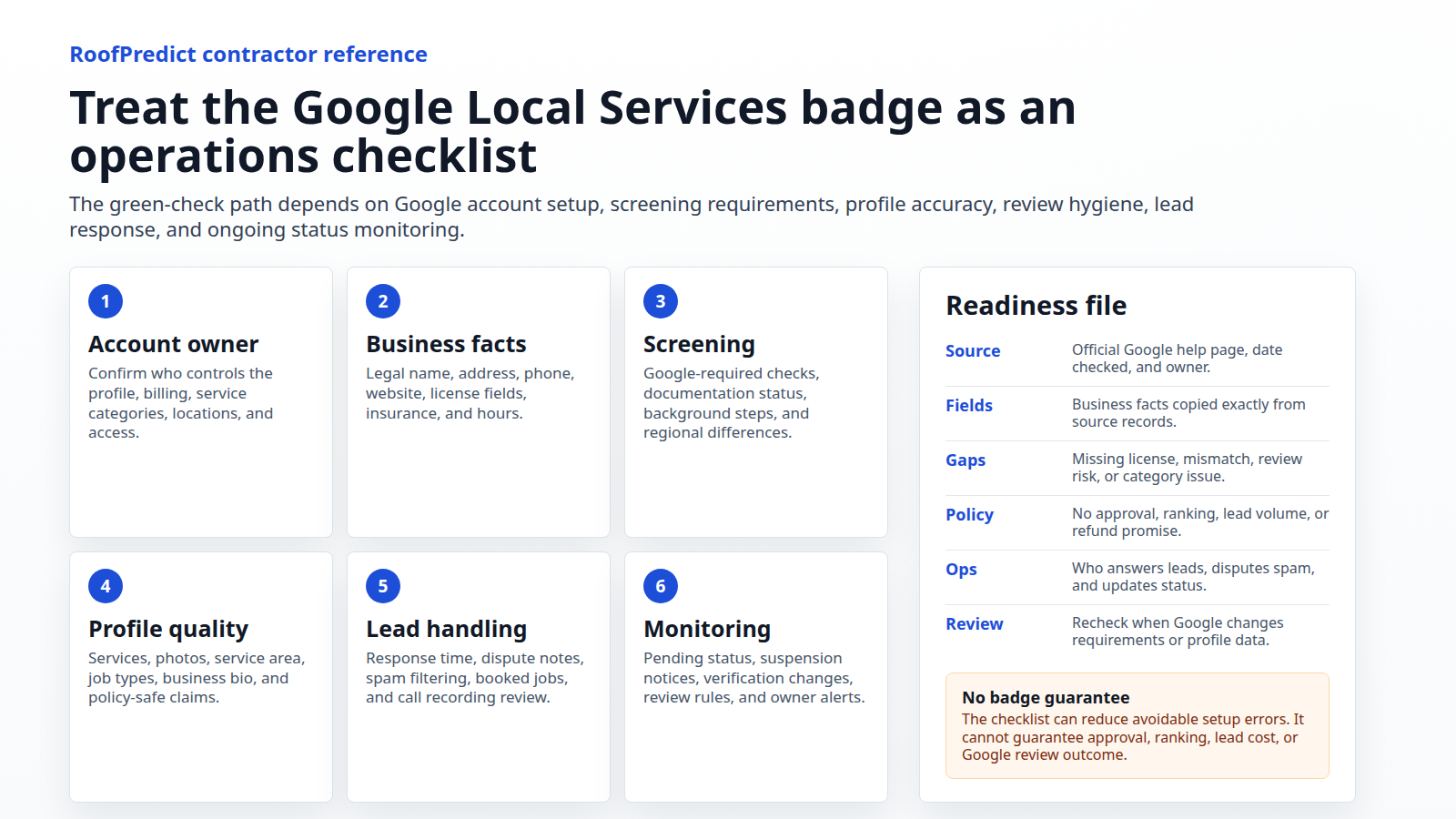
For a roofing company, the practical answer is not "buy a badge." It is: clean up the business identity, verify the Google Business Profile, prepare the roofing license and insurance packet, complete the Local Services Ads checks Google requests for the account, choose honest service areas and roofing job types, build a legitimate review base, and run the profile like a homeowner will judge it. The badge can support trust, but it does not promise approval, top placement, lower cost per lead, or more jobs.
RoofPredict can help with the operating work around the badge: market selection, service-area discipline, document readiness, review follow-up workflow, storm-response routing, missed-lead review, and profile-quality checks. RoofPredict cannot grant the Google Verified badge, verify documents for Google, override a Local Services policy decision, or guarantee Local Services Ads ranking.
| Searcher phrase | Current meaning | What a roofer should do | What RoofPredict can and cannot do |
|---|---|---|---|
| Green badge | Usually old Google Guarantee language | Translate the query to Google Verified and follow current LSA screening | Organize readiness work; not grant the badge |
| Google Verified badge | Current Local Services Ads badge language | Complete Google screening and verification | Track gaps, service areas, response quality, and review workflows |
| Google Business Profile verification | Proof that the business can manage its Google profile | Verify and keep the profile accurate | Compare profile details with market and service-area plans |
| Local Services Ads screening | Separate advertiser qualification process | Submit license, insurance, registration, identity, or background items Google requests | Prepare evidence and operating checks; not decide eligibility |
| Better ranking | Auction and profile-quality outcome | Improve responsiveness, relevance, reviews, photos, profile quality, and bid settings | Help prioritize markets and response workflow; not promise rank |
Official Source Links
Use Google's own pages for the policy claims below:
Sources checked: June 9, 2026.
- About Google Verified badge
- Business screening and verification requirements - United States
- Understand the screening and verification process
- About ad rankings
- Local Services platform policies
- Verify your business on Google
- Guidelines for representing your business on Google
- About Local Services data
- About reaching customers with your Local Services Ads
- Reviews and Ratings on Local Services Ads
- About Local Services Ads account suspensions
- AI features and your website
- Creating helpful, reliable, people-first content
- Spam policies for Google web search
- Ask Google to recrawl your URLs
What Changed About The Badge
Many roofing owners still say "green badge" because Google used Google Guarantee language in Local Services Ads for years. That shorthand can create bad decisions now. As of May 30, 2026, Google's Local Services documentation describes a single Google Verified badge for advertisers. Existing eligible advertisers who completed verification requirements receive the new badge automatically. New advertisers receive it after they successfully complete Local Services screening and verification.
The important planning change is that a roofer should stop treating the badge as a single visual asset and start treating it as the output of a verification system. The system looks at the business, the profile, the category, the market, and the account-level requirements Google shows in the Local Services Ads flow.
Google also says the badging change itself does not affect Local Services Ads ranking. That line matters. The badge can help a homeowner understand that the advertiser passed relevant checks, but Google's ranking page still describes an auction that considers bid and overall profile quality. Profile quality can include responsiveness, relevance, reviews, images, completed verification checks, average response time, and other business information.
Do not turn the badge into an endorsement claim. Google Local Services policies require accurate, complete, non-misleading information, and they warn against implying that Google endorses the business or controls pricing, service decisions, or customer disputes. The safer public message is: "We participate in Google Local Services Ads and have completed the required Google verification shown on that profile," not "Google recommends our roofing company."
Public Badge Claims Audit
Before a roofer publishes a badge page, ad landing page, sales deck, or intake script, translate each dashboard fact into safe public language. The dashboard may show useful operational status, but public copy should not overstate what that status means.
| Internal fact | Safe public use | Avoid saying |
|---|---|---|
| Local Services profile shows Google Verified badge | State that the visible Local Services profile shows the current Google verification status. | "Google recommends us" or "Google approved our workmanship." |
| Screening items are pending | Keep public pages quiet until the visible status is clear. | "We are basically verified" or "approval is guaranteed." |
| License or insurance was uploaded | Say documents were submitted only in internal notes unless Google status is visible. | "Google verified every crew member" or "all documents are approved." |
| Google Business Profile is verified | Say the business controls a public verified profile, if true. | "GBP verification means Local Services Ads verification is complete." |
| Reviews and photos are strong | Use legitimate public reviews and accurate photos according to platform and rights rules. | "Our reviews guarantee badge approval" or copied review text without review. |
| Profile quality improved | Say the company improved responsiveness, photos, business info, and review follow-up. | "These changes will rank us first" or "Google will lower our lead cost." |
| Old Google Guarantee copy was removed | Say the company updated wording to current Google Verified language. | Old reimbursement, guarantee, or green-badge promises. |
This audit is useful because the badge sits at the edge of marketing, operations, and platform policy. A sales manager may want a stronger claim. An agency may want a shorter headline. A roofer may remember the old Google Guarantee badge. The public page still needs to match current Google language and visible account status.
Use this rule: if the claim depends on a private dashboard, a future Google decision, a pending document review, a customer dispute process, a rank outcome, or a reimbursement promise, do not put it in public copy. Keep it in the internal launch card until it is visible, current, and source-supported.
Badge Status To Action Queue
Treat badge readiness as a queue, not a one-time checklist. Each status should create a practical owner task.
| Status or signal | Owner task | Public-page action |
|---|---|---|
| Existing advertiser automatically shows Google Verified | Confirm visible badge, update old wording, and monitor profile quality. | Use current Google Verified wording and remove old guarantee language. |
| New advertiser still in screening | Track document requests, owner access, and dashboard messages. | Do not imply the badge has been earned yet. |
| License or insurance mismatch | Reconcile entity names, DBA, qualifying party, policy dates, and issuing authority. | Keep credential claims narrow until records match. |
| Verified profile but weak response path | Assign lead-response owner, backup, hours, and missed-lead review. | Avoid "fast response" claims unless operations support them. |
| Strong badge/profile but weak website page | Update service areas, job types, photos, source limits, and contact expectations. | Publish fewer, clearer pages with real service boundaries. |
| Account paused, suspended, or pending | Read the dashboard notice and build the evidence packet before public comment. | Do not blame Google or promise a quick fix in public content. |
| Old reimbursement language still live | Remove old claims from website, email templates, sales scripts, and training notes. | Explain the current badge in plain language instead. |
The queue makes the work accountable. Verification is not only a marketing asset. It touches business identity, credential files, service-area truth, profile ownership, data handling, reviews, response time, and public claims. RoofPredict can help hold the operating notes together, but the company still needs owners for each queue item.
The Campaign-Type Matrix
Roofers often mix together several Google surfaces. Keep them separate before assigning work to an agency, operations manager, or sales team.
| Surface or campaign type | Primary purpose | Verification or quality input | Roofing risk if confused | RoofPredict role |
|---|---|---|---|---|
| Google Business Profile | Local identity, maps visibility, reviews, business info | Google chooses verification methods; service-area and address rules apply | Thinking GBP verification is enough for Local Services Ads | Align locations, service areas, categories, and review workflows |
| Local Services Ads | Paid lead generation from Local Services profiles | Google Verified badge after LSA screening and verification | Treating the badge as a ranking guarantee | Prepare document checklist, service-area map, and response workflow |
| Google Search Ads | Keyword-based paid search | Google Ads policy compliance and landing page quality | Sending paid traffic to vague or outdated roofing pages | Match market pages to real services and response capacity |
| Organic search pages | Unpaid organic discovery | Helpful, original, source-backed content and crawlable pages | Publishing thin city pages only to chase rankings | Build market-specific, homeowner-useful pages with real evidence |
| AI search features | Search features that may summarize or cite web content | No special AI file or schema is required; normal crawlability and content quality still matter | Creating artificial AI-first pages with little value | Build clearly sourced answer blocks, visible facts, and original tools |
| Review and reputation system | Trust before and after the lead | Legitimate customer reviews managed through Google Business Profile | Fake, gated, bought, or pressured reviews | Route post-job follow-up without policy-risky incentives |
This matrix changes the management question. The question is not "Which channel can we force?" The question is "Which evidence does each channel actually need, and which operating habit supports that evidence?"
The Roofer-Specific Verification Matrix
Google's United States screening requirements include a roofing category. Google describes roofing professionals as businesses that install, repair, and maintain shingles, gutters, venting, and other roof services. For that roofing category, the page lists these requirement areas:
| Requirement area | What Google's US roofing section lists | How to prepare without overclaiming |
|---|---|---|
| Background checks | Business check and owner check for select users only | Do not say every roofer or every fieldworker gets a background check; follow the account dashboard |
| Business registration | Business representative check for select users only | Keep ownership, entity, DBA, address, and authorized representative details consistent |
| Insurance | General liability insurance and professional liability insurance | Keep current certificates, insured entity names, policy periods, and renewal reminders |
| Licenses | Business license and owner license on state level | Store license numbers, issuing agencies, expiration dates, and qualifying-party details |
| Google Business Profile | Public and verified profile required for Local Services Ads | Verify the profile, keep service areas accurate, and control owner/manager access |
That matrix is more useful than a generic "get verified" checklist because it separates universal preparation from account-specific checks. If the Local Services Ads dashboard asks for something more specific than this matrix, the dashboard wins. If a state or city requires a roofing credential that Google does not list in a short help-center table, the local legal requirement still matters. Google policies also say service providers are responsible for applicable licensing, insurance, privacy, and other legal duties.
State And City Readiness Layer
For a roofing company, Local Services Ads readiness is never only a Google checklist. The account may be national-platform work, but the risk shows up in local markets: the state license field, the city a crew is sent to, the storm market the agency wants to open, the phone number a homeowner calls, and the public page that says the company serves a place.
Build a state and city readiness layer before expanding markets:
| Market question | What to verify before adding the area | Public-page consequence | RoofPredict use |
|---|---|---|---|
| State license fit | State roofing, contractor, business, or qualifying-party records where applicable | Do not claim verified service coverage beyond the credentialed market | Store license source, expiration, qualifying party, and state coverage note |
| City or county registration | Local contractor registration, permit, or business-license source if the market requires it | Avoid "we serve every city" copy when local paperwork is unclear | Attach local source notes to the service-area plan |
| Insurance fit | Named insured, DBA, policy dates, coverage type, and service territory | Keep insurance wording factual and current | Create renewal reminders and mismatch tasks |
| Service-area truth | Drive time, crew capacity, after-hours response, storm-surge backup, and job-type fit | Publish fewer, stronger city pages tied to real response ability | Compare target ZIPs, roof-age signals, storm context, and crew routing |
| Directory support | Whether the contractor profile can show service areas, job types, credentials, response process, photos, reviews, and limits | Use directory CTA only where profile fields help the reader compare honestly | Map directory fields to the evidence binder |
| State market brief fit | Whether state-level rules, insurance friction, weather regions, roof types, or material pressure affect LSA setup | Link to a state brief when it explains why the market needs different setup | Use the brief to keep service-area choices source-bounded |
The local reason-to-exist test is the same one used for RoofPredict city and state content: what would be wrong if this service-area claim were copied to another market? A Houston roofing profile may need different storm-response language, insurance-boundary review, and service-radius discipline than a Denver profile. A Florida profile may need different license-source review and hurricane-season response planning than an Ohio profile. A mountain, coastal, desert, plains, or dense urban market can change which job types, photos, service areas, and response promises are credible.
Do not turn that into legal advice or state-by-state credential tables unless the current official source has been checked for the specific jurisdiction. The safe workflow is to create a market readiness note:
Market:
State source checked:
City/county source checked:
Google dashboard requirement:
License or registration fields:
Insurance evidence:
Service-area limits:
Storm or seasonality concern:
Directory/profile fields supported:
Public wording allowed:
Public wording blocked:
Owner:
Next review date:
This makes city/state expansion stronger instead of riskier. A city page can rank when it has real local proof and a real roofer workflow. A Local Services Ads page can support that system when it tells the roofer which credentials, response paths, profile fields, and public claims have to line up before spend scales.
The Roofing Verification Checklist And Document Packet
Build the packet before the marketer starts pushing spend. The best time to find a mismatch is before the account is under review.
- Confirm the legal business name, DBA, phone, website, account owner, and profile name match.
- Confirm the Google Business Profile is public, verified, current, and controlled by the company.
- Collect roofing license numbers, issuing agencies, expiration dates, and qualifying-party details.
- Collect current insurance certificates and renewal dates.
- Map only service areas the company is licensed, insured, staffed, and willing to serve.
- Select only roofing job types the company actually performs.
- Set a compliant review follow-up process and a real lead-response owner.
Business identity. Record the legal name, DBA, phone number, website, account owner, service address or service-area setup, and the name that appears on the Google Business Profile. If the company recently bought another roofer, changed phone systems, or uses different brands in different cities, decide which entity is advertising before submitting documents.
Google Business Profile access. Confirm that the roofing company controls the profile owner account. Google says verification methods are chosen by Google, and review after verification steps can take up to 5 business days. If an agency owns the profile or a former employee controls it, fix access before LSA screening becomes urgent.
License folder. Store state-level business license records, owner or qualifying-party licenses, local contractor registrations when relevant, expiration dates, license numbers, issuing agency links, and entity names. Do not assume one state license covers every county, city, roof system, or insurance claim workflow.
Insurance folder. Store current certificates for general liability and other requested coverage, plus renewal dates and named insured details. The entity name on the certificate should not fight the entity name in the profile, license, or ad account.
Service-area map. Create a conservative map of cities, counties, neighborhoods, or ZIP codes the company can actually serve. Google Business Profile guidelines say service-area businesses should have one profile for the central office or location with a designated service area, and Google warns against virtual-office setups that are not staffed during business hours. Local Services policies also warn against targeting areas that cannot reasonably be served.
Job-type map. Choose roofing work the company actually performs and is licensed, insured, staffed, and willing to accept. Roof replacement, roof repair, leak repair, inspection, storm-damage response, gutter-adjacent work, skylight work, or ventilation work should be selected only if the account offers those options and the company can do the work honestly.
Review and photo packet. Build from real completed work. Photos should represent the business, equipment, employees, vehicles, or work accurately. Reviews should come from actual customers through a compliant review request process. Do not buy reviews, trade reviews, pressure homeowners, or offer discounts for positive reviews.
The 45-Minute LSA Readiness Audit
Before a roofing company pays an agency, changes budget, or asks why the badge is not showing, run a short audit. The goal is to find mismatches that create friction in Google's screening process or weaken the profile after approval.
| Time | Work | Evidence to save | Red flag |
|---|---|---|---|
| 0-5 minutes | Open the Google Business Profile, Local Services Ads account, website, license records, and insurance certificate | Screenshot or note of each business name, phone, URL, and service area | Different legal names, phone numbers, domains, or locations with no explanation |
| 5-10 minutes | Check profile ownership and manager access | Owner/manager list and account owner | Agency or former employee controls the profile without company oversight |
| 10-15 minutes | Compare roofing categories and job types | LSA selected services, GBP category, website services | Job types selected because they get leads, not because crews actually handle them |
| 15-20 minutes | Compare service areas to operations | ZIP/city/county list, crew capacity, drive-time notes, license/insurance fit | Targeting storm-hit markets the company cannot reasonably serve |
| 20-25 minutes | Check license and insurance packet | Current certificate, policy number, DBA support, license numbers, expiration dates | Entity name or DBA does not match the profile/account |
| 25-30 minutes | Review reviews and photos | Recent customer reviews, photo set, job examples | Bought-looking reviews, thin profile, stock images, or outdated trucks/branding |
| 30-35 minutes | Test lead response | Call path, message path, after-hours handling, missed-call owner | Leads route to a voicemail, agency number, or unmonitored inbox |
| 35-40 minutes | Read the public claim language | Website, ads, sales deck, email templates | "Google endorses us," "guaranteed leads," or old badge/reimbursement promises |
| 40-45 minutes | Write the launch decision | Go, fix first, or hold | No single owner for verification, profile quality, or lead response |
The audit should end with a short decision, not a motivational score. If the evidence is clean and the team can respond to leads, move to controlled launch planning. If the identity, licensing, insurance, or service-area story is inconsistent, fix that before spend goes live. If the profile is not controlled by the company, fix access before any other marketing work.
Source Of Truth Table
Local Services Ads problems often happen because the company has too many versions of itself online. One record says "ABC Roofing LLC." Another says "ABC Storm Restoration." The certificate of insurance uses a parent company. The Google Business Profile uses a city name. The website has a different phone number. None of those mismatches automatically means the account will fail, but they create review friction and homeowner confusion.
Use one source-of-truth table:
| Field | Source of truth | Where it must match or be explainable |
|---|---|---|
| Legal business name | Secretary of state, business registration, tax/accounting file | LSA account, insurance certificate, license record, website footer, contracts |
| DBA or trade name | DBA filing, internal brand record | GBP name, public website, LSA profile, vehicle/yard-sign branding |
| Phone number | Company-owned tracking plan | GBP, LSA, website, call-answering workflow, after-hours path |
| Website | Canonical company domain | GBP, LSA, ads, service-area pages, privacy/contact pages |
| Service address or service-area setup | Real office/location and service-area policy | GBP, LSA, website location pages, license/insurance coverage |
| Roofing license | State/local licensing authority or credential file | LSA screening, website claims, proposals, service pages |
| Insurance certificate | Current certificate from carrier/agent | LSA screening, proposal packet, internal renewal tracking |
| Account owner | Company-controlled Google account | GBP owner access, LSA owner/admin access, agency permissions |
This table also keeps agencies honest. An agency can help manage campaigns, reporting, creative, and profile cleanup. It should not be the only party that knows who owns the Google profile, which entity is being advertised, where credentials are stored, or how leads are handled.
Mismatch Scenarios To Fix Before Applying
Small inconsistencies become expensive when they reach a verification queue or a confused homeowner. Fix these before they turn into delays.
Scenario 1: the insurance certificate uses a different name. The Local Services screening process may need the insurance name to match the business information or be explained with a DBA document. Do not upload a certificate and hope the reviewer understands the corporate structure. Prepare the explanation and documentation before submitting.
Scenario 2: the Google Business Profile says one service area and the Local Services plan says another. A roofer may want to chase a hail market 70 miles away, but Local Services policies and Google Business Profile guidelines both make service-area accuracy important. If crews, licensing, insurance, and response coverage do not support the area, remove it.
Scenario 3: reviews exist under an old brand. A company acquisition, rebrand, or new location can leave reviews scattered. Do not create duplicate profiles or manipulate reviews to patch the optics. Get the profile ownership and brand story clean, then follow Google's review process for actual customers.
Scenario 4: the website promises every service but the LSA profile selects only a few. That mismatch confuses users and intake staff. If the company does not perform slate repair, commercial coatings, solar removal, emergency tarping, or gutter work, do not let generic website copy imply it does.
Scenario 5: the business has multiple nearby locations serving the same area. Google's ad ranking documentation notes that when multiple locations serve the same geographic area, Local Services may show only the highest ranking ad. Do not create overlapping locations just to occupy more space. Use real locations and clear territories.
Scenario 6: the badge copy is still written around the old Money Back Guarantee. Google's current badge documentation says the Money Back Guarantee tied to the Google Guarantee badge is being discontinued. Do not keep old reimbursement wording in landing pages, sales scripts, or customer emails.
What The Agency Should And Should Not Own
A good agency can be useful. It can help structure the account, read policy documentation, organize tasks, track leads, improve profile assets, and measure outcomes. But Local Services Ads are tied to the operating reality of the roofing company. The agency cannot manufacture that reality.
| Workstream | Agency can help with | Company must own |
|---|---|---|
| Verification packet | Checklist, upload coordination, dashboard monitoring | True entity details, license records, insurance records, qualifying-party details |
| Google Business Profile | Cleanup recommendations, category/service-area review, photo audit | Owner access, truthful business information, real office/service-area facts |
| Service areas | Market analysis, drive-time maps, lead reports | Which areas crews can serve legally, safely, and profitably |
| Job types | Campaign setup and performance notes | Which roofing work the company actually performs |
| Reviews | Workflow reminders and reporting | Real customer experience, compliant requests, no incentives or pressure |
| Lead response | Call tracking, dashboard, missed-call reports | Staffing, dispatch, after-hours rules, customer commitments |
| Public pages | Editorial support and search hygiene | Truthful service promises, source-backed claims, accurate local proof |
The simplest test: if the claim would be embarrassing in front of a homeowner, regulator, Google reviewer, insurer, or crew lead, do not publish it. The LSA profile should reflect the business that will actually answer the phone.
LSA Readiness Scorecard
This scorecard is a RoofPredict planning tool, not Google's scoring formula. It is useful because it forces the team to find weak spots before budget goes live.
| Readiness area | Points | Full-credit standard |
|---|---|---|
| Business identity consistency | 10 | Legal name, DBA, phone, website, address/service area, GBP, licenses, and insurance do not conflict |
| Google Business Profile control | 10 | Public verified profile, correct owner access, current category, service area, hours, photos, and website |
| Roofing license packet | 15 | State and local records collected, expiration dates tracked, entity names reconciled |
| Insurance packet | 15 | Current certificates collected, coverage types noted, renewal dates tracked |
| Service-area discipline | 10 | Map covers areas the crew can reasonably serve and where licensing/insurance fit |
| Job-type discipline | 10 | Selected services match crews, licenses, landing pages, intake scripts, and actual roofing work |
| Review quality process | 10 | Legitimate post-job review follow-up exists without incentives, gating, or pressure |
| Lead response coverage | 10 | Calls/messages have owner, backup, after-hours rules, and missed-lead review |
| Profile proof | 5 | Photos, bio, hours, and business details look credible to a homeowner |
| Policy and privacy review | 5 | No endorsement claims, misleading pricing, fake photos, unsafe data handling, or duplicate-account workaround |
Suggested interpretation:
- 85-100: strong readiness for human review and controlled launch planning.
- 70-84: workable, but fix named gaps before scaling budget.
- 50-69: likely to waste time or create policy risk.
- Below 50: pause spend planning and repair fundamentals.
Do not use this score as a sales promise. A high score means the team is organized. It does not mean Google will approve the account, rank the profile first, lower lead costs, or send a specific number of jobs.
Data-Source Fit Table
The right data helps a roofer run Local Services Ads with discipline. It does not replace Google's verification process.
| Data source | What it can help decide | What it cannot prove |
|---|---|---|
| Google Business Profile details | Whether the profile matches the entity, location, service area, hours, and category | That LSA screening is complete |
| License and insurance records | Whether the advertised market and job types fit known credentials | That Google or a state will accept every document |
| RoofPredict service-area analysis | Which ZIP codes, cities, or neighborhoods fit crew capacity and opportunity | That Google will rank the ad for those areas |
| Roof age and property signals | Where homeowner outreach or storm-readiness content may be more useful | That a homeowner currently needs a roof |
| Permit, parcel, or public-record data | Where roof replacement history or property context may inform market planning | That a specific homeowner should be contacted without compliant outreach rules |
| Storm history and weather context | Which markets may need faster response planning after hail, wind, or leaks | That an insurance claim is valid or payable |
| Call and message handling logs | Missed-lead patterns, response bottlenecks, and after-hours gaps | That Google will award better placement |
| Review and job completion workflow | Markets with weak proof, slow follow-up, or reputation gaps | That reviews can be manipulated or guaranteed |
This is where RoofPredict can make the article more than a policy summary. A roofing company does not need a thousand generic marketing tips. It needs to know which markets it can serve, which documents prove the business is real, which response paths break during storms, and which homeowner-facing proof is missing.
What Not To Expand Into This Page
Keep this page focused on Local Services Ads verification readiness. It should not become the master page for every marketing, sales, review, or service-area topic.
| Adjacent topic | Better home | Why it stays separate |
|---|---|---|
| Monthly Google Ads budget | Paid-search budget planning article | Budget strategy can drift into financial promises and cost-per-lead claims |
| Service-area page architecture | Service-area strategy article | Website city-page strategy is broader than LSA verification readiness |
| Press releases and newsworthiness | Press release strategy article | PR proof packets are not Local Services Ads screening evidence |
| Review/NPS operations | Customer feedback article while held or reviewed | Review collection has policy and privacy risk beyond LSA setup |
| Door knocking or storm follow-up | Storm follow-up/field operations articles | Outreach rules, contact channels, and weather response need their own review |
| Organic roofing lead scoring | Property data and lead-scoring articles | Data-source governance is broader than profile readiness |
This separation helps search quality. One page should solve one problem deeply. If a reader wants budget, local landing pages, review operations, or storm routing, send them to the right page instead of stretching this page until it repeats the whole site.
A Practical RoofPredict Workflow
Use this five-step workflow before asking for a public launch review.
1. Market and service-area audit. Start with the service areas already in the Google Business Profile and Local Services plan. Compare them with license coverage, insurance fit, crew capacity, drive time, storm-response expectations, and RoofPredict market opportunity. Remove ZIP codes that look attractive but cannot be served quickly or honestly.
2. Document cross-check. Build one table with business name, DBA, Google Business Profile name, license names, insurance named insured, account owner, phone number, and website. Highlight mismatches. A mismatch does not always mean the account will fail, but it is the kind of thing that creates avoidable back-and-forth.
3. Profile and proof cleanup. Check photos, business bio, hours, services, and review patterns like a skeptical homeowner. A badge next to a thin profile does not create much trust. A complete profile with current photos, a clear service area, a real phone path, and credible reviews gives the badge context.
4. Lead-response rehearsal. Pretend the first LSA lead is a leak call during a storm week. Who answers? Who handles messages? What happens after hours? How are missed calls reviewed? Google's ranking documentation includes responsiveness and average response time among profile-quality factors, and Local Services policies expect timely customer response.
5. Post-lead and post-job loop. Track accepted leads, rejected leads, poor-fit areas, slow response, completed jobs, review follow-up, and homeowner complaints. Feed those observations back into service areas, job types, hours, and profile proof. The goal is eligibility plus a profile that can keep earning trust after verification.
Lead Response Workflow For Roofing Teams
Local Services Ads can expose a roofing company's operational weak spots quickly. A storm week can create lead volume, homeowner urgency, missed calls, duplicate requests, and bad-fit jobs at the same time. If the response workflow is loose, the badge will not save the experience.
Create a lead path before the account is live:
- Primary answer owner. Name the person or team responsible for calls and messages during business hours.
- Backup path. Name the backup for lunch breaks, site visits, weather surges, and staff absences.
- After-hours rule. Decide whether after-hours inquiries receive live answering, a callback window, an emergency-only path, or next-business-day response.
- Job-type triage. Give the intake team a short list of accepted and rejected job types so they do not promise work the company does not perform.
- Service-area triage. Give the intake team the real service-area map, including areas that are paused, seasonal, or only served for larger jobs.
- Urgency triage. Separate active leaks, safety hazards, sales appointments, maintenance questions, warranty requests, and insurance documentation calls.
- Recordkeeping. Save lead source, caller need, market, outcome, response time, and reason for rejecting or accepting the lead.
- Weekly review. Review missed calls, slow messages, poor-fit areas, and complaints before changing budget.
RoofPredict fits this workflow because it can help connect storm context, roof-age signals, market selection, service-area discipline, and follow-up notes. It still should not claim that those signals decide Google's auction or verification outcome.
How To Build A Public Page Around The Badge Without Creating Spam
A roofing company may need a public page that explains its Local Services Ads readiness, service areas, or trust signals. That page should be written for homeowners and contractors who need clarity, not for a content quota.
Google Search Central's people-first guidance is the right standard here: create content that helps readers, demonstrates useful knowledge, and does not exist primarily to manipulate rankings. Google's spam policies also warn against scaled content abuse. For this topic, that means a roofer should avoid hundreds of near-identical "Google Verified roofer in [city]" pages.
A useful public page should answer specific questions:
| Page element | Strong version | Weak version |
|---|---|---|
| Badge explanation | Explains the current Google Verified wording and points to the visible Local Services profile | Says "Google recommends us" or uses old guarantee language |
| Service-area explanation | Names areas the company can actually serve and why | Lists every nearby ZIP code with no operational proof |
| Roofing work | Names specific roofing services the company performs | Stuffed list of every possible roofing keyword |
| Trust proof | Shows real reviews, photos, licenses, insurance language, response process, and service limits | Generic badge screenshot, stock roof photo, or unsupported "best roofer" claim |
| Homeowner next step | Gives a clear call, message, estimate, or inspection path | Pushes the user through vague lead forms with no expectations |
| Source behavior | Links official Google or company policy pages where useful | Hides policy limits or makes unsupported claims |
For AI search surfaces and ordinary readers, the same page should be clear enough to quote without inference. Define the badge, state what it does and does not mean, explain the company's real service boundary, and avoid claims that depend on a private dashboard or future Google decision.
What To Watch In The First 30 Days
The first month should be a controlled operations review, not a victory lap. Watch the account and the field workflow together.
| Signal | What to ask | Action if weak |
|---|---|---|
| Verification status | Are any dashboard checks pending, repeated, or unclear? | Assign one owner to resolve document, profile, or access issues |
| Lead response | Are calls/messages answered within the team's standard? | Fix staffing, routing, hours, and backup rules before increasing spend |
| Lead fit | Are leads coming from the right job types and areas? | Tighten services, service areas, website copy, and intake script |
| Review trend | Are recent reviews real, relevant, and policy-safe? | Improve post-job follow-up without incentives, gating, or pressure |
| Homeowner confusion | Are callers misunderstanding services, location, pricing, or availability? | Update profile, page copy, phone script, and service-area language |
| Bad-fit spend | Are leads rejected for areas or services the company selected? | Remove those settings until operations support them |
| Privacy handling | Are lead records stored and shared appropriately? | Limit access, avoid exporting customer data casually, and keep retention rules clear |
| Public claims | Did anyone keep old green-badge, reimbursement, or ranking language? | Correct the website, ads, sales deck, and training notes |
Do not use early lead volume alone as proof that the setup is healthy. A company can receive leads from poor-fit areas, answer slowly, confuse homeowners, and still see activity. The stronger metric is whether the profile is attracting jobs the company can actually serve well.
The First 10 Leads Review
Do a manual review after the first 10 Local Services leads, even if the account feels busy. Ten leads is not enough to judge a campaign forever, but it is enough to catch obvious mismatches between the profile, service areas, job types, call path, public page, and crew reality.
Use this review board:
| Lead review field | What to record | What it reveals |
|---|---|---|
| Lead date and source | Date, call/message, Local Services profile, market, and job type. | Whether the lead arrived through the expected channel and category. |
| Service-area fit | In-area, edge-area, outside-area, or unclear. | Whether the profile and public pages are too broad. |
| Job-type fit | Repair, replacement, leak, inspection, gutter-adjacent, warranty, storm, commercial, or wrong service. | Whether selected services match real roofing operations. |
| Response time | Answered live, same-day callback, next-day callback, missed, or no owner. | Whether responsiveness is an operating strength or a weak point. |
| Homeowner expectation | What the caller thought the company offered. | Whether badge, service-area, pricing, emergency, or insurance language is creating confusion. |
| Packet created | Notes, photos, appointment, estimate, rejected reason, or follow-up owner. | Whether leads become a usable customer record. |
| Outcome label | Accepted-good-fit, rejected-out-of-area, rejected-wrong-service, duplicate, missed-call, follow-up-needed, or privacy-controlled. | Whether lead quality problems are profile problems, operations problems, or normal filtering. |
| Public-page fix | None, service-area wording, job-type wording, privacy note, badge wording, phone path, or review proof. | Which website or profile update should happen before scaling. |
The review should ask four questions:
- Are the leads coming from places the company can serve?
- Are the leads asking for roofing work the company actually performs?
- Are calls and messages handled inside the response standard the company wants to claim?
- Do homeowners misunderstand anything because the public page, profile, ad, or old badge wording is unclear?
If the answer to any question is weak, fix the system before increasing spend. Do not treat "more leads" as the answer to bad service-area fit, wrong job types, slow response, unclear profile language, or missing follow-up ownership.
Use a short first-10-leads memo:
Review period:
Leads reviewed:
Good-fit leads:
Rejected outside area:
Rejected wrong service:
Missed or slow-response leads:
Homeowner confusion patterns:
Profile changes needed:
Website changes needed:
RoofPredict workflow changes needed:
Owner:
Recheck date:
This memo should stay operational. It should not become a public brag post. A roofing company can learn from lead patterns without exposing homeowner names, phone numbers, addresses, claim details, photos, or private call notes.
For RoofPredict, this is a useful integration point. The product can keep lead outcome labels, service-area notes, roof age context, storm context, inspection status, and follow-up ownership in one record. The product should not claim that those labels change Google's auction, guarantee better lead quality, or qualify a lead as payable, refundable, or valid under any platform rule.
What Improves Ranking After Eligibility
The badge is one input in a larger system. Google's ad ranking page says Local Services listings are displayed and ranked through an auction that takes bid and overall profile quality into account. It also names factors tied to the likelihood of a lead: responsiveness, what the customer is searching for, location, service relevance, business bio, message or booking options, ratings, number of reviews, average response time, high-quality images, completed verification checks, and other business information.
For a roofing company, that points to a practical operating target:
- answer calls and messages fast;
- set hours that match real coverage;
- choose job types the company actually handles;
- keep service areas tight enough for reliable response;
- add current, accurate photos;
- maintain legitimate reviews through completed work;
- write a business bio that tells homeowners what roofing problems the company solves;
- review missed calls and bad-fit leads every week;
- avoid duplicate or overlapping locations that serve the same area without a real operational reason;
- use bid and budget settings as business decisions, not as substitutes for profile quality.
No article should turn those factors into a secret formula. Google does not publish a fixed public ranking formula for one roofer in one market. The honest claim is narrower and stronger: these are the areas Google itself tells advertisers and providers to manage.
The Homeowner Trust Angle
Roofers often think about Local Services Ads from the contractor side: cost per lead, booked jobs, crews, dispatch, close rate. Homeowners see a different screen. They see a badge, business name, reviews, photos, hours, location or service area, phone path, and maybe a few other providers in the same search.
That means the badge has to sit inside a believable trust picture. A homeowner with an active roof leak asks more than, "Is there a badge?" They ask whether the company looks local, whether reviews sound real, whether photos look like actual work, whether the phone is answered, whether the business appears licensed and insured, and whether the service area makes sense.
This is also why adding more articles or more city pages cannot be the whole growth strategy. If the content says the company serves a city, but the Local Services profile, license position, review history, and response path do not support that promise, the content is thin at best and misleading at worst. Better pages describe real service areas, real roof problems, real limitations, and real next steps.
Policy, Privacy, And Review Boundaries
The fastest way to damage a Local Services Ads account is to treat verification as paperwork and ignore operations. Google's platform policies require accurate and non-misleading information. They also say providers are responsible for local laws, licensing, insurance, privacy, customer response, worker conduct, pricing disclosures, and commitments made to customers.
Use these boundaries:
- Do not claim Google endorses the roofing company.
- Do not say the badge guarantees workmanship, pricing, insurance approval, or dispute resolution.
- Do not advertise outside license, insurance, staffing, or reasonable service-area limits.
- Do not select roofing job types only because they might produce leads.
- Do not use another person's license or a disconnected business entity.
- Do not create duplicate accounts to work around review, suspension, or location problems.
- Do not use stock or misleading photos that imply crews, trucks, jobs, or locations the company does not have.
- Do not offer discounts or incentives in exchange for positive reviews.
- Do not sell, misuse, or casually share homeowner call, message, or lead data.
Google's Local Services data page says routed communications can involve consumer details passing through Google and to the provider, and it notes that providers may independently collect consumer information under their own privacy policy. Treat every lead like customer data, not like a spreadsheet row to sell or blast.
If The Account Is Paused, Suspended, Or Still Pending
Do not publish a defensive blog post blaming Google or promising a fast fix. Handle the account problem quietly and document what is known.
Start with the dashboard message. Identify whether the issue is verification, profile ownership, license, insurance, background check, business registration, review policy, duplicate account behavior, inaccurate business information, service-area mismatch, suspicious activity, or another policy category. Google's suspension documentation and platform policies are the source of truth; an outside article cannot diagnose a specific account.
Then create an evidence packet:
| Packet item | Why it matters |
|---|---|
| Dashboard notice | Prevents the team from guessing the issue |
| Account owner and profile owner | Confirms who can respond or request access |
| Business identity table | Shows legal name, DBA, phone, website, and entity details |
| License and insurance records | Supports verification without scrambling |
| Service-area map | Shows whether targeting is realistic and compliant |
| Review request process | Helps identify incentive, gating, or pressure risk |
| Recent profile edits | Shows whether changes triggered review or confusion |
| Lead handling notes | Helps evaluate responsiveness and customer-commitment issues |
If the company needs legal, licensing, insurance, privacy, or employment advice, get the appropriate professional involved. A marketing agency, software vendor, or blog article should not provide legal conclusions about why an account was paused or how a regulated credential applies.
What To Do With Old Green-Badge Language
If the website, sales deck, ad copy, or contractor training document still says "get the Google Guarantee green badge," update the wording. Keep the old phrase only where it helps users recognize the query, then immediately translate it to current Google Verified language.
For example:
| Old wording | Better wording |
|---|---|
| Get the green Google Guarantee badge | Complete Google Local Services Ads screening for the current Google Verified badge |
| Google recommends us | Our Local Services Ads profile shows the Google verification status available for that profile |
| The badge gets us ranked first | The badge is separate from the auction and profile-quality factors Google describes |
| We serve every storm-hit ZIP code | We serve listed areas where our license, insurance, crews, and response process fit |
| We can get you verified | We can help organize the documentation and operating workflow Google may review |
After a revised public page is published and included in normal site discovery, Google can recrawl it through ordinary links, Search Console submission paths, or URL Inspection for a few important URLs. Google's Search Central guidance says recrawling can take days to weeks and that requesting a crawl does not guarantee instant inclusion or inclusion at all. Do not treat resubmission as a substitute for making the page useful.
Dashboard-To-Public Change Log
Old badge language usually does not live in one place. It can sit in a website page, a paid-search landing page, a sales deck, an email template, a call script, a review request, a training note, a proposal PDF, a door hanger, a profile description, a reporting dashboard, or an agency onboarding document. A roofer can update the main article and still leave old claims in the sales process.
Use a dashboard-to-public change log any time the Local Services status, badge wording, business identity, service area, ownership, or credential file changes.
| Surface | What to check | Safe action | Owner |
|---|---|---|---|
| Website service pages | Old Google Guarantee, green-badge, reimbursement, endorsement, approval, or ranking claims | Rewrite to current Google Verified wording and visible profile status | Website owner |
| Paid landing pages | Badge language, service-area claims, response-time claims, review wording | Match current LSA profile and real operating capacity | Ads owner |
| Google Business Profile | Name, category, address/service area, phone, website, hours, photos, owner access | Keep it accurate and aligned with LSA facts | Profile owner |
| Local Services Ads profile | Badge status, job types, service areas, hours, response process, document requests | Use dashboard status as the private source of truth | LSA account owner |
| Sales scripts | "Google recommends us," "guaranteed," "ranked first," or old reimbursement language | Replace with a short, source-safe explanation | Sales manager |
| Call center or intake notes | Promises about badge meaning, response times, insurance, or reimbursement | Add allowed wording and escalation notes | Intake manager |
| Proposals and PDFs | Copied badge images, old guarantee phrasing, unsupported trust claims | Remove unsafe assets and use plain-language status | Estimating/admin owner |
| Email and SMS templates | Outdated badge names, review pressure, privacy issues | Update wording and keep customer data handling narrow | CRM owner |
| Review workflows | Incentives, gating, pressure, copied review text, or fake review prompts | Keep review requests policy-safe and customer-led | Reputation owner |
| Agency reports | Status labels that imply approval, ranking, or guaranteed lead volume | Separate badge status from ranking and lead performance | Agency/contact owner |
Each row should have three fields:
Changed item:
Old wording or setting:
New wording or setting:
Source checked:
Owner:
Date changed:
Where it still appears:
Next review date:
That last field matters. A team may fix the main page but forget a PDF in the sales folder, an old ad extension, a call script, or a contractor onboarding document. A stale phrase can be enough to confuse homeowners, agencies, and employees.
Here is a safe wording pattern:
Our Local Services Ads profile may display Google's current verification status when we meet the applicable screening and verification requirements for that profile. Google decides badge eligibility and Local Services Ads ranking. We keep our business information, credentials, service areas, and response workflow updated so homeowners see accurate information.
That wording is not flashy, but it avoids the common overclaims. It does not say Google endorses the roofer. It does not promise ranking, lead volume, lower cost, reimbursement, approval, or document acceptance. It also leaves room for the visible Local Services profile to be the place where the current platform status is confirmed.
For RoofPredict, this creates a useful workflow: track badge-related fields as operational records, not marketing slogans. The system can store owner access notes, service-area maps, credential renewal dates, response metrics, profile-quality tasks, old-copy cleanup status, and recheck triggers. The roofer and agency still need to read Google's dashboard and follow Google's current requirements.
Build A Badge Evidence Binder Before Spend Scales
The safest Local Services Ads file is a binder that lets the roofing company explain, in plain language, what the profile says, what the company can prove, who owns the next step, and what the public website is allowed to say. It is boring in the right way. It keeps a team from turning a partial dashboard status into a bigger claim than Google, the credential file, or the operating team can support.
Build the binder before the company raises budget, opens a new service area, adds a new roofing category, hands the account to an agency, or rewrites a page around the badge. The binder does not need to be fancy. It needs to be current, owned, and specific enough that a manager can find the weak spot in 15 minutes.
Use these fields:
| Binder field | What goes in it | Why it matters |
|---|---|---|
| Profile status snapshot | Current Local Services Ads dashboard status, date checked, and account owner | Prevents sales and website copy from outrunning the visible account status |
| Public profile link | The visible profile or public surface where a user can confirm status | Keeps website claims tied to something a homeowner can inspect |
| Business identity record | Legal name, DBA, address or service-area setup, phone, website, tax/entity notes if relevant | Helps catch name and access mismatches before screening or profile edits create confusion |
| Google Business Profile record | Owner access, primary category, service area, hours, phone, website, photos, and recent edits | Separates GBP maintenance from Local Services screening while keeping facts aligned |
| License packet | License number, jurisdiction, qualifying party if applicable, expiration, renewal owner, and source link | Keeps credential language inside what the company can actually prove |
| Insurance packet | Certificate holder, named insured, coverage type summary, expiration, renewal owner, and agency contact | Reduces last-minute document scrambling and avoids vague insured-status claims |
| Service-area map | Areas the company selected, areas crews can actually reach, excluded areas, and reason for each exclusion | Prevents the profile from advertising markets the company cannot serve responsibly |
| Job-type map | Selected roofing services, services intentionally excluded, and who approves changes | Stops a broad lead setting from creating bad-fit calls |
| Lead-handling record | Intake owner, backup owner, hours, missed-call rule, response target, privacy handling, and rejected-lead reason labels | Connects profile quality to operations instead of treating leads as a dashboard number |
| Review and photo process | How legitimate reviews and job photos are requested, stored, approved, and removed if inaccurate | Keeps profile quality work away from fake, pressured, or misleading assets |
| Public wording ledger | Allowed wording, blocked wording, last reviewed page, last reviewed script, and reviewer name | Prevents old Google Guarantee, endorsement, reimbursement, approval, or ranking claims from surviving in stale assets |
| Recheck trigger list | Rebrand, acquisition, agency change, office change, license renewal, insurance renewal, service-area change, suspension, or profile edit | Makes revalidation routine instead of reactive |
The public wording ledger is the most useful part of the binder because it forces the team to write in sentences instead of slogans.
| Internal fact | Allowed public wording | Blocked wording |
|---|---|---|
| The dashboard shows a current Google Verified status for the profile | "Our Local Services Ads profile shows the current Google verification status available for this profile." | "Google recommends us." |
| The account is still pending screening | "Our Local Services Ads account is still being reviewed." | "We are Google Verified." |
| The company has a license record in the file | "We keep license records on file and review them when profile information changes." | "Google has approved all of our credentials." |
| The company has a defined service area | "We list service areas that match our crew coverage and credential file." | "We serve every storm-hit neighborhood." |
| The company responds to leads during set hours | "Calls and messages are routed to the intake team during listed hours." | "Every Local Services lead gets instant service." |
| RoofPredict stores readiness records | "RoofPredict helps organize service-area, credential, response, and follow-up records." | "RoofPredict verifies the badge." |
Add a spend-hold rule beside the binder. Local Services Ads spend should stay limited when the file has unresolved identity, access, credential, service-area, lead-response, review, privacy, or public-claim problems. That rule protects the company from paying for confusion. A clean binder cannot guarantee approval or lead quality, but it can keep the team from scaling a profile that is visibly out of alignment.
Use a simple weekly check while spend is active:
| Weekly check | Pass condition | Hold condition |
|---|---|---|
| Dashboard status | Status is understood and no unresolved account notice is open | The team cannot explain the current status or who owns the next step |
| Profile facts | Business name, phone, website, hours, service area, and job types match operations | A profile field changed and the binder was not updated |
| Credential dates | License and insurance dates are current or renewal owner is assigned | A credential expired, changed, or no owner can produce the record |
| Lead handling | Missed calls, response delays, bad-fit jobs, and duplicate leads have reason labels | Leads are being accepted or rejected without a record |
| Public claims | Website, landing pages, scripts, PDFs, and templates match the allowed wording ledger | Old badge, endorsement, reimbursement, ranking, or approval language appears |
| Agency access | Company owner access and agency permissions are documented | The agency controls the account and the company cannot confirm ownership |
For a roofing company, this binder also creates better conversations between marketing and operations. The marketing team can see why a service area was excluded. The intake team can explain why a lead was a poor fit. The owner can see which credential date creates the next risk. The agency can see which words are allowed. Nobody has to guess whether an old page, PDF, or sales script is still creating an unsupported promise.
RoofPredict's useful role is to make that operating memory easier to keep. A roofer can store service-area notes, property-type fit, storm-response capacity notes, credential renewal reminders, response-time observations, profile cleanup tasks, and old-asset review status. The Google dashboard and Google documentation remain the source of truth for platform status. The roofing company remains responsible for credentials, account access, customer data, and public claims.
Badge Asset And Brand-Use Boundary
A roofing company can explain its Local Services Ads status in public copy, but that does not mean it can freely copy Google's badge, logo, screenshots, or brand elements into every website page, mailer, truck wrap, door hanger, or sales deck. Google's Local Services platform policies include a prohibited-practices section for unauthorized use of Google branding and trademarks. Treat the badge as a platform status shown in Google's Local Services surfaces unless the company has reviewed what it is allowed to show elsewhere.
Use this rule before publishing any visual claim:
| Asset or phrase | Safer handling | Hold if |
|---|---|---|
| Google Verified badge image | Use only in ways allowed by Google brand and platform rules | The team copied the image from a screenshot or another advertiser |
| Google logo | Avoid using it in marketing material unless brand-use rules permit it | It implies Google sponsors, endorses, or recommends the roofer |
| Local Services profile screenshot | Use cautiously and redact private account/customer details | The screenshot shows dashboard data, leads, customer names, or outdated badge wording |
| "Google Verified" text | Tie it to the visible Local Services profile status | The status is pending, suspended, hidden, or not visible to users |
| "Google Guarantee" text | Use only when explaining old user language and current transition | The page still sells an old reimbursement promise |
| Sales script badge language | Train the team to say what the status means and does not mean | The script claims ranking, lead volume, lower prices, or workmanship approval |
The public website does not need a giant badge graphic to be trustworthy. A better page explains the company's current service areas, license and insurance posture, real review process, lead response, and profile-status boundaries. If the visible Local Services profile shows a Google Verified badge, link the claim to that status and keep the wording plain. If the badge is pending, do not pre-announce it.
This also matters for generated images and design assets. Do not create fake badge art. Do not redesign the Google Verified badge. Do not place a badge-like symbol beside unsupported claims. A simple operations diagram, readiness checklist, or profile-quality worksheet is safer than a visual that looks like a Google endorsement.
The Credential Drift Calendar
Local Services Ads readiness is not static. A roofer can be clean on launch day and drift out of alignment months later because an insurance certificate renews, a license expires, a qualifying party changes, an agency loses access, a call-tracking number changes, a new market is added, or a storm season stretches crews beyond the advertised service area.
Create a calendar that treats LSA evidence like an operating file:
| Review item | Review timing | Owner question |
|---|---|---|
| General liability and professional liability certificates | 60 days before renewal and again after renewal | Does the named insured still match the entity, DBA, and profile? |
| Roofing license or contractor registration | 60 days before expiration and after any state/local change | Is the license current for every advertised market and job type? |
| Google Business Profile owner access | Quarterly and after staff or agency changes | Does the company still control owner-level access? |
| Local Services Ads account access | Quarterly and after agency or billing changes | Can the company see leads, billing, profile status, and dashboard notices? |
| Service areas | Monthly during storm season; quarterly otherwise | Are listed ZIP codes, cities, and counties still realistic for crews and credentials? |
| Job types | Quarterly and after adding or dropping a service | Are selected services still performed by the company? |
| Photos and profile content | Quarterly | Do photos accurately represent crews, vehicles, work, and branding? |
| Public badge language | Quarterly and after Google policy or UI changes | Does public wording still match current Google terminology? |
| Lead data handling | Quarterly | Who can access calls, messages, homeowner details, and exported lead notes? |
The calendar prevents a common failure: the marketing page keeps saying the company is ready while the operating facts have changed. If an insurance renewal is late, mark the account file. If a service area is no longer staffed, remove it from the Local Services plan and public pages. If a former agency still owns access, fix that before the next emergency.
RoofPredict can support the calendar by keeping service-area notes, storm markets, roof-age signals, lead follow-up, and account-readiness tasks visible to the team. The calendar still needs human owners because Google, licensing authorities, insurers, and customers judge the actual business, not the software workspace.
Lead Quality Feedback Loop
After the profile is live, the most useful question is not simply "How many leads came in?" The better question is "Which leads matched the company we told Google and homeowners we are?"
Build a weekly lead-quality review:
| Lead pattern | What it may reveal | Action |
|---|---|---|
| Many leads outside the realistic service area | Service-area settings or public pages may be too broad | Remove unsupported areas and update website language |
| Many leads for work the company does not perform | Job types, profile text, or page copy may be too broad | Narrow job types and rewrite the service explanation |
| Slow response during storm weeks | Intake capacity is below the advertised coverage | Add backup owners, adjust hours, or reduce market coverage |
| High rejection rate from one ZIP code | That market may not fit crews, licensing, or job economics | Pause or separate the market before scaling spend |
| Confused callers asking about price or guarantee | Public copy may imply a promise the profile cannot support | Rewrite badge, pricing, and reimbursement language |
| Complaints after accepted jobs | There may be a service-quality, expectation, or handoff problem | Review call notes, estimate wording, receipts, and follow-up process |
| Strong leads with weak closeout notes | The marketing data is not making it back to operations | Add outcome labels and owner review |
Use a small label set:
Accepted-good-fit
Accepted-but-slow-response
Rejected-out-of-area
Rejected-wrong-service
Rejected-credential-boundary
Missed-call
Duplicate-lead
Homeowner-confused-by-claim
Follow-up-needed
The point is to adjust the system, not to blame the lead source. If the company rejects many calls from a county, the Local Services setup and public service-area pages should change. If callers expect emergency tarping but the company does not offer it, the page and profile should say that more clearly. If response slows every time hail hits, the issue is staffing and routing, not badge wording.
Recheck Triggers
Some events should force an immediate LSA readiness review even if the quarterly check is not due.
| Trigger | What to review before continuing |
|---|---|
| Rebrand, acquisition, merger, or new DBA | Entity name, profile ownership, license records, insurance certificates, public pages, reviews, and phone routing |
| New branch, office, or service area | Google Business Profile eligibility, service-area accuracy, license geography, insurance fit, staffing, and duplicate-account risk |
| New roofing service line | Job-type settings, crew training, license/insurance fit, landing pages, intake scripts, and proof photos |
| Storm-response surge | Service-area limits, lead-routing backup, emergency wording, crew capacity, and privacy handling |
| Agency change | Owner access, billing, lead data, campaign settings, public claims, and dashboard notifications |
| Insurance renewal or lapse | Current certificate, named insured, coverage dates, and account documentation |
| License renewal, suspension, or qualifying-party change | License status, advertised markets, owner records, and public credential wording |
| Account pause, suspension, or disapproval | Dashboard notice, policy category, evidence packet, recent edits, duplicate accounts, and public claims |
Do not wait for a ranking drop, a review problem, or a profile warning to run this review. Local Services Ads sits close to the real business. When the business changes, the profile, pages, and claims need to change with it.
Source Limits
| Source area | What it supports | What it does not support |
|---|---|---|
| Google Verified badge page | Current badge name, existing/new advertiser flow, Money Back Guarantee change, ranking note | Approval, ranking, or lead guarantee |
| US business screening requirements | Roofer category requirements, verified GBP requirement, average timing statement | Every account-specific dashboard requirement or local legal answer |
| Screening process | Category/location variation, repeated evaluation, possible checks | A fixed checklist for all roofing advertisers |
| Google Business Profile documentation | Profile verification review timing, service-area and virtual-office boundaries | Local Services Ads approval by itself |
| Ad ranking page | Auction, bid, relevance, responsiveness, reviews, images, verification checks, profile quality | A public formula for one roofing market |
| Platform policies | Accuracy, licenses, insurance, privacy, service areas, reviews, pricing, commitments, enforcement risk | Legal advice or diagnosis of a specific suspension |
| Search Central guidance | Helpful content, AI feature basics, recrawl limits, scaled-content risk | A guarantee of indexing, AI feature inclusion, or rankings |
What To Review Before Launch
Before a roofing company launches or updates a page around Local Services Ads, answer these questions:
- Do the badge, screening, ranking, review, data, and policy claims match current Google documentation?
- Do the license, insurance, service-area, and job-type claims match the way the company actually operates?
- Does the public copy avoid Google endorsement, ranking, lead, cost, reimbursement, and approval promises?
- Does the lead-handling workflow treat calls, messages, and customer details as private customer data?
- Does the page serve the old "green badge" query while clearly using current Google Verified terminology?
- Is RoofPredict framed as readiness and operating support, not as a badge-granting tool?
- Can a homeowner understand the company's service boundaries without decoding ad-platform language?
- Is every public claim still true if a Google reviewer, licensing board, insurer, or customer reads it?
The LSA Launch Decision Card
Before turning on spend or publishing a public badge-readiness page, make one launch card. It should fit on one internal page and force a clear go, fix-first, or defer decision.
Business name:
DBA or brand:
Google Business Profile URL:
Local Services Ads account owner:
Launch owner:
Backup owner:
Review date:

Badge wording:
Current Google source checked:
Old Google Guarantee wording removed:

Business identity status:
License packet status:
Insurance packet status:
Service-area status:
Job-type status:
Profile owner access:
Lead-response owner:
Review workflow owner:
Privacy/data owner:

Public page or landing page URL:
Claims to remove:
Claims approved:
Final decision: go / fix first / hold
Next review date:
Use the decision honestly:
| Decision | Use when | Next step |
|---|---|---|
| Go | Entity, profile, license, insurance, service area, job types, lead response, review process, and public claims are coherent. | Launch carefully and monitor the first 30 days. |
| Fix first | One or more gaps are clear and fixable before spend starts. | Assign owners and do not scale budget until the gap is closed. |
| Hold | The company lacks profile control, credential clarity, insurance clarity, service-area discipline, or compliant public claims. | Stop launch work and repair operations before marketing. |
Choosing to defer is not failure. It is cheaper than sending paid leads into a profile the company does not control, a phone path nobody owns, a service area crews cannot cover, or a page that still uses old reimbursement language.
Owner Map For Google Verified Readiness
Local Services Ads readiness fails when everyone assumes someone else owns the hard part. Put names beside the work before launch.
| Workstream | Owner should be | What they must confirm |
|---|---|---|
| Google Business Profile access | Company owner or trusted internal admin | The company controls owner access, categories, hours, website, service area, and public business details. |
| LSA account access | Company marketing/operations owner | The advertiser account, billing, lead handling, and permissions are not trapped inside an agency account. |
| Licensing | Owner, compliance lead, or office manager | License numbers, state/local coverage, qualifying party, expiration dates, and entity names are accurate. |
| Insurance | Office manager, finance lead, or agent contact | Certificates are current, named insured details match the business, and renewal reminders exist. |
| Service areas and job types | Operations lead or sales manager | Selected markets and roofing work match crews, credentials, equipment, and schedule capacity. |
| Lead response | Sales manager or intake manager | Calls/messages have owner, backup, after-hours rule, rejection reasons, and weekly review. |
| Reviews and photos | Customer experience or marketing owner | Reviews are legitimate, photos are accurate, and no incentives, gating, or misleading assets are used. |
| Public claims | Editor, compliance reviewer, or owner | Badge, ranking, reimbursement, Google endorsement, insurance, warranty, and service-area claims stay inside source limits. |
| RoofPredict workflow | Internal operator or admin | RoofPredict is used for readiness, market, routing, and follow-up context, not as a Google approval tool. |
This owner map is more useful than a generic launch checklist because it names the person who has to fix the mismatch. If nobody owns insurance renewals, the insurance packet is not ready. If nobody owns missed-lead review, profile quality work is not ready. If nobody owns public claims, old badge language will return.
FAQ
Can a roofer still call it the green badge?
Use the phrase only as a bridge for people who remember the old wording. Public-facing guidance should use Google's current term: Google Verified badge.
Is Google Business Profile verification enough for Local Services Ads?
No. A public verified Google Business Profile is required for Local Services Ads, but Local Services screening is a separate advertiser process.
Does every roofer get employee background checks?
Do not assume that. Google's US roofing section lists business and owner checks for select users only. Follow the account dashboard and current category requirements.
How long does Local Services verification take?
Google's US requirements page says the process averages three to four weeks after submitting documents. Treat that as planning guidance, not a deadline.
Does the badge improve ranking?
Google says the badge-change rollout itself does not affect ranking. Separately, Local Services ranking is auction-based and can consider bid, profile quality, responsiveness, reviews, images, average response time, completed verification checks, relevance, and other business information. Treat badge status as a trust and profile-quality input, not a ranking guarantee.
Can RoofPredict get the badge for a roofing company?
No. RoofPredict can help organize the readiness work around service areas, documentation, reviews, response workflow, and market focus. Google decides verification and badge eligibility.
Should a roofer publish hundreds of Local Services pages to get more leads?
Not if the pages are thin, repetitive, or written mainly to manipulate rankings. Google Search guidance warns against scaled low-value content. Build fewer, stronger pages that answer real homeowner and contractor questions with original evidence.
What should be fixed before turning on Local Services Ads spend?
Fix profile ownership, business identity mismatches, expired or mismatched insurance, missing license records, unsupported service areas, wrong job types, weak call response, old Google Guarantee wording, misleading endorsement claims, and unclear review or privacy workflows before spend scales.
What should a roofer review after the first 10 Local Services leads?
Review service-area fit, job-type fit, response time, homeowner expectations, accepted and rejected reasons, missed calls, duplicate leads, privacy handling, and whether public page or profile wording caused confusion. Use the pattern to tighten service areas, job types, response workflow, badge wording, and follow-up ownership before scaling spend.
Who should own the Google profile and Local Services account?
The roofing company should control owner-level access. An agency can help manage campaigns and reporting, but the company should know who owns the Google Business Profile, who owns the Local Services Ads account, who receives leads, and who can update credentials, hours, services, and service areas.
Should old Google Guarantee wording be removed?
Yes. Keep "green badge" language only as a bridge for users who search with old wording, then translate it to Google's current Google Verified badge language. Remove outdated reimbursement, guarantee, endorsement, ranking, and approval claims from website pages, ads, sales decks, and intake scripts.
Where should old badge wording be checked?
Check website pages, paid landing pages, Google Business Profile notes, Local Services Ads profile fields, sales scripts, intake notes, proposals, PDFs, email templates, SMS templates, review workflows, and agency reports. Use one change log so old Google Guarantee, reimbursement, endorsement, ranking, and approval claims do not survive in forgotten assets.
Can a roofer put the Google Verified badge on its website?
Do not copy Google's badge, logo, or brand elements into website pages or marketing assets unless the use is allowed by Google's brand and platform rules. A safer public page can state the current visible Local Services profile status in plain language, link users to the profile where appropriate, and avoid any wording that implies Google endorses the roofer.
What evidence should be saved before scaling Local Services Ads spend?
Save the current dashboard status, public profile link, Google Business Profile owner access, license and insurance records, service-area map, selected job types, lead-handling rules, review/photo process, allowed public wording, blocked public wording, and the owner/date for each item. Use that file to decide whether spend can scale, should stay limited, or should pause until the mismatch is fixed.
What should trigger a Local Services Ads readiness recheck?
Recheck the file after a rebrand, acquisition, agency change, new office, new service area, new roofing service line, insurance renewal, license change, storm-response surge, account pause, suspension, disapproval, or any public claim update. The review should cover profile access, badge wording, service areas, job types, license and insurance fit, lead handling, reviews, photos, and privacy.
Operating Standard
Treat the Google Verified badge as a trust workflow, not a sticker. Use current Google language. Keep official sources visible. Maintain the Google Business Profile. Prepare the roofing license and insurance packet. Choose job types and service areas that match real operations. Build reviews through real customers. Answer leads quickly. Keep homeowner data private. Do not promise approval, rankings, cost per lead, lead count, reimbursement, or Google endorsement.
For RoofPredict, the strongest position is not "we can get you verified." It is "we help roofing companies operate cleanly enough to support the trust signals they are trying to earn."
The Roofline by RoofPredict
Stay Ahead of Roofing Market Changes
Join The Roofline by RoofPredict for weekly roofing intelligence: material price signals, storm demand, insurance and regulatory updates, sales tactics, and local contractor opportunities.
Sources
- About Google Verified badge — support.google.com
- Business screening and verification requirements - United States — support.google.com
- Understand the screening and verification process — support.google.com
- About ad rankings — support.google.com
- Local Services platform policies — support.google.com
- Verify your business on Google — support.google.com
- Guidelines for representing your business on Google — support.google.com
- About Local Services data — support.google.com
- About reaching customers with your Local Services Ads — support.google.com
- Reviews and Ratings on Local Services Ads — support.google.com
- About Local Services Ads account suspensions — support.google.com
- AI features and your website — developers.google.com
- Creating helpful, reliable, people-first content — developers.google.com
- Spam policies for Google web search — developers.google.com
- Ask Google to recrawl your URLs — developers.google.com